Litorid Phenotype - Face Features & Origin
Historical anthropology places the Litorid phenotype in Middle East, with a documented center near 38.1° N, 28.6° E. Type of coastal European regions that contains Mediterranid and Dinaro-Armenid elements. The sections that follow unpack the Litorid entry in practice: the composite face, the traits it summarizes, the naming history, and the sources.
Average Face
Averaging the portraits behind Litorid leaves the features that repeat and erases the ones that do not. That is exactly how the Litorid composite below was built: individual photographs were aligned and statistically merged, exaggerating shared structure into a single reference face that no actual person looks like.
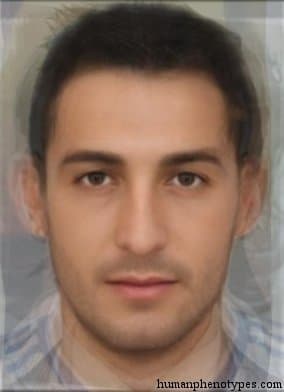
Composite source: Human Phenotypes — Litorid
Geographic Distribution
The reference center for Litorid sits near 38.1° N, 28.6° E in Middle East. Around that anchor, prevalence falls off gradually — the type is not confined to one valley or one modern border, and the historical map should be read as a gradient rather than a boundary.
Physical Characteristics
Light brown skin.
- Straight to curly, brown or black hair
- Dark eyes
- Rather tall, ecto- to endomorph, meso-, sometimes macroskelic
- Mesocephalic, mildly hypsicranic, slightly flattened occiput
- Nose hyperleptorrhine, often convex, prominent
- Face is oval, body hair strong
Historical Background
Type of coastal European regions that contains Mediterranid and Dinaro-Armenid elements. Probably the result of ancient migrations from Asia Minor across the sea. Found from Lebanon and Southern Turkey to Cyprus, Greece, Italy, Spain, France (Brittany, Gironde), partially British Isles (western and southern coasts, Wales, Scotland), Netherlands, Frisia, sometimes even Scandinavia and Poland.
Research History & Naming
Every label in the historical catalogue has an author and a date, and Litorid has accumulated its share of competing attributions. For Litorid, the literature extract below shows the naming chain — from the first definition through the later revisions that shaped the current entry.
Originally defined as Atlanto Mediterranid / Littoral by Deniker (1900) , this was kept by Montandon (1933) , Saller (1949) and Vallois (1971) . Many others ( Eickstedt, 1934 ; Coon, 1939 ) didn't accept it as Atlanto Mediterranid proper and considered it mixed. Czekanowski's (1929) Armenoid-admixed numerical Littoral type inspired Lundman ( 1952 , 1957 , 1967 ) among others to define a Littoral/ Litor(o)id. Hooton's (1955) Irish Dinarics and Coon's (1939) Dinaricized Meds are very similar. Biasutti's (1967) Padana type can be included.
Comparison With Nearby Phenotypes
Ranked by great-circle distance from Litorid's reference center, these are the five nearest documented phenotypes — the closest being Anatolid at 425 km. Overlapping distributions like these are exactly what makes the quiz hard, and the Anatolid row is where to start looking.
| Phenotype | Region | Distance | Distinguishing trait |
|---|---|---|---|
| Anatolid | Middle East | 425 km | Light brown skin, wavy, dark brown hair. |
| Pontid | Southern Europe | 569 km | Light brown skin, straight or wavy, brown to black hair, pigmentation sometimes somewhat lighter than in other Mediterranids. |
| Eurafricanid | Southern Europe | 864 km | Light brown skin, straight to curly, usually dark brown hair. |
| Gracile Mediterranid | Southern Europe | 889 km | Light brown skin, straight to wavy, rarely curly, usually abundant brown to brown-black hair. |
| Carpathid | Eastern Europe | 1,020 km | Pale to light brown skin, straight or wavy, often brown hair and dark-mixed eyes. |
Litorid in the Game
When the Litorid composite shows up in the quiz, players who know the Middle East distribution pattern have the edge. The reference answer sits near 38.1° N, 28.6° E; pins on the wrong continent score close to zero, so even a rough regional instinct beats a precise but misdirected pin.
Litorid Phenotype FAQ
- Where does the Litorid phenotype come from?
- Historical sources center the Litorid phenotype on 38.1° N, 28.6° E (Middle East). Treat that as a rough anchor: the type appeared across a wider surrounding area — its nearest documented neighbors, Anatolid and Pontid, sit 425 and 569 km from the reference point — and its present-day distribution no longer matches the historical map.
- What does the Litorid phenotype look like?
- The composite emphasizes recurring traits: light brown skin. The full trait list for Litorid appears in the physical characteristics section above.
- Is the Litorid phenotype a race or a nationality?
- No. A phenotype is a recurring bundle of visible traits documented by historical anthropologists across a population — for Litorid, patterns such as light brown skin. The Litorid entry is not a genetic ancestry, not a nationality, and not a statement about any individual person. Two people from the same country can match completely different phenotypes — one resembling Litorid, another closer to Anatolid — and one phenotype can span many modern borders.
- How does Litorid appear in the game?
- When the Litorid face comes up in Classic Daily or Challenge Mode, you pin the world map where you believe the type is historically most common, and the score decays with your distance to 38.1° N, 28.6° E. The nearest documented type, Anatolid, lies about 425 km away, so regional placement usually carries most of the score.
References & Literature
Primary sources for the Litorid entry, listed as cited in the historical literature. The naming and classification debates around Litorid referenced above run through these works.
- D00
- Montandon, G. 1933. La race, les races: mise au point d éthnologie somatique. Payot. Paris.
- Saller, K. 1949. Art- und Rassenlehre des Menschen. Curt E. Schwab. Stuttgart.
- Vallois, H. V. 1971. Las races humaines. 8 Ed. Grammont.
- Eickstedt, E. von. 1934. Rassenkunde und Rassengeschichte der Menschheit. Ferdinand Enke. Stuttgart.
- Coon, C.S.. 1939.. The Races of Europe. The Macmillan Company. New York.
- Czekanowski, J. 1929. Das Typenfrequenzgesetz. Anthropologischer Anzeiger 5 (4), 335-359.
- Lundman, B. 1952. Umriss der Rassenkunde des Menschen in geschichtlicher Zeit. Ejnar Munksgaard. Kopenhagen.
- Lundman, B. 1957. The Problem of Ancient Oriental Shipping on the North Sea. Journal of Near Eastern Studies, 16, II. 105-117.
- Lundman, B. 1967. Geographische Anthropologie. Rassen und Völker der Erde. G. Fischer, Stuttgart
- Hooton, E. A., Dupertuis, C. W. and H. L. Dawson. 1955. The Physical Anthropology of Ireland. Harvard University.
- Biasutti, R. 1967 (1941). Le Razze e i Popoli della terra. 4th Ed. Vol 1-4. U.T.E.T., Torino.
Related Phenotypes
More entries from the same region of the historical map as Litorid, each with its own composite and trait profile.
Anatolid
Middle East · 425 km away
Armenid subtype of Anatolia with Dinaroid features. The core population lives in West Anatolia. Probably the result of Armenid influx into a...
Pontid
Southern Europe · 569 km away
East Mediterranid type, sometimes associated with ancient Scythians, Kurgans, and other steppe peoples. Common in the Balkans, especially Bu...
Eurafricanid
Southern Europe · 864 km away
Atlanto Mediterranid proper type. Relatively old, present in early Natufians and European as well as North African megalith builders. Spread...
Gracile Mediterranid
Southern Europe · 889 km away
Mediterranid proper, smaller than other Mediterranids: the most gracile type of Europe. Appears first in Mesolithic groups of Palestine (Nat...
Carpathid
Eastern Europe · 1,020 km away
European type with Gorid and Dinaro-Armenid elements. Common around the Carpathian Mountains of Central Eastern Europe, e.g. in Huzulis and ...
Further Reading
Background articles from the blog that explain where the Litorid type fits, how these composites are built, and what a face can and cannot tell you.
Ethnicity Guesser Tools: Three Methods, Three Answers
One search term covers three unrelated tools: genetic ancestry estimation, photo classifiers, and documented phenotype catalogues.
Ethnicity Guesser Game: How the Answer Space Shapes a Round
A face-mapping game scores an answer three ways: a point on the map, a named catalogue entry, or a modern country.