Pontid Phenotype - Face Features & Origin
Historical anthropology places the Pontid phenotype in Southern Europe, with a documented center near 42.6° N, 25.5° E. East Mediterranid type, sometimes associated with ancient Scythians, Kurgans, and other steppe peoples. The sections that follow unpack the Pontid entry in practice: the composite face, the traits it summarizes, the naming history, and the sources.
Average Face
Averaging the portraits behind Pontid leaves the features that repeat and erases the ones that do not. That is exactly how the Pontid composite below was built: individual photographs were aligned and statistically merged, exaggerating shared structure into a single reference face that no actual person looks like.
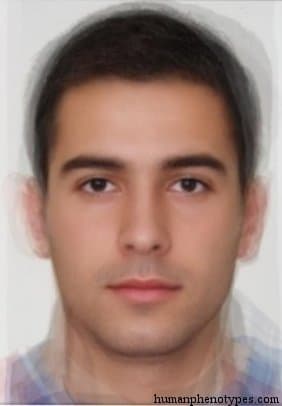
Composite source: Human Phenotypes — Pontid
Geographic Distribution
Geographically, Pontid anchors to 42.6° N, 25.5° E (Southern Europe). That is the point where historical anthropologists judged Pontid most concentrated, not a hard edge; modern migration and intermarriage have long since softened whatever boundaries once existed.
Physical Characteristics
Light brown skin, straight or wavy, brown to black hair, pigmentation sometimes somewhat lighter than in other Mediterranids.
- Rather tall, mesoskelic, ectomorph
- Mesocephalic and mildly hypsicranic with a straight and leptorrhine nose
- The face is long
- Facial features are not very robust, eye apertures often narrow
Historical Background
East Mediterranid type, sometimes associated with ancient Scythians, Kurgans, and other steppe peoples. Common in the Balkans, especially Bulgaria, Macedonia, Greece (Thracian subvariety), Western Turkey, Ukraine, Southern Russia, Azerbaijan, Northwestern Iran (e.g. North-West Persians and Lurs), and parts of Mesopotamia (Chaldeans, Mandaeans, Samaritans). Sporadically in Lithuania, Poland, Romania, Silesia, Italy, Caucasus (Cherkess), and Arabia.
Research History & Naming
Typological names were coined, contested, and renamed repeatedly across the 20th century, and Pontid is no exception. The extract below records the researchers who defined Pontid, the alternative labels it accumulated, and where the modern consensus settled.
Bunak ( 1932 , 1976 ) originally named the type. Coon (1939) called it Pontic Mediterreanean. Boev (1957) found it in Bulgarians. Lundman (1967) and Vondernach (2008) regarded Pontid an East Mediterranid subtype. Poulianos (1961) considered a southern Thracian variety of Pontid. Also called Kurgan race ( Lebzelter, 1928b ).
Comparison With Nearby Phenotypes
The five phenotypes whose documented centers lie closest to Pontid, ranked by great-circle distance. They are the types players most often confuse with Pontid in the quiz, precisely because their distributions overlap.
| Phenotype | Region | Distance | Distinguishing trait |
|---|---|---|---|
| Carpathid | Eastern Europe | 465 km | Pale to light brown skin, straight or wavy, often brown hair and dark-mixed eyes. |
| Litorid | Middle East | 569 km | Light brown skin. |
| Alföld | Central Europe | 624 km | Fair to light reddish-brown skin with straight brown or black hair and yellowish-brown eyes. |
| Anatolid | Middle East | 685 km | Light brown skin, wavy, dark brown hair. |
| Dinarid (proper) | Southeastern Europe | 696 km | Light brown skin. |
Pontid in the Game
Pontid is one of the faces that can appear in Classic Daily and Challenge Mode. When it does, the winning pin lands near 42.6° N, 25.5° E in Southern Europe — and because the scoring decays with distance, recognizing the region matters more than pixel-perfect placement.
Pontid Phenotype FAQ
- Where does the Pontid phenotype come from?
- The reference coordinates for the Pontid phenotype sit near 42.6° N, 25.5° E, in Southern Europe. That point marks the center of the Southern Europe distribution documented roughly 1500 years ago — actual prevalence spread well beyond it, toward entries such as Carpathid 465 km away, and modern migration has blurred those boundaries further.
- What does the Pontid phenotype look like?
- In the historical literature, light brown skin, straight or wavy, brown to black hair, pigmentation sometimes somewhat lighter than in other Mediterranids. For Pontid these are statistical tendencies across a population, not a checklist every individual matches.
- Is the Pontid phenotype a race or a nationality?
- No — and the Pontid naming history above shows why. Pontid was defined, renamed, and regrouped repeatedly by different researchers, which is the opposite of how a fixed racial category would behave. A phenotype is a recurring bundle of visible traits recorded across a population; the Pontid label says nothing about where any individual's ancestors were born.
- How does Pontid appear in the game?
- In Classic Daily and Challenge Mode, the Pontid composite face appears without a label. Your task is to drop a pin on the world map where you think that face is historically most common — the scoring uses the distance between your pin and the reference coordinates near 42.6° N, 25.5° E. The post-round review then shows the correct location, your distance error, and this Pontid entry.
References & Literature
Every claim on this page traces back to the sources below — the researchers who defined, measured, and argued over the Pontid type. The originals behind the Pontid entry are worth consulting directly.
- Bunak, V. 1932. Neues Material zur Aussonderung anthropologischer Typen unter der Bevölkerung Osteuropas. Zeitschrift für Morphologie und Anthropologie, 30 (3). 441-503.
- Bunak, V. V. 1976. Rassengeschichte Osteuropas. In: Schwidetzky, I.: Rassengeschichte der Menschheit, Ost- und Nordeuropa. R. Odenbourg. München. Wien.
- Coon, C.S.. 1939.. The Races of Europe. The Macmillan Company. New York.
- Boev, P. 1957. Die Anthropologie der Bulgaren. Homo 8. 173-178.
- Lundman, B. 1967. Geographische Anthropologie. Rassen und Völker der Erde. G. Fischer, Stuttgart
- Vonderach, A. 2008. Anthropologie Europas. Völker, Typen und Gene vom Neandertaler bis zur Gegenwart. Ares Verlag. Graz.
- Poulianos, A. N. 1961. The Origin of the Greeks. Ph.D. thesis. University of Moscow.
- Lebzelter, V. 1928b. Zur Rassengeschichte der Jugoslaven. Journal of the Zagreb Archaeological Museum, 15 (1).
Related Phenotypes
If Pontid interested you, these neighboring phenotype entries cover adjacent parts of the map with distinctly different trait bundles.
Carpathid
Eastern Europe · 465 km away
European type with Gorid and Dinaro-Armenid elements. Common around the Carpathian Mountains of Central Eastern Europe, e.g. in Huzulis and ...
Litorid
Middle East · 569 km away
Type of coastal European regions that contains Mediterranid and Dinaro-Armenid elements. Probably the result of ancient migrations from Asia...
Alföld
Central Europe · 624 km away
Western Turanid subtype, named after the Alföld (Great Hungarian Plain). It developed when Huns and Magyars entered the area during the earl...
Anatolid
Middle East · 685 km away
Armenid subtype of Anatolia with Dinaroid features. The core population lives in West Anatolia. Probably the result of Armenid influx into a...
Dinarid (proper)
Southeastern Europe · 696 km away
Central European type typical for mountain and forest regions. Presents the counterpart of Alpinids. The name derives from the Dinaric Alps ...
Further Reading
Background articles from the blog that explain where the Pontid type fits, how these composites are built, and what a face can and cannot tell you.
Ethnicity Guesser vs DNA Test: Two Different Questions About Where You're From
A DNA test answers 'what fraction of my ancestors came from reference regions' - a face quiz answers 'what historical pattern does this...
Race Guesser: Why the Word Does Not Fit a Face Quiz
The phrase is a search term before it is a tool. Here is where the word race came from as a sorting device, why a century of measuring...