hbd.gg vs Ethnoguessr: Two Menus, Two Kinds of Variety
hbd.gg widens the task with six modes, ethnoguessr.org widens the answer list to 350 groups, and the two choices move a score in opposite directions. What each one does to the arithmetic of a round.
Two menus, two kinds of variety
hbd.gg, a daily geography-style quiz site, and ethnoguessr.org, a separate project that lists more than 350 ethnic groups against 195 countries, are usually discussed as rival answers to one question. They are not quite that. The first varies the task: six modes, among them a World Cup bracket and a Genomes mode that accepts a submitted photograph. The second varies the answer set, holding the task steady while widening the pool a player chooses from. One menu is longer, the other map is denser, and the two strategies do different things to a score.
Variety of task and variety of answer are easy to confuse because both make a site feel larger. A mode is a rule change, so each one asks for a different act: pick a bracket winner, read a submitted file, place a single face. An answer is a coordinate in a fixed space, and adding answers changes only how fine the grid is. A player who wants more ways to spend an evening is asking the first question. A player who wants to be tested on a longer list is asking the second, and no single menu answers both.
An answer set works like a prior
An answer set behaves like a prior, and its size can be measured. Take this site's 48 country pages, whose anchors sit a mean of 5,573 kilometres apart in great-circle distance. Score a round with a 5,000-point ceiling and a 1,500-kilometre decay, and a blind guess on that set returns about 120 points on average, because almost any two anchors on the globe sit far apart relative to the decay length. Widen the set and the floor drops further, since more options mean more ways to be distant from all of them.
That floor is where a first-time player's score sits, and it is rarely discussed. A round opening at 120 out of 5,000 is a round in which nearly all available points come from the top two answers, which is why the same handful of near misses decides most leaderboards. When a site reports totals without the size of its answer set and the shape of its decay, two players' scores stop being comparable even when both played well. The arithmetic behind the number is part of the number.
Granularity creates neighbours
Granularity carries a cost that a long answer list hides. The 209 entries in this catalogue are anchored at points whose nearest neighbour sits a median of 395 kilometres away, and two pairs sit about 40 kilometres apart, close enough that one valley would cover both. In Europe the tightest groups are Alföld and Carpathid at 334 kilometres, Armenid and Mtebid at 368, and Dinarid and Norid at 413. Those pairs differ by pigmentation, skull height and the profile of a nose, which is a paragraph of text rather than a shape on a map.
On the same decay curve a correct neighbour still returns more than 3,800 points, so the gap between choosing Armenid and choosing Mtebid is small in score and large in meaning. This is what a longer answer list buys: resolution in the middle of the map, paid for in neighbours. A player who has learned the distinctions does better across many rounds, but a single round cannot separate recognising a pattern from guessing the region next door, because both land in the same band.
Where the two sites genuinely diverge
The clearest advantage on hbd.gg's side is range. Six modes open more entry points than a single daily draw, a tournament bracket gives a session a shape that a one-face round cannot, and the Genomes mode accepts a submission, which is a capability a statically built catalogue does not have at all. This site exports to flat files; there is no server here to receive an upload, and that is a structural limit rather than a stylistic preference.
The clearest advantage on ethnoguessr.org's side is the size of its pool. A list of 350 groups and 195 countries supports longer sessions and repeated play without the same face returning, and more answers give a player who has studied one region closely more chances to show it. Both advantages are real, and neither is about accuracy. What neither site publishes is the sampling behind a composite: how many portraits, drawn from where, taken when. That absence is the shared ceiling rather than a difference between them.
What an upload changes about the claim
The moment a site accepts your own photograph, the product changes category. A composite round asks where a historical distribution was anchored; an uploaded portrait invites a statement about the person who sent it. The visible traits such a statement would rest on are few and well described. SLC24A5, at rs1426654, carries a large share of the skin-lightness difference between European and West African samples in Lamason's 2005 work. HERC2, at rs12913832, does much of the work in blue versus brown eyes, as Eiberg reported in 2008.
These are pigment and development genes with large effects, which is why they are detectable and why they are a poor proxy for ancestry. Add EDAR V370A, the variant tied to hair thickness and incisor shape in East Asian samples in Fujimoto's 2008 study, and the list is still short, and every entry on it names a trait rather than a population. A face carries those traits plus age, sunlight, sleep, a lens and a compression algorithm. Nothing in that stack resolves into one of 350 groups, whichever site is doing the asking.
Both maps describe a past
Both products rest on material collected before the world moved as much as it does now. The United Nations counted about 281 million people living outside their country of birth in 2024, roughly 3.6 percent of the world population, and the share runs higher in the cities where photographs get taken. A composite built from portraits of a region describes people who mostly stayed near where they were born: a fair description of that region a century ago, and a weaker one of a street in it today.
The catalogue's own baseline is older still, roughly 1,500 years before the present, which its entries state where it matters. Three layers therefore stack awkwardly: a distribution recorded in the literature, a set of photographs taken in the twentieth century, and a population alive this year. A quiz score refers to the first layer at best. Sites that say so give a player something to hold; sites that do not leave a number looking like a fact about a face.
Which reader each one suits
A reader who wants variety, a themed round and the option to submit something is better served by hbd.gg, and the tournament format has no equivalent here. A reader who wants a long session against a large pool is better served by ethnoguessr.org, whose answer space is several times the size of this one's. A reader who wants to know what a claim rests on is better served by a catalogue that cites the survey behind each entry, down to the cemetery a type was named after.
None of the three is a ranking, and the test that separates them is short. Ask what the answer set is made of, how far apart its members sit, and whether a score would still mean something if the same round were handed to another player tomorrow. A site that answers those three questions is doing something a site that answers none of them cannot, whatever its mode count happens to be.
Frequently Asked Questions
- What is the main difference between hbd.gg and ethnoguessr.org?
- One varies the task and the other varies the answer list. hbd.gg runs six modes, including a World Cup bracket and a mode that accepts a submitted photograph, so each session can ask for a different act. ethnoguessr.org keeps the act steady and widens the pool, listing more than 350 ethnic groups against 195 countries. Task variety makes a site feel larger; answer variety changes how fine the grid is. Both are legitimate designs, and they move a score in different directions.
- Does a bigger answer list make a quiz harder or easier?
- Harder to win outright and easier to score on. A wider list lowers the expected score of a blind guess, since more options mean more ways to land far from the right one, but it also creates near neighbours: entries a few hundred kilometres apart that a player must distinguish by a paragraph of description rather than a border. On a 1,500-kilometre decay curve, choosing the neighbouring entry still returns most of the points, so one round rarely separates recognition from a lucky region guess.
- Can either site tell me my ethnicity from a photo?
- Neither can, and the reason is structural rather than a matter of model quality. A photograph carries pigment and development traits influenced by a handful of genes with large effects, such as SLC24A5, HERC2 and EDAR V370A, along with age, lighting and lens distortion. Those traits do not map onto a list of 350 groups, because appearance varies gradually across geography while ancestry is a genealogy. A quiz can place a face on a map; it cannot read a family tree from one.
Related Phenotypes
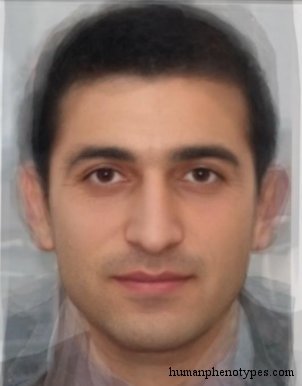
Faces from the encyclopedia that appear in this article. Open any entry for its full description, distribution, and references.
Armenid
Caucasus
Widespread type, found in its most specialised form in the mountains of Asia Minor. Associated with the ancient Cypriots and the Hittite Kin...
Mtebid
Caucasus
Regional type of the Caucasus Mountains. Probably an Alpinised Dinaro-Armenid adapted to life in mountainous regions. Mtebids are typical of...
Norid
Southeastern Europe
Central European type that closely resembles Dinarids except for lighter pigmentation. Authors interpret this to be the result of Nordid and...
Pontid
Southern Europe
East Mediterranid type, sometimes associated with ancient Scythians, Kurgans, and other steppe peoples. Common in the Balkans, especially Bu...
Test what you learned
Put your eye for regional faces to work in the daily quiz — a composite face, a world map, and your best guess.