Strandid Phenotype - Face Features & Origin
Alpinoid North European type most common in Southwestern Norway. The entry below collects the Strandid composite face, its documented distribution around 66.9° N, 13.9° E in Northern Europe, its physical characteristics, the research history behind the name, and the academic references that support all of it.
Average Face
The Strandid composite below is not a photograph of a real person. Historical anthropologists aligned multiple individual portraits from the Strandid reference population and averaged them into one image, so recurring structures — skull outline, nose form, lip thickness, brow position — dominate while individual idiosyncrasies cancel out.
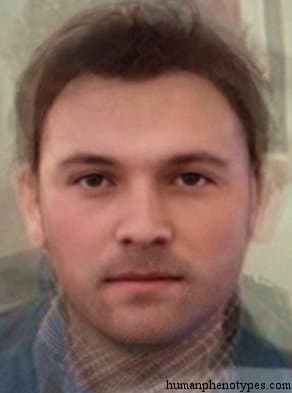
Composite source: Human Phenotypes — Strandid
Geographic Distribution
Strandid is documented across Northern Europe, with its historical reference center near 66.9° N, 13.9° E. The coordinates mark where the type was most characteristic roughly 1500 years ago; population movements since then have scattered and blended the distribution far beyond that point.
Physical Characteristics
Fair to light brown skin, straight or wavy, usually brown to black hair and mixed eyes.
- Medium height, mesoskelic, endomorph
- Brachycephalic and chamaecranic (in contrast to Lappid) with a leptorrhine, often concave nose
- Face relatively broad and low, chin rather weak
- Forehead is less bulbous than in Alpinids proper, the head more oval than round, and the stature taller
Historical Background
Alpinoid North European type most common in Southwestern Norway. The name derives from the Norwegian word for beach ("Strand"). Probably a reduced Paleo Atlantid. Associated with the ancient Norwegian Fosna culture. Strandids are not very numerous and often mixed, however they can occur in many North European populations from Western Finland to Sweden, Denmark, Ireland, and Iceland.
Research History & Naming
Every label in the historical catalogue has an author and a date, and Strandid has accumulated its share of competing attributions. For Strandid, the literature extract below shows the naming chain — from the first definition through the later revisions that shaped the current entry.
Defined as the Strandiner type by Lundman (1946b) after Byrn (1926) had described it as Norwegian Alpinoid and others as Keltoid. Some pointed out differences to Lappid ( Eickstedt, 1934 ), others to Alpinid, placing it closer to Paleo Atlantid ( Lundman, 1967 ).
Comparison With Nearby Phenotypes
Ranked by great-circle distance from Strandid's reference center, these are the five nearest documented phenotypes — the closest being Trønder at 373 km. Overlapping distributions like these are exactly what makes the quiz hard, and the Trønder row is where to start looking.
| Phenotype | Region | Distance | Distinguishing trait |
|---|---|---|---|
| Trønder | Northern Europe | 373 km | Rosy-white skin, straight or wavy, often golden blonde, sometimes red or brown hair with light eyes. |
| North Lappid | Northern Europe | 562 km | Light brown skin, straight, usually dark brown, sometimes lighter hair and brown eyes. |
| Dalofaelid | Northern Europe | 646 km | Pale to fair skin. |
| Fenno Nordid | Northern Europe | 693 km | Pale skin, straight, red to white-blonde sometimes reddish-brown hair. |
| Paleo Atlantid | Northern Europe | 738 km | Fair skin, curly or wavy, sometimes straight, usually brown-black, occasionally red or blonde hair, eyes mixed. |
Strandid in the Game
When the Strandid composite shows up in the quiz, players who know the Northern Europe distribution pattern have the edge. The reference answer sits near 66.9° N, 13.9° E; pins on the wrong continent score close to zero, so even a rough regional instinct beats a precise but misdirected pin.
Strandid Phenotype FAQ
- Where does the Strandid phenotype come from?
- Historical sources center the Strandid phenotype on 66.9° N, 13.9° E (Northern Europe). Treat that as a rough anchor: the type appeared across a wider surrounding area — its nearest documented neighbors, Trønder and North Lappid, sit 373 and 562 km from the reference point — and its present-day distribution no longer matches the historical map.
- What does the Strandid phenotype look like?
- The composite emphasizes recurring traits: fair to light brown skin, straight or wavy, usually brown to black hair and mixed eyes. The full trait list for Strandid appears in the physical characteristics section above.
- Is the Strandid phenotype a race or a nationality?
- No. A phenotype is a recurring bundle of visible traits documented by historical anthropologists across a population — for Strandid, patterns such as fair to light brown skin, straight or wavy, usually brown to black hair and mixed eyes. The Strandid entry is not a genetic ancestry, not a nationality, and not a statement about any individual person. Two people from the same country can match completely different phenotypes — one resembling Strandid, another closer to Trønder — and one phenotype can span many modern borders.
- How does Strandid appear in the game?
- When the Strandid face comes up in Classic Daily or Challenge Mode, you pin the world map where you believe the type is historically most common, and the score decays with your distance to 66.9° N, 13.9° E. Fair warning: the nearest other entry in our dataset, Trønder, sits just 373 km away, so this face rewards precise placement — the right country alone is not always enough.
References & Literature
Primary sources for the Strandid entry, listed as cited in the historical literature. The naming and classification debates around Strandid referenced above run through these works.
- Lundman, B. 1946b. Raser och folkstockar i Baltoskandia, en översikt. Uppsala.
- B26
- Eickstedt, E. von. 1934. Rassenkunde und Rassengeschichte der Menschheit. Ferdinand Enke. Stuttgart.
- Lundman, B. 1967. Geographische Anthropologie. Rassen und Völker der Erde. G. Fischer, Stuttgart
Related Phenotypes
More entries from the same region of the historical map as Strandid, each with its own composite and trait profile.
Trønder
Northern Europe · 373 km away
North European type, combines features of Paleo Atlantid, Hallstatt, and East Nordid. One of the main elements in the ancient Vikings. Their...
North Lappid
Northern Europe · 562 km away
Northern Lappid variety, somewhat closer to Sibirid, possibly due to Samoyedic influence. Associated with Eastern Saami (formerly "Lapps"), ...
Dalofaelid
Northern Europe · 646 km away
Coarse, Cromagniform Nordid variety of Central and Northern Europe. Named after the Swedish province of Dalarna and the German region of Wes...
Fenno Nordid
Northern Europe · 693 km away
Ancient type of Northeastern Europe, sometimes placed in Nordid, sometimes East Baltid. Associated with Finno-Ugric people, once widespread ...
Paleo Atlantid
Northern Europe · 738 km away
Ancient type that is sporadically found in Northern and Western Europe, usually only in relict populations. A resemblance with Cro-Magnons h...
Further Reading
Background articles from the blog that explain where the Strandid type fits, how these composites are built, and what a face can and cannot tell you.
Guess the Nationality: What 48 Country Average Faces Actually Show
National average faces converge with geography - neighbors look alike because populations mix along the routes terrain allows.
What Is an Ethnicity Guesser? The Map Game Where Faces Are the Clues
Ethnicity guessers are the newest branch of geography gaming: a composite face appears, you pin the map. Here is the genre, where it...