East Palaungid Phenotype - Face Features & Origin
Eastern Palaungid variety, found in the hills of South China. Its reference coordinates sit near 25.0° N, 102.0° E in Southeast Asia. Rather than a single portrait, the East Palaungid composite below is a statistical average, and the surrounding sections — traits, distribution, research history, references — give that average its context.
Average Face
What you see below is a statistical construction of the East Palaungid reference population. Faces recorded from the East Palaungid sample were overlaid and merged; the result keeps the features most members shared and discards personal variation. It reads like a East Palaungid portrait, but it works like a histogram.
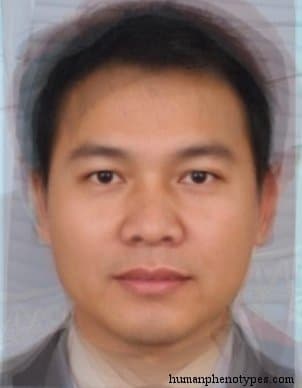
Composite source: Human Phenotypes — East Palaungid
Geographic Distribution
Geographically, East Palaungid anchors to 25.0° N, 102.0° E (Southeast Asia). That is the point where historical anthropologists judged East Palaungid most concentrated, not a hard edge; modern migration and intermarriage have long since softened whatever boundaries once existed.
Physical Characteristics
Yellowish light brown skin with straight or wavy hair.
- Short, often ectomorph, sometimes endomorph, meso- macroskelic
- Meso- brachycephalic, mildly hypsicranic
- Short, mesorrhine nose
- The face is round, low and wide
- Mongolian folds are occasionally found
- Similar to Palaungid, but wider-nosed, less pigmented with more refined, gracile, and Mongoloid features
Historical Background
Eastern Palaungid variety, found in the hills of South China. Shows stronger Sinoid tendencies. Common along the China-Myanmar /-Vietnam border region and from South Yunnan far into Guangdong, Guizhou, and Sichuan. More frequent on hills and mountains than in valleys. Often in Pakanic, Liau, Pu-man, Zhuang, Angku, etc. More mixed in Yi, Miao, Hmong, Yao, and others.
Research History & Naming
The passage below traces who first defined East Palaungid, which rival names competed with it, and how later authors consolidated or disputed the classification — the raw material of any serious phenotype reference.
Eickstedt, 1937 named and described the East Palaungid variety. Ofen included in Palaungid / South Mongolid ( Lundman,1967 ; Biasutti,1967 ; Knussmann,1996 ) or Indonesian of Vallois (1971) and Hooton (1946) .
Comparison With Nearby Phenotypes
Geography, not alphabet, ordered this table: the five phenotype centers closest to East Palaungid's, with the traits most likely to be mistaken for it (Kachinid leads at 466 km). In gameplay, these five account for most of the wrong-but-nearby pins against East Palaungid.
| Phenotype | Region | Distance | Distinguishing trait |
|---|---|---|---|
| Kachinid | Southeast Asia | 466 km | Yellowish light to medium brown skin with wavy, sometimes straight hair. |
| Palaungid | Southeast Asia | 563 km | Yellowish-reddish light to medium brown skin with straight or wavy hair. |
| South Palaungid | Southeast Asia | 572 km | Yellowish medium brown skin with straight or wavy hair. |
| East Shanid | Southeast Asia | 630 km | Yellowish light to medium brown skin with straight, sometimes wavy hair. |
| Tonkinesid | Southeast Asia | 687 km | Yellowish light brown skin with coarse straight to slightly wavy hair. |
East Palaungid in the Game
In gameplay terms, East Palaungid rewards region-level recall: the score is computed from the distance between your pin and 25.0° N, 102.0° E. Players often confuse East Palaungid with Kachinid (466 km out) in the comparison table above — those confusions are exactly what the distance penalty is designed to expose.
East Palaungid Phenotype FAQ
- Where does the East Palaungid phenotype come from?
- Historical sources center the East Palaungid phenotype on 25.0° N, 102.0° E (Southeast Asia). Treat that as a rough anchor: the type appeared across a wider surrounding area — its nearest documented neighbors, Kachinid and Palaungid, sit 466 and 563 km from the reference point — and its present-day distribution no longer matches the historical map.
- What does the East Palaungid phenotype look like?
- The composite emphasizes recurring traits: yellowish light brown skin with straight or wavy hair. The full trait list for East Palaungid appears in the physical characteristics section above.
- Is the East Palaungid phenotype a race or a nationality?
- No — and the East Palaungid naming history above shows why. East Palaungid was defined, renamed, and regrouped repeatedly by different researchers, which is the opposite of how a fixed racial category would behave. A phenotype is a recurring bundle of visible traits recorded across a population; the East Palaungid label says nothing about where any individual's ancestors were born.
- How does East Palaungid appear in the game?
- When the East Palaungid face comes up in Classic Daily or Challenge Mode, you pin the world map where you believe the type is historically most common, and the score decays with your distance to 25.0° N, 102.0° E. The nearest documented type, Kachinid, lies about 466 km away, so regional placement usually carries most of the score.
References & Literature
The East Palaungid phenotype entry above is compiled from the 6 academic references. Readers are encouraged to consult the original East Palaungid sources for verification and deeper context.
- Eickstedt, E. von. 1937. Geschichte der anthropologischen Namengebung und Klassifikation. In: Zeitschrift für Rassenkunde. Band 5, 209-282, Band 6, 36-96, 151-210.
- Lundman, B. 1967. Geographische Anthropologie. Rassen und Völker der Erde. G. Fischer, Stuttgart
- Biasutti, R. 1967 (1941). Le Razze e i Popoli della terra. 4th Ed. Vol 1-4. U.T.E.T., Torino.
- Knussmann, R. 1996. Vergleichende Biologie des Menschen: Lehrbuch der Anthropologie und Humangenetik. 2ed. Spektrum Akademischer Verlag.
- Vallois, H. V. 1971. Las races humaines. 8 Ed. Grammont.
- Hooton, E.A. 1946. Up from the Ape. Rev. ed. Macmillan Company . New York.
Related Phenotypes
Other human phenotypes whose documented centers lie in the same part of the map as East Palaungid.
Kachinid
Southeast Asia · 466 km away
Robust Proto Malayid subtype that probably originated in the Tibet/China border region and spread southwards some millennia ago. Named after...
Palaungid
Southeast Asia · 563 km away
The proper Palaungid variety, typical for the Central Burmese hill tribes, also in Yunnan, Himalaya, South Tibet, Thailand, and parts of Ind...
South Palaungid
Southeast Asia · 572 km away
Southern Palaungid variety, weakly influenced by Veddid. Typical for the hill tribes of Thailand, Laos, and parts of Vietnam. Occasionally i...
East Shanid
Southeast Asia · 630 km away
Eastern variety of Shanid, weakly influenced by Veddid. Typical for the plains and river valleys of Indochina, especially from North Thailan...
Tonkinesid
Southeast Asia · 687 km away
South Sinid subvariety, typical for the plains of the Red River in Northern Vietnam. Named after the old Tonkin protectorate / Ðông Kinh reg...
Further Reading
Background articles from the blog that explain where the East Palaungid type fits, how these composites are built, and what a face can and cannot tell you.
Ethnicity Guesser Game: How the Answer Space Shapes a Round
A face-mapping game scores an answer three ways: a point on the map, a named catalogue entry, or a modern country.
Ethnicity Guesser AI: Two Model Families, Two Kinds of Error
Tools sold under the same name behave nothing alike. One prints a label from a fixed list; the other writes a sentence.