East Shanid Phenotype - Face Features & Origin
Historical anthropology places the East Shanid phenotype in Southeast Asia, with a documented center near 19.8° N, 99.7° E. Eastern variety of Shanid, weakly influenced by Veddid. The sections that follow unpack the East Shanid entry in practice: the composite face, the traits it summarizes, the naming history, and the sources.
Average Face
Averaging the portraits behind East Shanid leaves the features that repeat and erases the ones that do not. That is exactly how the East Shanid composite below was built: individual photographs were aligned and statistically merged, exaggerating shared structure into a single reference face that no actual person looks like.
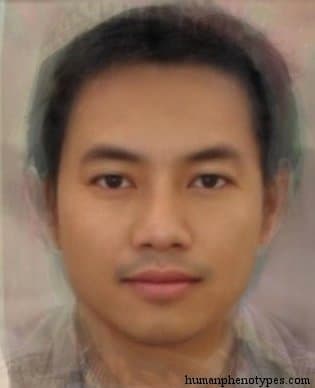
Composite source: Human Phenotypes — East Shanid
Geographic Distribution
The reference center for East Shanid sits near 19.8° N, 99.7° E in Southeast Asia. Around that anchor, prevalence falls off gradually — the type is not confined to one valley or one modern border, and the historical map should be read as a gradient rather than a boundary.
Physical Characteristics
Yellowish light to medium brown skin with straight, sometimes wavy hair.
- Medium height, macro- mesoskelic, ectomorph
- (Hyper-) brachycephalic with a relatively high, meso- leptorrhine nose
- Face is relatively long, not as flat as in Sinid, and more elongated than in Palaungid, but still round, features are more refined and gracile
- Eyes are relatively large, slanting, sometimes with the Mongolian fold
Historical Background
Eastern variety of Shanid, weakly influenced by Veddid. Typical for the plains and river valleys of Indochina, especially from North Thailand to Laos. Probably migrated South from China in historic times, soon outnumbering older types. In recent centuries Sinid elements have caused heavy admixture. Still relatively pure in Lao, Northern Thai, Tay, Sibala, etc. More mixed in Dai, Akha, Brau, Vietnamese, South Chinese, Malay people, and Cambodians.
Research History & Naming
Every label in the historical catalogue has an author and a date, and East Shanid has accumulated its share of competing attributions. For East Shanid, the literature extract below shows the naming chain — from the first definition through the later revisions that shaped the current entry.
Eickstedt, 1937 named and described the East Shanid variety. Lundman (1967) included it in Malaid, Biasutti (1967) in South Mongolid, Hooton (1946) and Cole (1965) in Malay-Mongolid.
Comparison With Nearby Phenotypes
Ranked by great-circle distance from East Shanid's reference center, these are the five nearest documented phenotypes — the closest being Palaungid at 261 km. Overlapping distributions like these are exactly what makes the quiz hard, and the Palaungid row is where to start looking.
| Phenotype | Region | Distance | Distinguishing trait |
|---|---|---|---|
| Palaungid | Southeast Asia | 261 km | Yellowish-reddish light to medium brown skin with straight or wavy hair. |
| Shanid | Southeast Asia | 298 km | Yellowish light to medium brown skin with straight, sometimes wavy hair. |
| South Palaungid | Southeast Asia | 388 km | Yellowish medium brown skin with straight or wavy hair. |
| East Palaungid | Southeast Asia | 630 km | Yellowish light brown skin with straight or wavy hair. |
| Tonkinesid | Southeast Asia | 726 km | Yellowish light brown skin with coarse straight to slightly wavy hair. |
East Shanid in the Game
When the East Shanid composite shows up in the quiz, players who know the Southeast Asia distribution pattern have the edge. The reference answer sits near 19.8° N, 99.7° E; pins on the wrong continent score close to zero, so even a rough regional instinct beats a precise but misdirected pin.
East Shanid Phenotype FAQ
- Where does the East Shanid phenotype come from?
- Historical sources center the East Shanid phenotype on 19.8° N, 99.7° E (Southeast Asia). Treat that as a rough anchor: the type appeared across a wider surrounding area — its nearest documented neighbors, Palaungid and Shanid, sit 261 and 298 km from the reference point — and its present-day distribution no longer matches the historical map.
- What does the East Shanid phenotype look like?
- The composite emphasizes recurring traits: yellowish light to medium brown skin with straight, sometimes wavy hair. The full trait list for East Shanid appears in the physical characteristics section above.
- Is the East Shanid phenotype a race or a nationality?
- No. A phenotype is a recurring bundle of visible traits documented by historical anthropologists across a population — for East Shanid, patterns such as yellowish light to medium brown skin with straight, sometimes wavy hair. The East Shanid entry is not a genetic ancestry, not a nationality, and not a statement about any individual person. Two people from the same country can match completely different phenotypes — one resembling East Shanid, another closer to Palaungid — and one phenotype can span many modern borders.
- How does East Shanid appear in the game?
- When the East Shanid face comes up in Classic Daily or Challenge Mode, you pin the world map where you believe the type is historically most common, and the score decays with your distance to 19.8° N, 99.7° E. Fair warning: the nearest other entry in our dataset, Palaungid, sits just 261 km away, so this face rewards precise placement — the right country alone is not always enough.
References & Literature
Primary sources for the East Shanid entry, listed as cited in the historical literature. The naming and classification debates around East Shanid referenced above run through these works.
- Eickstedt, E. von. 1937. Geschichte der anthropologischen Namengebung und Klassifikation. In: Zeitschrift für Rassenkunde. Band 5, 209-282, Band 6, 36-96, 151-210.
- Lundman, B. 1967. Geographische Anthropologie. Rassen und Völker der Erde. G. Fischer, Stuttgart
- Biasutti, R. 1967 (1941). Le Razze e i Popoli della terra. 4th Ed. Vol 1-4. U.T.E.T., Torino.
- Hooton, E.A. 1946. Up from the Ape. Rev. ed. Macmillan Company . New York.
- Cole, S. 1965. Races of Man. Butler & Tanner Ltd. Frome and London.
Related Phenotypes
Other human phenotypes whose documented centers lie in the same part of the map as East Shanid.
Palaungid
Southeast Asia · 261 km away
The proper Palaungid variety, typical for the Central Burmese hill tribes, also in Yunnan, Himalaya, South Tibet, Thailand, and parts of Ind...
Shanid
Southeast Asia · 298 km away
Sinoid South Mongolid type, typical in the (Irrawaddy) plains and the Shan Plateau of Myanmar. The name derives from the Shan people, who mi...
South Palaungid
Southeast Asia · 388 km away
Southern Palaungid variety, weakly influenced by Veddid. Typical for the hill tribes of Thailand, Laos, and parts of Vietnam. Occasionally i...
East Palaungid
Southeast Asia · 630 km away
Eastern Palaungid variety, found in the hills of South China. Shows stronger Sinoid tendencies. Common along the China-Myanmar /-Vietnam bor...
Tonkinesid
Southeast Asia · 726 km away
South Sinid subvariety, typical for the plains of the Red River in Northern Vietnam. Named after the old Tonkin protectorate / Ðông Kinh reg...
Further Reading
Background articles from the blog that explain where the East Shanid type fits, how these composites are built, and what a face can and cannot tell you.
Ethnoguessr: The Spelling, the Sites, and the Game
Ethnoguessr is a compressed spelling of "ethnicity guesser", and more than one site answers to it. Here is how to tell what you are...
Ethno Guessr Explained: The Daily Face-Mapping Game
Ethno guessr is the loose nickname for a family of quiz games in which a face is the only clue. Here is how one round is built, what the...