Annamid Phenotype - Face Features & Origin
Historical anthropology places the Annamid phenotype in Southeast Asia, with a documented center near 16.5° N, 107.6° E. South Sinid subvariety with less pronounced Sinid features that often tend to be very gracile. The sections that follow unpack the Annamid entry in practice: the composite face, the traits it summarizes, the naming history, and the sources.
Average Face
Averaging the portraits behind Annamid leaves the features that repeat and erases the ones that do not. That is exactly how the Annamid composite below was built: individual photographs were aligned and statistically merged, exaggerating shared structure into a single reference face that no actual person looks like.
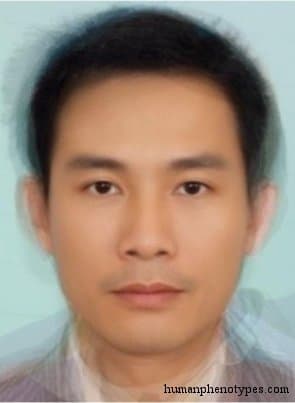
Composite source: Human Phenotypes — Annamid
Geographic Distribution
Annamid is documented across Southeast Asia, with its historical reference center near 16.5° N, 107.6° E. The coordinates mark where the type was most characteristic roughly 1500 years ago; population movements since then have scattered and blended the distribution far beyond that point.
Physical Characteristics
Yellowish light brown skin, often slightly darker than in other South Sinids.
- Coarse straight to slightly wavy hair
- (Rather) short, macro- mesoskelic, ectomorph with very gracile bodies
- Brachycephalic, hypsicranic
- Mesorrhine or mildly leptorrhine nose that is higher than in other South Sinids
- The face is longer and fine-featured, eyes larger, features deviate in a Europiform direction, mouth smaller
- Eyes slanting, sometimes with epicanthic folds
- Body hair scant
Historical Background
South Sinid subvariety with less pronounced Sinid features that often tend to be very gracile. Typical for the old province of Annam in Vietnam. Developed through continuous Sinid expansions to the South and assimilation of indigenous South Mongolid and even Veddoid elements. Most common in Central Vietnam, slightly more mixed in South Vietnam. Sporadically across Indochina and South China.
Research History & Naming
Typological names were coined, contested, and renamed repeatedly across the 20th century, and Annamid is no exception. The extract below records the researchers who defined Annamid, the alternative labels it accumulated, and where the modern consensus settled.
Named and defined as the southernmost South Sinid variety by Eickstedt ( 1938-1940 , 1944 ) during his expeditions in Asia. Biasutti (1967) , Vogel (1974) already place it closer to South / Paleo Mongoloid, Lundman (1967) close to Malaid. Anthropometric analysis by Olivier (1967) .
Comparison With Nearby Phenotypes
Ranked by great-circle distance from Annamid's reference center, these are the five nearest documented phenotypes — the closest being Tonkinesid at 460 km. Overlapping distributions like these are exactly what makes the quiz hard, and the Tonkinesid row is where to start looking.
| Phenotype | Region | Distance | Distinguishing trait |
|---|---|---|---|
| Tonkinesid | Southeast Asia | 460 km | Yellowish light brown skin with coarse straight to slightly wavy hair. |
| South Palaungid | Southeast Asia | 595 km | Yellowish medium brown skin with straight or wavy hair. |
| Khmerid | Southeast Asia | 789 km | Reddish medium brown skin with straight or wavy hair. |
| East Shanid | Southeast Asia | 913 km | Yellowish light to medium brown skin with straight, sometimes wavy hair. |
| Chukiangid | East Asia | 936 km | Yellow to olive- or coppery brown skin with straight hair. |
Annamid in the Game
When the Annamid composite shows up in the quiz, players who know the Southeast Asia distribution pattern have the edge. The reference answer sits near 16.5° N, 107.6° E; pins on the wrong continent score close to zero, so even a rough regional instinct beats a precise but misdirected pin.
Annamid Phenotype FAQ
- Where does the Annamid phenotype come from?
- The reference coordinates for the Annamid phenotype sit near 16.5° N, 107.6° E, in Southeast Asia. That point marks the center of the Southeast Asia distribution documented roughly 1500 years ago — actual prevalence spread well beyond it, toward entries such as Tonkinesid 460 km away, and modern migration has blurred those boundaries further.
- What does the Annamid phenotype look like?
- In the historical literature, yellowish light brown skin, often slightly darker than in other South Sinids. For Annamid these are statistical tendencies across a population, not a checklist every individual matches.
- Is the Annamid phenotype a race or a nationality?
- No. A phenotype is a recurring bundle of visible traits documented by historical anthropologists across a population — for Annamid, patterns such as yellowish light brown skin, often slightly darker than in other South Sinids. The Annamid entry is not a genetic ancestry, not a nationality, and not a statement about any individual person. Two people from the same country can match completely different phenotypes — one resembling Annamid, another closer to Tonkinesid — and one phenotype can span many modern borders.
- How does Annamid appear in the game?
- In Classic Daily and Challenge Mode, the Annamid composite face appears without a label. Your task is to drop a pin on the world map where you think that face is historically most common — the scoring uses the distance between your pin and the reference coordinates near 16.5° N, 107.6° E. The post-round review then shows the correct location, your distance error, and this Annamid entry.
References & Literature
Every claim on this page traces back to the sources below — the researchers who defined, measured, and argued over the Annamid type. The originals behind the Annamid entry are worth consulting directly.
- Eickstedt, E. von 1938-1940. Forschungen in Süd- und Ostasien. In: Zeitschrift für Rassenkunde 8, 10, 11.
- Eickstedt, E. von. 1944. Rassendynamik von Ostasien. Walter de Gruyter. Berlin.
- Biasutti, R. 1967 (1941). Le Razze e i Popoli della terra. 4th Ed. Vol 1-4. U.T.E.T., Torino.
- B74
- Lundman, B. 1967. Geographische Anthropologie. Rassen und Völker der Erde. G. Fischer, Stuttgart
- Olivier, G. 1967. Contribution à l'anthropologie des Vietnamiens méridionaux. Bull. Mém. Soc. anthr. de Paris, 12 (1), 155-176.
Related Phenotypes
More entries from the same region of the historical map as Annamid, each with its own composite and trait profile.
Tonkinesid
Southeast Asia · 460 km away
South Sinid subvariety, typical for the plains of the Red River in Northern Vietnam. Named after the old Tonkin protectorate / Ðông Kinh reg...
South Palaungid
Southeast Asia · 595 km away
Southern Palaungid variety, weakly influenced by Veddid. Typical for the hill tribes of Thailand, Laos, and parts of Vietnam. Occasionally i...
Khmerid
Southeast Asia · 789 km away
Intermediate type between South Mongolid and Senoid native to Southern Indochina. The type is the result of intermixture followed by cultura...
East Shanid
Southeast Asia · 913 km away
Eastern variety of Shanid, weakly influenced by Veddid. Typical for the plains and river valleys of Indochina, especially from North Thailan...
Chukiangid
East Asia · 936 km away
South Sinid proper subvariety, named after the Chu Khang (Xi) river in South China. Developed in the fishing and gatherer populations of sou...
Further Reading
Background articles from the blog that explain where the Annamid type fits, how these composites are built, and what a face can and cannot tell you.
What Ethnicity Do I Look Like? What a Face Can and Cannot Tell
The question assumes a face carries an ethnicity label. What it carries is a set of trait distributions that overlap heavily between...
Ethnicity Guesser Game: How the Answer Space Shapes a Round
A face-mapping game scores an answer three ways: a point on the map, a named catalogue entry, or a modern country.