Targid Phenotype - Face Features & Origin
Specialised type of the Sahara, linked to Mediterranid and Orientalid - the southern counterpart of Libyid and Eurafricanid, but more strongly adapted to the desert. Its reference coordinates sit near 23.3° N, 5.5° E in North Africa. Rather than a single portrait, the Targid composite below is a statistical average, and the surrounding sections — traits, distribution, research history, references — give that average its context.
Average Face
What you see below is a statistical construction of the Targid reference population. Faces recorded from the Targid sample were overlaid and merged; the result keeps the features most members shared and discards personal variation. It reads like a Targid portrait, but it works like a histogram.
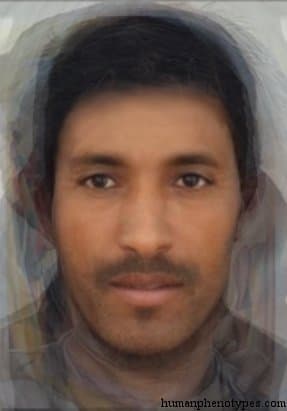
Composite source: Human Phenotypes — Targid
Geographic Distribution
Targid is documented across North Africa, with its historical reference center near 23.3° N, 5.5° E. The coordinates mark where the type was most characteristic roughly 1500 years ago; population movements since then have scattered and blended the distribution far beyond that point.
Physical Characteristics
Light to medium brown skin, often wavy black hair.
- Tall, brachyskelic, ectomorph with long arms
- Dolichocephalic, orthocranic with a long face, dark eyes
- Mandible less shallow than in most Mediterranids
- The high-bridged nose is long, leptorrhine, and often hooked
- Eyes occasionally pseudo-Mongoloid like in some Berberids
Historical Background
Specialised type of the Sahara, linked to Mediterranid and Orientalid - the southern counterpart of Libyid and Eurafricanid, but more strongly adapted to the desert. The result of isolation and selection under extreme environmental stimuli. Typified by the nobles of Tuareg (Imoshag) who migrate through a vast, sparsely populated area, especially found in the Ahaggar Plateau. Sometimes in Songhai and Kanuri. The name derives from the singular of Tuareg, "Targi".
Research History & Naming
Typological names were coined, contested, and renamed repeatedly across the 20th century, and Targid is no exception. The extract below records the researchers who defined Targid, the alternative labels it accumulated, and where the modern consensus settled.
First separated by Verneau (1916) as a distinct Europid type. Later named Targid by Eickstedt ( 1943 , 1951 ). Coon (1939) recognised it as a specialised Mediterranean, Biasutti (1967) as a desert variant of Libica, Lundman (1967) and Vallois (1971) as part of Saharid.
Comparison With Nearby Phenotypes
Geography, not alphabet, ordered this table: the five phenotype centers closest to Targid's, with the traits most likely to be mistaken for it (Paleo Saharid leads at 452 km). In gameplay, these five account for most of the wrong-but-nearby pins against Targid.
| Phenotype | Region | Distance | Distinguishing trait |
|---|---|---|---|
| Paleo Saharid | North Africa | 452 km | Medium brown, sometimes yellowish skin. |
| Fezzanid | North Africa | 942 km | Light to dark brown skin, curly to kinky hair. |
| Saharan Ethiopid | West Africa | 1,246 km | Reddish brown-black skin, tight-curly hair. |
| Libyid | North Africa | 1,327 km | Light brown skin, often wavy black hair. |
| Berberid | North Africa | 1,447 km | Light to medium brown skin, curly-wavy, brown to black hair. |
Targid in the Game
In gameplay terms, Targid rewards region-level recall: the score is computed from the distance between your pin and 23.3° N, 5.5° E. Players often confuse Targid with Paleo Saharid (452 km out) in the comparison table above — those confusions are exactly what the distance penalty is designed to expose.
Targid Phenotype FAQ
- Where does the Targid phenotype come from?
- Historical sources center the Targid phenotype on 23.3° N, 5.5° E (North Africa). Treat that as a rough anchor: the type appeared across a wider surrounding area — its nearest documented neighbors, Paleo Saharid and Fezzanid, sit 452 and 942 km from the reference point — and its present-day distribution no longer matches the historical map.
- What does the Targid phenotype look like?
- The composite emphasizes recurring traits: light to medium brown skin, often wavy black hair. The full trait list for Targid appears in the physical characteristics section above.
- Is the Targid phenotype a race or a nationality?
- No. A phenotype is a recurring bundle of visible traits documented by historical anthropologists across a population — for Targid, patterns such as light to medium brown skin, often wavy black hair. The Targid entry is not a genetic ancestry, not a nationality, and not a statement about any individual person. Two people from the same country can match completely different phenotypes — one resembling Targid, another closer to Paleo Saharid — and one phenotype can span many modern borders.
- How does Targid appear in the game?
- When the Targid face comes up in Classic Daily or Challenge Mode, you pin the world map where you believe the type is historically most common, and the score decays with your distance to 23.3° N, 5.5° E. The nearest documented type, Paleo Saharid, lies about 452 km away, so regional placement usually carries most of the score.
References & Literature
Every claim on this page traces back to the sources below — the researchers who defined, measured, and argued over the Targid type. The originals behind the Targid entry are worth consulting directly.
- Verneau, R. 1916. Resultats anthropologiques de la Mission de M. de Gironcourt en Afrique occidentale. L'Anthr. 27. 47-568.
- Eickstedt, E. von. 1943. Völkerbiologische Probleme der Sahara. In: Beiträge zur Kolonialforschung. Tagungsband I, 169-240.
- Eickstedt, E. von 1951. Die Träger der Afrikanischen Kulturen. In: Bernatzik, H. Afrika. Handbuch der angewandten Völkerkunde. F. Bruckmann. München.
- Coon, C.S.. 1939.. The Races of Europe. The Macmillan Company. New York.
- Briggs, L.C. 1969. Hominid Evolution in Northwest Africa and the Question of North African "Neanderthaloids". Amer. Journ. Phy Anthrop. 29. 377-386.
- L68
- Vallois, H. V. 1971. Las races humaines. 8 Ed. Grammont.
Related Phenotypes
Other human phenotypes whose documented centers lie in the same part of the map as Targid.
Paleo Saharid
North Africa · 452 km away
Very ancient type native to the Sahara Desert. Related to Proto Ethiopid, but possibly also shows traces of ancient Khoisanids who were more...
Fezzanid
North Africa · 942 km away
Saharan type combining ancient elements including Berberid with sub-Saharan elements that often entered the region during the Middle Ages. C...
Saharan Ethiopid
West Africa · 1,246 km away
Ethiopid type that was more common during the Neolithic when the Sahara was still green. Today it extends from Chad to Niger, Northern Niger...
Libyid
North Africa · 1,327 km away
North African steppe type that is usually regarded as part of Orientalid. Although Arab invasions enhanced the Orientalid element in Africa ...
Berberid
North Africa · 1,447 km away
A Proto Atlanto Mediterranean type, originally named after Berbers and the North African Barbary. Associated with Paleolithic types that onc...
Further Reading
Background articles from the blog that explain where the Targid type fits, how these composites are built, and what a face can and cannot tell you.
What Is My Ethnicity? Who Is Asking Changes the Answer
What the phrase assumes is that ethnicity is one thing a person has. Four registers answer it instead: a census form, a family record, a...
Ethnicity Guesser Game: How the Answer Space Shapes a Round
A face-mapping game scores an answer three ways: a point on the map, a named catalogue entry, or a modern country.