Central Pamirid Phenotype - Face Features & Origin
The most typical Pamirid variety, also called Mountain Pamirid. The entry below collects the Central Pamirid composite face, its documented distribution around 39.4° N, 73.3° E in Central Asia, its physical characteristics, the research history behind the name, and the academic references that support all of it.
Average Face
The Central Pamirid composite below is not a photograph of a real person. Historical anthropologists aligned multiple individual portraits from the Central Pamirid reference population and averaged them into one image, so recurring structures — skull outline, nose form, lip thickness, brow position — dominate while individual idiosyncrasies cancel out.
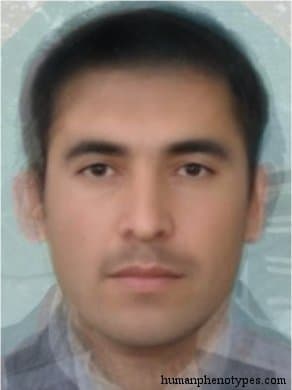
Composite source: Human Phenotypes — Central Pamirid
Geographic Distribution
Geographically, Central Pamirid anchors to 39.4° N, 73.3° E (Central Asia). That is the point where historical anthropologists judged Central Pamirid most concentrated, not a hard edge; modern migration and intermarriage have long since softened whatever boundaries once existed.
Physical Characteristics
Light brown skin, straight or wavy, brown-black hair.
- Medium height to rather tall, mesoskelic, ectomorph
- Brachycephalic, mildly hypsicranic
- Leptorrhine, sometimes convex nose
- Head oval, mid face high, chin weakly protruding, lips thin
- Eyes sometimes slanting, eyebrows thick, sometimes united, body hair modest to strong
Historical Background
The most typical Pamirid variety, also called Mountain Pamirid. Often considered the most typical Turanid. Most common in highland Tajiks, who not only live in Tajikistan, but also Northern Afghanistan and Eastern Uzbekistan. Shows intermediate features between the Plains Pamirid and East Pamirid. It was originally more widespread, and has been pushed back by the Tungid expansion. Sometimes in Uzbeks, Uyghurs, and other Turkic people.
Research History & Naming
The passage below traces who first defined Central Pamirid, which rival names competed with it, and how later authors consolidated or disputed the classification — the raw material of any serious phenotype reference.
Defined as the Mountain variety of the Central-Asiatic-Inter-River race by Oshanin (1964) , this race was also called Pamiro-Ferghan ( Debets, 1974 ; Alekseev and Gochman, 1983 ). Originally united with Aralid in Turko-Tatar ( Deniker, 1900 ) or Turanid ( Eickstedt, 1934 ). Schwidetzky (1950) later regarded only Pamirid as the real Turanid like others ( Lundman, 1967 ; Knussmann, 1996 ).
Comparison With Nearby Phenotypes
The five phenotypes whose documented centers lie closest to Central Pamirid, ranked by great-circle distance. They are the types players most often confuse with Central Pamirid in the quiz, precisely because their distributions overlap.
| Phenotype | Region | Distance | Distinguishing trait |
|---|---|---|---|
| East Pamirid | Central Asia | 221 km | Light brown skin, straight or wavy, often brown hair, and mixed eyes. |
| Plains Pamirid | Central Asia | 232 km | Light brown skin, often straight, brown or black hair, eyes sometimes mixed. |
| Indo Nordic | South Asia | 372 km | Rosy to light brown skin, blonde to black wavy hair. |
| Mountain Aralid | Central Asia | 648 km | Light brown skin, straight, often black, sometimes light hair, and dark, sometimes mixed eyes. |
| Mountain Indid | South Asia | 899 km | Light brown skin, straight or wavy hair. |
Central Pamirid in the Game
Central Pamirid is one of the faces that can appear in Classic Daily and Challenge Mode. When it does, the winning pin lands near 39.4° N, 73.3° E in Central Asia — and because the scoring decays with distance, recognizing the region matters more than pixel-perfect placement.
Central Pamirid Phenotype FAQ
- Where does the Central Pamirid phenotype come from?
- The reference coordinates for the Central Pamirid phenotype sit near 39.4° N, 73.3° E, in Central Asia. That point marks the center of the Central Asia distribution documented roughly 1500 years ago — actual prevalence spread well beyond it, toward entries such as East Pamirid 221 km away, and modern migration has blurred those boundaries further.
- What does the Central Pamirid phenotype look like?
- In the historical literature, light brown skin, straight or wavy, brown-black hair. For Central Pamirid these are statistical tendencies across a population, not a checklist every individual matches.
- Is the Central Pamirid phenotype a race or a nationality?
- No — and the Central Pamirid naming history above shows why. Central Pamirid was defined, renamed, and regrouped repeatedly by different researchers, which is the opposite of how a fixed racial category would behave. A phenotype is a recurring bundle of visible traits recorded across a population; the Central Pamirid label says nothing about where any individual's ancestors were born.
- How does Central Pamirid appear in the game?
- In Classic Daily and Challenge Mode, the Central Pamirid composite face appears without a label. Your task is to drop a pin on the world map where you think that face is historically most common — the scoring uses the distance between your pin and the reference coordinates near 39.4° N, 73.3° E. The post-round review then shows the correct location, your distance error, and this Central Pamirid entry.
References & Literature
The Central Pamirid phenotype entry above is compiled from the 8 academic references. Readers are encouraged to consult the original Central Pamirid sources for verification and deeper context.
- Oshanin, L. V. 1964. Anthropological Composition of the Population of Central Asia, and the ethnogenesis of its Peoples. Vol 1-3.
- Debets, G. 1974. Essay on the Graphical Presentation of the Genealogical Classification of Human Races. In: Bromley, Y. Soviet Ethnology and Anthropology Today. Mouton & Co.
- Alekseev, V.P. and I. I. Gochman. 1983. Physical anthropology of Soviet Asia. In: Schwidetzky, I. Rassengeschichte der Menschheit 9.
- F00
- Eickstedt, E. von. 1934. Rassenkunde und Rassengeschichte der Menschheit. Ferdinand Enke. Stuttgart.
- Schwidetzky, I. 1950. Turaniden-Studien. Verl. d. Akademie d. Wissenschaften u.d. Literatur.
- Lundman, B. 1967. Geographische Anthropologie. Rassen und Völker der Erde. G. Fischer, Stuttgart
- Knussmann, R. 1996. Vergleichende Biologie des Menschen: Lehrbuch der Anthropologie und Humangenetik. 2ed. Spektrum Akademischer Verlag.
Related Phenotypes
Other human phenotypes whose documented centers lie in the same part of the map as Central Pamirid.
East Pamirid
Central Asia · 221 km away
The most Europoid Pamirid subtype. Most common in Pamiri speakers of the Pamir Mountains in Eastern Tajikistan and Northern Afghanistan, esp...
Plains Pamirid
Central Asia · 232 km away
The most widespread Pamirid variety, typical for the steppes and lowlands from Uzbekistan to Xinjiang and the Ferghana Valley. Somewhat infl...
Indo Nordic
South Asia · 372 km away
Type of the Northwestern Himalaya and the Hindu Kush. Connected to Indid, but altered by old unique elements, possibly Proto Nordic that mig...
Mountain Aralid
Central Asia · 648 km away
Tungid variety, weakly influenced by Turanid. Usually united with Aralid, but more Mongoloid. Native to the Tian Shan mountains of Kyrgyzsta...
Mountain Indid
South Asia · 899 km away
(Gracile) Indid variety native to the valleys south of the Western Himalaya and in the Hindu Kush. Once the principal element of the Khas an...
Further Reading
Background articles from the blog that explain where the Central Pamirid type fits, how these composites are built, and what a face can and cannot tell you.
AI Ethnicity Analyzer: Four Instruments, One Name
An analyzer implies parts, but four quite different machines trade under that name: a label classifier, a geometry tool, an embedding...
Ethnicity Guesser AI: Two Model Families, Two Kinds of Error
Tools sold under the same name behave nothing alike. One prints a label from a fixed list; the other writes a sentence.