Ethnicity Guesser AI: Two Model Families, Two Kinds of Error
Tools sold under the same name behave nothing alike. One prints a label from a fixed list; the other writes a sentence. The difference decides what their answers can mean.
A Closed Label Set Versus Open Vocabulary
An ethnicity guesser built as a computer vision classifier has a fixed output layer. It was trained to emit one score per label in a list that engineers chose in advance, and that list is finite: five categories, seven, sixteen, whatever the training data carried. Every answer is a maximum taken over that list, so the model cannot express anything the list cannot hold, and you can read the whole vocabulary before you use the tool.
A general-purpose multimodal model works on entirely different terms. It has no ethnicity output layer and no enumerated label set; it generates text conditioned on the image and the prompt it was given. It may decline to answer, hedge across two possibilities, or invent a category that exists in no dataset at all. Its sense of the subject comes from patterns in web text rather than from a trained representation of the labels, and that is why two products with the same name can behave nothing alike.
Where the Training Labels Come From
For the classifier side, every label in that finite list had to be attached to an image by someone, and there are three routes. Self-report is strong on identity and weak on appearance. Inference from a name or a country field is accurate often enough to be useful in audit designs and wrong often enough to matter one person at a time. Annotation by a person looking at the photograph encodes that annotator's own cue thresholds, which is precisely the fallible judgement the model is later said to automate.
Public face datasets differ in which route they took. Labeled Faces in the Wild, released in 2007 with 13,233 images, carries only identity labels: whether two photographs show the same person. UTKFace attaches age, gender, and race to roughly 20,000 images. FairFace, published by Kärkkäinen and Joo in 2021, was assembled explicitly to balance race, gender, and age across 108,501 images, because earlier collections were skewed enough to distort what a model learned from them.
Why the Base Rate Decides the Headline Number
A percentage on a product page usually comes from a balanced test set, where each label appears equally often. Real populations are not balanced against those labels, and the metric that matters then is precision: of the faces the model puts in a bucket, how many actually belong there. A classifier can post high overall accuracy while being close to useless for its smallest categories, because always predicting the majority label already scores well on a skewed set.
The sibling task has been audited far more carefully than ethnic classification. Grother and colleagues at the National Institute of Standards and Technology published a demographic-effects analysis of face recognition in 2019 and found error rates that varied by demographic group and by algorithm. That study measured matching, not ethnicity labelling, and the distinction is the point: the auditing machinery exists for recognition, while ethnicity classification mostly ships with nothing comparable behind it.
What the Model Is Saying When It Answers
The honest reading of a score is narrow. A classifier's output is a distribution over the labels in its training taxonomy, and the interface normally prints only the largest one. A face that splits 34, 28, 19 across three categories appears on screen as a single word, which converts a close call into a confident-sounding fact. Nothing about the underlying numbers changed, only the display.
The answer is also unstable in ways users rarely test. Change the prompt, add a name, mention a country, or upload the same face under different light, and models shift their output. That sensitivity is not hidden knowledge about the person. Name-based demographic inference has been a research subject since at least the resume audit Bertrand and Mullainathan published in 2004, where identically qualified applications with different names drew measurably different callback rates. The name moved the judgement, not the face.
Two Failure Modes You Can Tell Apart
A closed-set classifier fails by returning a confident wrong label from its list. The error is bounded: you can enumerate every answer it will ever give and test each category. An open model fails differently, producing a fluent explanation that reads like reasoning while drifting between label vocabularies from one run to the next, and it may refuse tomorrow a question it answered today.
Three quick checks separate the two. Ask whether the label set has been published. Run the same image five times and compare the answers. Change one small detail of the photograph and see whether the label holds. A classifier built on a fixed list usually hands you the first check for free and fails the third, while an open model may fail all three and still sound convincing.
Labels Age Faster Than Faces
The taxonomy inside a model is frozen at collection time, and the vocabulary of identity does not hold still across decades. The United States standardised its federal race and ethnicity categories in 1977 through Statistical Policy Directive 15, revised them in 1997, and revised them again in 2024. Whatever a 2015 dataset called someone is a recorded administrative decision from that period, and a model trained on it inherits the decision without inheriting the reasons behind it.
People also move. A face carrying the visible markers of two regions at once tells the model nothing it was trained to express, because a maximum over a fixed list still has to pick one bucket. This site works from the older descriptions instead. An entry such as Central Pamirid or Anatolid names a region, a period, and a described trait set, and it carries no probability at all. Modern migration is exactly why those entries come with a date stamp.
What a Documented Entry Does Instead
The catalogue entries are the contrast case, and the difference is not that they are more accurate about people. An entry such as Deutero Malayid or Micronesid states where a documented appearance pattern was recorded and what observers saw, with the period attached to it. It draws no inference about any individual, because it was never designed to take a photograph as input. Nothing in it can be misread as a score.
Which of the two suits you depends on the question being asked. If you want a single word generated from your photograph, that is what the machine-learning tools do, and general models are now fluent enough to make the output look more considered than it is. If you want to know where a documented pattern was historically common and how the literature described it, the catalogue answers that and states its own limits. The two are not competing measurements of one quantity.
Frequently Asked Questions
- Why do two ethnicity guesser AI tools give different answers?
- They are usually different kinds of system. A purpose-built classifier scores a photo against a fixed list of labels chosen when the training data was assembled, so its answers are bounded by that list. A general multimodal model generates free text with no fixed label set, so it can hedge, refuse, or invent a category. Different label vocabularies and different training signals produce different outputs from the same image.
- Does a high accuracy score make one of these tools reliable?
- Not by itself. Accuracy is normally measured on a balanced test set, while real populations are not balanced against the model's labels, and overall accuracy can stay high while the smallest categories are handled almost at random. Precision per category, calibrated confidence, and a clearly published label taxonomy are what make a figure interpretable.
- Can an AI model tell me my ethnicity from a photo?
- It can return a label or a sentence, but that output describes a category in its training data, not your ancestry or identity. Appearance and descent are loosely coupled, the label set is an administrative choice made at collection time, and admixture is the ordinary human condition rather than an edge case. Treat any single word about a face as a statement about a dataset.
Related Phenotypes
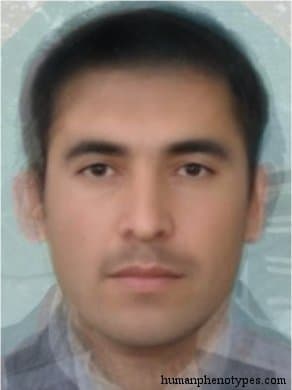
Faces from the encyclopedia that appear in this article. Open any entry for its full description, distribution, and references.
Central Pamirid
Central Asia
The most typical Pamirid variety, also called Mountain Pamirid. Often considered the most typical Turanid. Most common in highland Tajiks, w...
Anatolid
Middle East
Armenid subtype of Anatolia with Dinaroid features. The core population lives in West Anatolia. Probably the result of Armenid influx into a...
Deutero Malayid
Southeast Asia
The insular counterpart of Shanids. Several components gave rise to this type in mainland Asia: Proto Malayid and Proto Sinid consumed other...
Micronesid
Polynesia
Northwestern Polynesid subtype. Combines Nesiotid elements with Proto Malayid and some Melanesid influence. Typically found on the islands o...
Test what you learned
Put your eye for regional faces to work in the daily quiz — a composite face, a world map, and your best guess.