Micronesid Phenotype - Face Features & Origin
Historical anthropology places the Micronesid phenotype in Polynesia, with a documented center near 8.6° N, 151.8° E. Northwestern Polynesid subtype. The sections that follow unpack the Micronesid entry in practice: the composite face, the traits it summarizes, the naming history, and the sources.
Average Face
Averaging the portraits behind Micronesid leaves the features that repeat and erases the ones that do not. That is exactly how the Micronesid composite below was built: individual photographs were aligned and statistically merged, exaggerating shared structure into a single reference face that no actual person looks like.
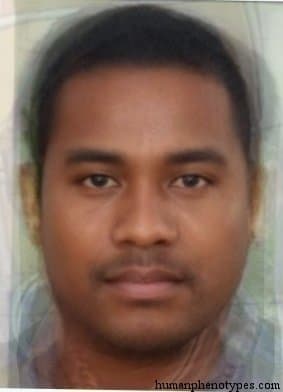
Composite source: Human Phenotypes — Micronesid
Geographic Distribution
Micronesid is documented across Polynesia, with its historical reference center near 8.6° N, 151.8° E. The coordinates mark where the type was most characteristic roughly 1500 years ago; population movements since then have scattered and blended the distribution far beyond that point.
Physical Characteristics
Coppery medium brown skin with straight to wavy, sometimes curly brown-black hair.
- Rather short, mesoskelic, endomorph
- Dolicho- mesocephalic, hypsicranic with a mesorrhine, sometimes bulbous nose
- Face relatively flat, sometimes fleshy
- Lips rather thick
- Eyes tend to be narrow, often slanting
Historical Background
Northwestern Polynesid subtype. Combines Nesiotid elements with Proto Malayid and some Melanesid influence. Typically found on the islands of Micronesia, Guam, and more mixed in Palau, Mariana, and other islands. Associated with Chuukese, Pohnpeian, Kosraean, Yapese, Chamorro, Palauans, and related people.
Research History & Naming
Typological names were coined, contested, and renamed repeatedly across the 20th century, and Micronesid is no exception. The extract below records the researchers who defined Micronesid, the alternative labels it accumulated, and where the modern consensus settled.
Only some authors placed the type in a distinct group. The first was Desmoulins (1826) , who described it as Carolinese. Named Mikronesid by Eickstedt ( 1937 , 1952 ), who regarded it a Polynesid subtype like Biasutti (1967) . Lundman (1967) , among others, describes it as a special mixed type, but not as a subrace.
Comparison With Nearby Phenotypes
Ranked by great-circle distance from Micronesid's reference center, these are the five nearest documented phenotypes — the closest being Insular Melanesid at 1,538 km. Overlapping distributions like these are exactly what makes the quiz hard, and the Insular Melanesid row is where to start looking.
| Phenotype | Region | Distance | Distinguishing trait |
|---|---|---|---|
| Insular Melanesid | Melanesia | 1,538 km | Dark brown skin. |
| Bukaid | Melanesia | 1,682 km | Black, sometimes dark dark brown skin - the darkest in Oceania. |
| Mountain Melanesid | Melanesia | 1,783 km | Usually dark, sometimes light brown skin. |
| Neo Melanesid | Melanesia | 1,906 km | Dark brown, sometimes medium brown skin. |
| Tapirid | Melanesia | 1,907 km | Dark to medium brown, yellowish-reddish skin. |
Micronesid in the Game
When the Micronesid composite shows up in the quiz, players who know the Polynesia distribution pattern have the edge. The reference answer sits near 8.6° N, 151.8° E; pins on the wrong continent score close to zero, so even a rough regional instinct beats a precise but misdirected pin.
Micronesid Phenotype FAQ
- Where does the Micronesid phenotype come from?
- Historical sources center the Micronesid phenotype on 8.6° N, 151.8° E (Polynesia). Treat that as a rough anchor: the type appeared across a wider surrounding area — its nearest documented neighbors, Insular Melanesid and Bukaid, sit 1,538 and 1,682 km from the reference point — and its present-day distribution no longer matches the historical map.
- What does the Micronesid phenotype look like?
- The composite emphasizes recurring traits: coppery medium brown skin with straight to wavy, sometimes curly brown-black hair. The full trait list for Micronesid appears in the physical characteristics section above.
- Is the Micronesid phenotype a race or a nationality?
- No. Phenotypes like Micronesid are descriptive averages, not ancestry groups. Micronesid is one of several types documented in and around Polynesia — see the comparison table above — and the same individual can carry traits associated with several of them at once. The Micronesid entry describes a statistical pattern, not a group of people and not a nationality.
- How does Micronesid appear in the game?
- When the Micronesid face comes up in Classic Daily or Challenge Mode, you pin the world map where you believe the type is historically most common, and the score decays with your distance to 8.6° N, 151.8° E. The nearest documented type, Insular Melanesid, lies 1,538 km away — an isolated reference point, so even a broad regional answer scores respectably here.
References & Literature
Every claim on this page traces back to the sources below — the researchers who defined, measured, and argued over the Micronesid type. The originals behind the Micronesid entry are worth consulting directly.
- Desmoulins, A. 1826. Histoire naturelle des races humaines du Nord-Est de l'Europe, de l'Asie Coréale et orientale et de l'Afrique australe. Paris.
- Eickstedt, E. von. 1937. Geschichte der anthropologischen Namengebung und Klassifikation. In: Zeitschrift für Rassenkunde. Band 5, 209-282, Band 6, 36-96, 151-210.
- Eickstedt, E. von. 1952. Biodynamik der Europiden. In: Historia Mundi. Band 1, Munich, 115-134.
- Biasutti, R. 1967 (1941). Le Razze e i Popoli della terra. 4th Ed. Vol 1-4. U.T.E.T., Torino.
- Lundman, B. 1967. Geographische Anthropologie. Rassen und Völker der Erde. G. Fischer, Stuttgart
Related Phenotypes
Other human phenotypes whose documented centers lie in the same part of the map as Micronesid.
Insular Melanesid
Melanesia · 1,538 km away
Melanesid proper, associated with many Austronesian speakers of Melanesia. Similar to Paleo Melanesid, but with softer features. Common in E...
Bukaid
Melanesia · 1,682 km away
Melanesid variety, associated with the ancient "Walzenbeil" culture. Has sometimes been described as bantuiform, although no close genetic r...
Mountain Melanesid
Melanesia · 1,783 km away
Melanesian mountain variety, relatively ancient with similarities to Paleo Melanesid. Found mainly among New Guinean highlanders like Dani, ...
Neo Melanesid
Melanesia · 1,906 km away
Melanesid subtype of New Guinea. Found especially in lowlands and river plains, with its highest concentration in the south of the island. M...
Tapirid
Melanesia · 1,907 km away
Pygmy Melanesian type. In difference to many other Pygmies, it shares a common history with its taller neighbours and probably represents a ...
Further Reading
Background articles from the blog that explain where the Micronesid type fits, how these composites are built, and what a face can and cannot tell you.
Ethnicity Guesser AI: Two Model Families, Two Kinds of Error
Tools sold under the same name behave nothing alike. One prints a label from a fixed list; the other writes a sentence.
Ethnicity Guesser Photo: What Happens to the File First
A photo handed to a face tool stops being a photograph almost at once: the file is decoded, rotated, colour-converted and resized before...