Insular Melanesid Phenotype - Face Features & Origin
Historical anthropology places the Insular Melanesid phenotype in Melanesia, with a documented center near 5.2° S, 151.6° E. Melanesid proper, associated with many Austronesian speakers of Melanesia. The sections that follow unpack the Insular Melanesid entry in practice: the composite face, the traits it summarizes, the naming history, and the sources.
Average Face
Averaging the portraits behind Insular Melanesid leaves the features that repeat and erases the ones that do not. That is exactly how the Insular Melanesid composite below was built: individual photographs were aligned and statistically merged, exaggerating shared structure into a single reference face that no actual person looks like.
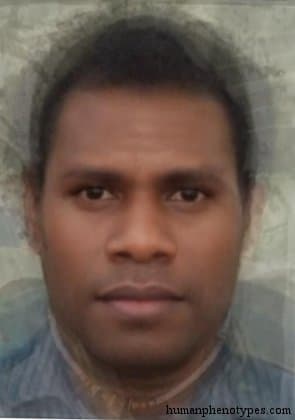
Composite source: Human Phenotypes — Insular Melanesid
Geographic Distribution
Geographically, Insular Melanesid anchors to 5.2° S, 151.6° E (Melanesia). That is the point where historical anthropologists judged Insular Melanesid most concentrated, not a hard edge; modern migration and intermarriage have long since softened whatever boundaries once existed.
Physical Characteristics
Dark brown skin.
- Black-brown, sometimes blonde or even reddish, tight-curly, sometimes kinky hair
- Short to medium-height, brachy- sometimes mesoskelic, endo- to ectomorph
- Dolicho- mesocephalic, hypsicranic
- Features similar to Paleo Melanesid, but much softer
- The face is comparatively long, brow ridges and prognathism only mild
- (Mildly) platyrrhine snub nose, often concave
- Forehead high, lips rather thick, never bulging
- Body hair strong, chin receding
Historical Background
Melanesid proper, associated with many Austronesian speakers of Melanesia. Similar to Paleo Melanesid, but with softer features. Common in East Papua, New Britain, New Ireland, Admiralty Islands, Eastern Solomon Islands, Nendo, Banks Islands, and Vanuatu. More mixed in Eastern Indonesia, New Caledonia, Fiji, across Polynesia and Micronesia, Philippines, and even Taiwan.
Research History & Naming
The passage below traces who first defined Insular Melanesid, which rival names competed with it, and how later authors consolidated or disputed the classification — the raw material of any serious phenotype reference.
Earlier classifications included it Paleo Melanesid ( Eickstedt, 1934 ; Speiser, 1938 ), often as its northern, gracilised variety, or Insular Melanesid ( Drexel, 1955 ). After new analyses separated New Caledonians ( Howells, 1970 ; Howells and Schwidetzky, 1981 ) it appeared as Melanesid in various systems ( Biasutti, 1952 ; Vallois, 1971 ; Debets, 1974 ) or as part of Papua-Melanesid ( Biasutti, 1967 ).
Comparison With Nearby Phenotypes
The five phenotypes whose documented centers lie closest to Insular Melanesid, ranked by great-circle distance. They are the types players most often confuse with Insular Melanesid in the quiz, precisely because their distributions overlap.
| Phenotype | Region | Distance | Distinguishing trait |
|---|---|---|---|
| Bukaid | Melanesia | 416 km | Black, sometimes dark dark brown skin - the darkest in Oceania. |
| Mountain Melanesid | Melanesia | 689 km | Usually dark, sometimes light brown skin. |
| Brachio Melanesid | Melanesia | 858 km | Dark reddish-brown skin. |
| Neo Melanesid | Melanesia | 891 km | Dark brown, sometimes medium brown skin. |
| Tapirid | Melanesia | 1,049 km | Dark to medium brown, yellowish-reddish skin. |
Insular Melanesid in the Game
Insular Melanesid is one of the faces that can appear in Classic Daily and Challenge Mode. When it does, the winning pin lands near 5.2° S, 151.6° E in Melanesia — and because the scoring decays with distance, recognizing the region matters more than pixel-perfect placement.
Insular Melanesid Phenotype FAQ
- Where does the Insular Melanesid phenotype come from?
- Historical sources center the Insular Melanesid phenotype on 5.2° S, 151.6° E (Melanesia). Treat that as a rough anchor: the type appeared across a wider surrounding area — its nearest documented neighbors, Bukaid and Mountain Melanesid, sit 416 and 689 km from the reference point — and its present-day distribution no longer matches the historical map.
- What does the Insular Melanesid phenotype look like?
- The composite emphasizes recurring traits: dark brown skin. The full trait list for Insular Melanesid appears in the physical characteristics section above.
- Is the Insular Melanesid phenotype a race or a nationality?
- No — and the Insular Melanesid naming history above shows why. Insular Melanesid was defined, renamed, and regrouped repeatedly by different researchers, which is the opposite of how a fixed racial category would behave. A phenotype is a recurring bundle of visible traits recorded across a population; the Insular Melanesid label says nothing about where any individual's ancestors were born.
- How does Insular Melanesid appear in the game?
- When the Insular Melanesid face comes up in Classic Daily or Challenge Mode, you pin the world map where you believe the type is historically most common, and the score decays with your distance to 5.2° S, 151.6° E. The nearest documented type, Bukaid, lies about 416 km away, so regional placement usually carries most of the score.
References & Literature
The Insular Melanesid phenotype entry above is compiled from the 9 academic references. Readers are encouraged to consult the original Insular Melanesid sources for verification and deeper context.
- Eickstedt, E. von. 1934. Rassenkunde und Rassengeschichte der Menschheit. Ferdinand Enke. Stuttgart.
- Speiser, F. 1938. Melanesien und Indonesien. Zeitschrift fuer Ethnologie. 70(6). Berlin.
- Dart, R. 1955. Three Strandloper from the Kaokoveld Coast. S. Afr. J. Sci 51. 175-179.
- Howells, W. W. 1970. Anthropometric Grouping Analysis of Pacific Peoples. Archaeology & Physical Anthropology in Oceania. 5, 3. 192-217.
- Howells, W. W. and I. Schwidetzky. 1981. Oceania. In: Schwidetzky, I.: Rassengeschichte der Menschheit, Asien In: Japan, Indonesien, Ozeanien. R. Odenbourg. München. Wien.
- Biasutti, R.. 1952. Rassenkunde und Rassengeschichte von Ozeanien. In: Historia Mundi. Band 1, Munich, 204-216.
- Vallois, H. V. 1971. Las races humaines. 8 Ed. Grammont.
- Debets, G. 1974. Essay on the Graphical Presentation of the Genealogical Classification of Human Races. In: Bromley, Y. Soviet Ethnology and Anthropology Today. Mouton & Co.
- Biasutti, R. 1967 (1941). Le Razze e i Popoli della terra. 4th Ed. Vol 1-4. U.T.E.T., Torino.
Related Phenotypes
Other human phenotypes whose documented centers lie in the same part of the map as Insular Melanesid.
Bukaid
Melanesia · 416 km away
Melanesid variety, associated with the ancient "Walzenbeil" culture. Has sometimes been described as bantuiform, although no close genetic r...
Mountain Melanesid
Melanesia · 689 km away
Melanesian mountain variety, relatively ancient with similarities to Paleo Melanesid. Found mainly among New Guinean highlanders like Dani, ...
Brachio Melanesid
Melanesia · 858 km away
Atypical brachycephalic Melanesid variety native to Melanesia and New Guinea. In its most pronounced form in the Kerewo of Goaribari Island ...
Neo Melanesid
Melanesia · 891 km away
Melanesid subtype of New Guinea. Found especially in lowlands and river plains, with its highest concentration in the south of the island. M...
Tapirid
Melanesia · 1,049 km away
Pygmy Melanesian type. In difference to many other Pygmies, it shares a common history with its taller neighbours and probably represents a ...
Further Reading
Background articles from the blog that explain where the Insular Melanesid type fits, how these composites are built, and what a face can and cannot tell you.
Ethnic Guesser: Which Facial Cues Actually Decide a Round
A round of the game turns on a handful of facial cues, and they are not equal. Here is how pigment, the epicanthic fold, nasal shape...
Ethnicity Guesser vs hbd.gg: Two Ways to Ask a Face
Two sites ask a face to name a place. Here is what each one shows you, where breadth and provenance actually differ, and how to tell...