Deutero Malayid Phenotype - Face Features & Origin
Historical anthropology places the Deutero Malayid phenotype in Southeast Asia, with a documented center near 7.3° S, 109.6° E. The insular counterpart of Shanids. The sections that follow unpack the Deutero Malayid entry in practice: the composite face, the traits it summarizes, the naming history, and the sources.
Average Face
Averaging the portraits behind Deutero Malayid leaves the features that repeat and erases the ones that do not. That is exactly how the Deutero Malayid composite below was built: individual photographs were aligned and statistically merged, exaggerating shared structure into a single reference face that no actual person looks like.
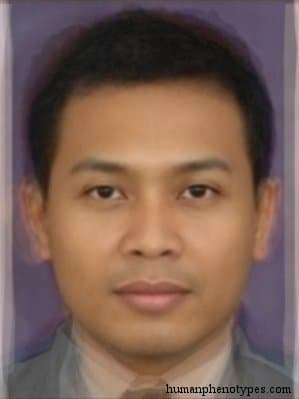
Composite source: Human Phenotypes — Deutero Malayid
Geographic Distribution
Geographically, Deutero Malayid anchors to 7.3° S, 109.6° E (Southeast Asia). That is the point where historical anthropologists judged Deutero Malayid most concentrated, not a hard edge; modern migration and intermarriage have long since softened whatever boundaries once existed.
Physical Characteristics
Yellowish light to medium brown skin with straight or wavy hair.
- (Rather) short, mildly macroskelic, ectomorph
- Brachycephalic, hypsicranic with a mesorrhine, relatively flat nose with round wings
- Lips are relatively thick, jaw squat, body hair weak
- Eyes slanting, Mongolian folds in some individuals, prognathy is mild
Historical Background
The insular counterpart of Shanids. Several components gave rise to this type in mainland Asia: Proto Malayid and Proto Sinid consumed other elements (e.g. Indid) when they migrated South. Over the past millennia the type dispersed across a vast area from Madagascar to the Easter Island. Typified today by Malays. The dominant element in Malaysia, Java, Central Philippines. Also common across Indonesia, in East Madagascar (e.g. Hova), Cham of Vietnam, West Micronesia, and occasionally Taiwan, East India, South Japan, and Polynesia.
Research History & Naming
Typological names were coined, contested, and renamed repeatedly across the 20th century, and Deutero Malayid is no exception. The extract below records the researchers who defined Deutero Malayid, the alternative labels it accumulated, and where the modern consensus settled.
The type was named and described by Sarasin (1905) , many others adopted the name ( Eickstedt, 1934 ; Weinert, 1965 ; Glinka et al. 2010 ). Lundman (1988) called it Malaid, Biasutti (1967) Neo Indonesian, Hooton (1946) Malay-Mongolid and Cole (1965) Malay.
Comparison With Nearby Phenotypes
The five phenotypes whose documented centers lie closest to Deutero Malayid, ranked by great-circle distance. They are the types players most often confuse with Deutero Malayid in the quiz, precisely because their distributions overlap.
| Phenotype | Region | Distance | Distinguishing trait |
|---|---|---|---|
| Proto Malayid | Southeast Asia | 594 km | Medium, sometimes dark brown skin, wavy or curly hair. |
| Dayakid | Southeast Asia | 1,075 km | Medium brown skin with straight or wavy hair. |
| Senoid | Southeast Asia | 1,193 km | Medium to dark brown skin, wavy to curly hair. |
| Toalid | Southeast Asia | 1,325 km | Medium to dark brown skin, usually wavy, sometimes curly hair. |
| Semangid | Southeast Asia | 1,535 km | Dark (copper) brown skin and kinky hair. |
Deutero Malayid in the Game
Deutero Malayid is one of the faces that can appear in Classic Daily and Challenge Mode. When it does, the winning pin lands near 7.3° S, 109.6° E in Southeast Asia — and because the scoring decays with distance, recognizing the region matters more than pixel-perfect placement.
Deutero Malayid Phenotype FAQ
- Where does the Deutero Malayid phenotype come from?
- The reference coordinates for the Deutero Malayid phenotype sit near 7.3° S, 109.6° E, in Southeast Asia. That point marks the center of the Southeast Asia distribution documented roughly 1500 years ago — actual prevalence spread well beyond it, toward entries such as Proto Malayid 594 km away, and modern migration has blurred those boundaries further.
- What does the Deutero Malayid phenotype look like?
- In the historical literature, yellowish light to medium brown skin with straight or wavy hair. For Deutero Malayid these are statistical tendencies across a population, not a checklist every individual matches.
- Is the Deutero Malayid phenotype a race or a nationality?
- No — and the Deutero Malayid naming history above shows why. Deutero Malayid was defined, renamed, and regrouped repeatedly by different researchers, which is the opposite of how a fixed racial category would behave. A phenotype is a recurring bundle of visible traits recorded across a population; the Deutero Malayid label says nothing about where any individual's ancestors were born.
- How does Deutero Malayid appear in the game?
- In Classic Daily and Challenge Mode, the Deutero Malayid composite face appears without a label. Your task is to drop a pin on the world map where you think that face is historically most common — the scoring uses the distance between your pin and the reference coordinates near 7.3° S, 109.6° E. The post-round review then shows the correct location, your distance error, and this Deutero Malayid entry.
References & Literature
Every claim on this page traces back to the sources below — the researchers who defined, measured, and argued over the Deutero Malayid type. The originals behind the Deutero Malayid entry are worth consulting directly.
- Sarasin, P. 1905. Versuch einer Anthropologie der Insel Celebes II. Wiesbaden.
- Eickstedt, E. von. 1934. Rassenkunde und Rassengeschichte der Menschheit. Ferdinand Enke. Stuttgart.
- Weinert, H. 1965. Die heutigen Rassen der Menschheit. In: Lundwig, B. and H. Plank. Handbuch der Biologie. Vol 9 (2).
- G10
- Lundman, B. 1988. Jordens folkstammar. Huddinge.
- Biasutti, R. 1967 (1941). Le Razze e i Popoli della terra. 4th Ed. Vol 1-4. U.T.E.T., Torino.
- Hooton, E.A. 1946. Up from the Ape. Rev. ed. Macmillan Company . New York.
- Cole, S. 1965. Races of Man. Butler & Tanner Ltd. Frome and London.
Related Phenotypes
If Deutero Malayid interested you, these neighboring phenotype entries cover adjacent parts of the map with distinctly different trait bundles.
Proto Malayid
Southeast Asia · 594 km away
Proto Malayid proper type. Relatively old element that probably arrived in the Sunda Archipelago during the period of land bridges in the la...
Dayakid
Southeast Asia · 1,075 km away
Proto Malayid subtype, the insular counterpart of Palaungids, predates the arrival of Deutero Malayids. Has thus developed a stronger tropic...
Senoid
Southeast Asia · 1,193 km away
East Veddid type, native to the forests of South-East Asia. Was more widespread in historic times and has probably pushed back the even olde...
Toalid
Southeast Asia · 1,325 km away
The easternmost Veddid type, usually shorter-skulled. The oldest living type of the Sunda Islands. More widespread in historic times and pro...
Semangid
Southeast Asia · 1,535 km away
Paleolithic, Negriform phenotype found in the forests of the Malay Peninsula, similar to Aetid. Even older and rarer than the cohabitant Sen...
Further Reading
Background articles from the blog that explain where the Deutero Malayid type fits, how these composites are built, and what a face can and cannot tell you.
Ethnicity Guesser AI: Two Model Families, Two Kinds of Error
Tools sold under the same name behave nothing alike. One prints a label from a fixed list; the other writes a sentence.
Ethnicity Guesser Game: How the Answer Space Shapes a Round
A face-mapping game scores an answer three ways: a point on the map, a named catalogue entry, or a modern country.