Toalid Phenotype - Face Features & Origin
The easternmost Veddid type, usually shorter-skulled. The entry below collects the Toalid composite face, its documented distribution around 2.0° S, 120.3° E in Southeast Asia, its physical characteristics, the research history behind the name, and the academic references that support all of it.
Average Face
The Toalid composite below is not a photograph of a real person. Historical anthropologists aligned multiple individual portraits from the Toalid reference population and averaged them into one image, so recurring structures — skull outline, nose form, lip thickness, brow position — dominate while individual idiosyncrasies cancel out.
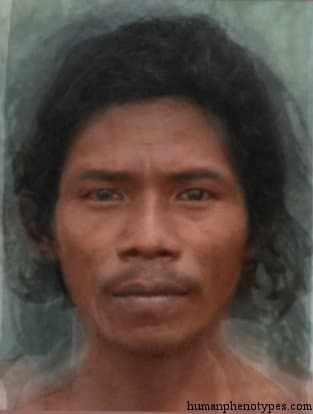
Composite source: Human Phenotypes — Toalid
Geographic Distribution
Toalid is documented across Southeast Asia, with its historical reference center near 2.0° S, 120.3° E. The coordinates mark where the type was most characteristic roughly 1500 years ago; population movements since then have scattered and blended the distribution far beyond that point.
Physical Characteristics
Medium to dark brown skin, usually wavy, sometimes curly hair.
- Short, ectomorph, meso- macroskelic and infantile
- Meso- brachycephalic, mildly hypsicranic with a round occiput and a platyrrhine, often depressed and concave nose
- The face is broad, low and angular
- Males often show supraciliary arches, women are more infantile
- Prognathy is common, chin receding
Historical Background
The easternmost Veddid type, usually shorter-skulled. The oldest living type of the Sunda Islands. More widespread in historic times and probably pushed back by South Mongolids. Diluted today. In its purest form in the Toala of Celebes, where it occurs in Tokea and Loinang as well. May also be found in Sumatra (Kubu, Lubu, Batak), Borneo (Ulu Ajar), Lombok, Philippines (Aeta, Mangyan), even South-East Papua and Madagascar (Sihanaka).
Research History & Naming
Every label in the historical catalogue has an author and a date, and Toalid has accumulated its share of competing attributions. For Toalid, the literature extract below shows the naming chain — from the first definition through the later revisions that shaped the current entry.
First identified by Sarasin ( 1905 , 1907 ) and named Toalid by Eickstedt ( 1937 , 1952 ). Kleiweg de Zwaan (1925) found Veddoids in Loiang, Heberer and Lehmann (1950) in Lombok, Heberer (1950) in Flores , Conklin (1949) in Mindoro, Biasutti (1967) from Sumatra to Borneo, Palawan, Celebes, and Lombok.
Comparison With Nearby Phenotypes
Geography, not alphabet, ordered this table: the five phenotype centers closest to Toalid's, with the traits most likely to be mistaken for it (Dayakid leads at 824 km). In gameplay, these five account for most of the wrong-but-nearby pins against Toalid.
| Phenotype | Region | Distance | Distinguishing trait |
|---|---|---|---|
| Dayakid | Southeast Asia | 824 km | Medium brown skin with straight or wavy hair. |
| Proto Malayid | Southeast Asia | 1,144 km | Medium, sometimes dark brown skin, wavy or curly hair. |
| Deutero Malayid | Southeast Asia | 1,325 km | Yellowish light to medium brown skin with straight or wavy hair. |
| Aetid | Southeast Asia | 1,949 km | Dark brown skin and kinky hair. |
| Senoid | Southeast Asia | 2,086 km | Medium to dark brown skin, wavy to curly hair. |
Toalid in the Game
In gameplay terms, Toalid rewards region-level recall: the score is computed from the distance between your pin and 2.0° S, 120.3° E. Players often confuse Toalid with Dayakid (824 km out) in the comparison table above — those confusions are exactly what the distance penalty is designed to expose.
Toalid Phenotype FAQ
- Where does the Toalid phenotype come from?
- Historical sources center the Toalid phenotype on 2.0° S, 120.3° E (Southeast Asia). Treat that as a rough anchor: the type appeared across a wider surrounding area — its nearest documented neighbors, Dayakid and Proto Malayid, sit 824 and 1,144 km from the reference point — and its present-day distribution no longer matches the historical map.
- What does the Toalid phenotype look like?
- The composite emphasizes recurring traits: medium to dark brown skin, usually wavy, sometimes curly hair. The full trait list for Toalid appears in the physical characteristics section above.
- Is the Toalid phenotype a race or a nationality?
- No. A phenotype is a recurring bundle of visible traits documented by historical anthropologists across a population — for Toalid, patterns such as medium to dark brown skin, usually wavy, sometimes curly hair. The Toalid entry is not a genetic ancestry, not a nationality, and not a statement about any individual person. Two people from the same country can match completely different phenotypes — one resembling Toalid, another closer to Dayakid — and one phenotype can span many modern borders.
- How does Toalid appear in the game?
- When the Toalid face comes up in Classic Daily or Challenge Mode, you pin the world map where you believe the type is historically most common, and the score decays with your distance to 2.0° S, 120.3° E. The nearest documented type, Dayakid, lies about 824 km away, so regional placement usually carries most of the score.
References & Literature
Primary sources for the Toalid entry, listed as cited in the historical literature. The naming and classification debates around Toalid referenced above run through these works.
- Sarasin, P. 1905. Versuch einer Anthropologie der Insel Celebes II. Wiesbaden.
- Sarasin, P. 1907. Über die niedersten Menschenformen des südöstlichen Asiens. Verhandlungen der Schweizer Naturforschenden Gesellschaft 1: 225 242. Genf.
- Eickstedt, E. von. 1937. Geschichte der anthropologischen Namengebung und Klassifikation. In: Zeitschrift für Rassenkunde. Band 5, 209-282, Band 6, 36-96, 151-210.
- Eickstedt, E. von. 1952. Biodynamik der Europiden. In: Historia Mundi. Band 1, Munich, 115-134.
- Kleinweg de Zwaan, J.P. 1925. De Rassen van den Indischen Archipel. Amsterdam.
- Herberer, G. and W. Lehmann. 1950. Die Inland-Malaien von Lombok und Sumbawa. Göttingen.
- Herberer, G. .1950. Anthropologischer Streifzug durch West- und Mittelflores (Kleine Sunda~lnseln). Zeitschrift für Morphologie und Anthropologie 42, 2.
- Conklin, H. C. 1949. Preliminary report of field work on the islands of Mindoro and Palawan, Philippines. American Anthropologist 51(2): 268-273.
- Biasutti, R. 1967 (1941). Le Razze e i Popoli della terra. 4th Ed. Vol 1-4. U.T.E.T., Torino.
Related Phenotypes
More entries from the same region of the historical map as Toalid, each with its own composite and trait profile.
Dayakid
Southeast Asia · 824 km away
Proto Malayid subtype, the insular counterpart of Palaungids, predates the arrival of Deutero Malayids. Has thus developed a stronger tropic...
Proto Malayid
Southeast Asia · 1,144 km away
Proto Malayid proper type. Relatively old element that probably arrived in the Sunda Archipelago during the period of land bridges in the la...
Deutero Malayid
Southeast Asia · 1,325 km away
The insular counterpart of Shanids. Several components gave rise to this type in mainland Asia: Proto Malayid and Proto Sinid consumed other...
Aetid
Southeast Asia · 1,949 km away
Ancient type found in the mountains of the Philippine islands of Luzon, Mindandao and Palawan. Probably developed during the Paleolithic. Si...
Senoid
Southeast Asia · 2,086 km away
East Veddid type, native to the forests of South-East Asia. Was more widespread in historic times and has probably pushed back the even olde...
Further Reading
Background articles from the blog that explain where the Toalid type fits, how these composites are built, and what a face can and cannot tell you.
Ethnicity Guesser Game: How the Answer Space Shapes a Round
A face-mapping game scores an answer three ways: a point on the map, a named catalogue entry, or a modern country.
Ethnicity Guesser AI: Two Model Families, Two Kinds of Error
Tools sold under the same name behave nothing alike. One prints a label from a fixed list; the other writes a sentence.