Senoid Phenotype - Face Features & Origin
Historical anthropology places the Senoid phenotype in Southeast Asia, with a documented center near 0.1° S, 101.6° E. East Veddid type, native to the forests of South-East Asia. The sections that follow unpack the Senoid entry in practice: the composite face, the traits it summarizes, the naming history, and the sources.
Average Face
Averaging the portraits behind Senoid leaves the features that repeat and erases the ones that do not. That is exactly how the Senoid composite below was built: individual photographs were aligned and statistically merged, exaggerating shared structure into a single reference face that no actual person looks like.
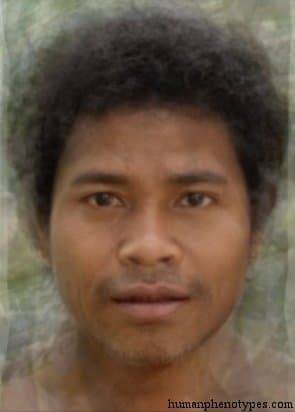
Composite source: Human Phenotypes — Senoid
Geographic Distribution
The reference center for Senoid sits near 0.1° S, 101.6° E in Southeast Asia. Around that anchor, prevalence falls off gradually — the type is not confined to one valley or one modern border, and the historical map should be read as a gradient rather than a boundary.
Physical Characteristics
Medium to dark brown skin, wavy to curly hair.
- Short, ectomorph, mildly brachyskelic
- Mesocephalic, sometimes dolichocephalic, mildly hypsicranic, small-headed
- Mesorrhine, sometimes very short nose
- Features often infantile, especially in women
- Males may show a receding forehead and superciliary arches
- Mild to significant prognathy common, chin slightly receding
Historical Background
East Veddid type, native to the forests of South-East Asia. Was more widespread in historic times and has probably pushed back the even older Negritids. Today a few relict populations remain. Typified by the Senoi (Semai, Temiar, Mahmeri, Chewong...) of the Malay Peninsula. Common in Moken, Degar, Porr, and Shompen. More mixed in Khmer, Sumatrans, Ka, Chinbok, and their neighbours.
Research History & Naming
The passage below traces who first defined Senoid, which rival names competed with it, and how later authors consolidated or disputed the classification — the raw material of any serious phenotype reference.
Detailed early investigations were made by Martin (1905) and Schebesta (1927) . The type was named Senoid by Eickstedt (1937) . In other publications part of the East Veddid spectrum ( Eickstedt, 1944 , Eickstedt, 1952 ). He included Lundman's (1967) Khmerid, that was regarded as Mongoloid admixed by most others ( Biasutti, 1967 ).
Comparison With Nearby Phenotypes
The five phenotypes whose documented centers lie closest to Senoid, ranked by great-circle distance. They are the types players most often confuse with Senoid in the quiz, precisely because their distributions overlap.
| Phenotype | Region | Distance | Distinguishing trait |
|---|---|---|---|
| Semangid | Southeast Asia | 479 km | Dark (copper) brown skin and kinky hair. |
| Jahai Semangid | Southeast Asia | 556 km | Dark (copper) brown skin and kinky hair. |
| Proto Malayid | Southeast Asia | 954 km | Medium, sometimes dark brown skin, wavy or curly hair. |
| Khmerid | Southeast Asia | 1,170 km | Reddish medium brown skin with straight or wavy hair. |
| Deutero Malayid | Southeast Asia | 1,193 km | Yellowish light to medium brown skin with straight or wavy hair. |
Senoid in the Game
Senoid is one of the faces that can appear in Classic Daily and Challenge Mode. When it does, the winning pin lands near 0.1° S, 101.6° E in Southeast Asia — and because the scoring decays with distance, recognizing the region matters more than pixel-perfect placement.
Senoid Phenotype FAQ
- Where does the Senoid phenotype come from?
- The reference coordinates for the Senoid phenotype sit near 0.1° S, 101.6° E, in Southeast Asia. That point marks the center of the Southeast Asia distribution documented roughly 1500 years ago — actual prevalence spread well beyond it, toward entries such as Semangid 479 km away, and modern migration has blurred those boundaries further.
- What does the Senoid phenotype look like?
- In the historical literature, medium to dark brown skin, wavy to curly hair. For Senoid these are statistical tendencies across a population, not a checklist every individual matches.
- Is the Senoid phenotype a race or a nationality?
- No. Phenotypes like Senoid are descriptive averages, not ancestry groups. Senoid is one of several types documented in and around Southeast Asia — see the comparison table above — and the same individual can carry traits associated with several of them at once. The Senoid entry describes a statistical pattern, not a group of people and not a nationality.
- How does Senoid appear in the game?
- In Classic Daily and Challenge Mode, the Senoid composite face appears without a label. Your task is to drop a pin on the world map where you think that face is historically most common — the scoring uses the distance between your pin and the reference coordinates near 0.1° S, 101.6° E. The post-round review then shows the correct location, your distance error, and this Senoid entry.
References & Literature
The Senoid phenotype entry above is compiled from the 6 academic references. Readers are encouraged to consult the original Senoid sources for verification and deeper context.
- Martin, R. 1905. Die Inlandstämme der malaiischen Halbinsel. Jena.
- Schebesta, P. 1927. Bei den Urwaldzwergen von Malaya. Lipsia.
- Eickstedt, E. von. 1937. Geschichte der anthropologischen Namengebung und Klassifikation. In: Zeitschrift für Rassenkunde. Band 5, 209-282, Band 6, 36-96, 151-210.
- Eickstedt, E. von. 1944. Rassendynamik von Ostasien. Walter de Gruyter. Berlin.
- Eickstedt, E. von. 1952. Biodynamik der Europiden. In: Historia Mundi. Band 1, Munich, 115-134.
- E67
Related Phenotypes
More entries from the same region of the historical map as Senoid, each with its own composite and trait profile.
Semangid
Southeast Asia · 479 km away
Paleolithic, Negriform phenotype found in the forests of the Malay Peninsula, similar to Aetid. Even older and rarer than the cohabitant Sen...
Jahai Semangid
Southeast Asia · 556 km away
Semangid variety, a Paleolithic relict of the original Malaysian forest population. Shows more Veddoid/Australoid features and is similar to...
Proto Malayid
Southeast Asia · 954 km away
Proto Malayid proper type. Relatively old element that probably arrived in the Sunda Archipelago during the period of land bridges in the la...
Khmerid
Southeast Asia · 1,170 km away
Intermediate type between South Mongolid and Senoid native to Southern Indochina. The type is the result of intermixture followed by cultura...
Deutero Malayid
Southeast Asia · 1,193 km away
The insular counterpart of Shanids. Several components gave rise to this type in mainland Asia: Proto Malayid and Proto Sinid consumed other...
Further Reading
Background articles from the blog that explain where the Senoid type fits, how these composites are built, and what a face can and cannot tell you.
Ethnicity Guesser Game: How the Answer Space Shapes a Round
A face-mapping game scores an answer three ways: a point on the map, a named catalogue entry, or a modern country.
Ethnicity Guesser AI: Two Model Families, Two Kinds of Error
Tools sold under the same name behave nothing alike. One prints a label from a fixed list; the other writes a sentence.