Jahai Semangid Phenotype - Face Features & Origin
Historical anthropology places the Jahai Semangid phenotype in Southeast Asia, with a documented center near 4.8° N, 101.0° E. Semangid variety, a Paleolithic relict of the original Malaysian forest population. The sections that follow unpack the Jahai Semangid entry in practice: the composite face, the traits it summarizes, the naming history, and the sources.
Average Face
Averaging the portraits behind Jahai Semangid leaves the features that repeat and erases the ones that do not. That is exactly how the Jahai Semangid composite below was built: individual photographs were aligned and statistically merged, exaggerating shared structure into a single reference face that no actual person looks like.
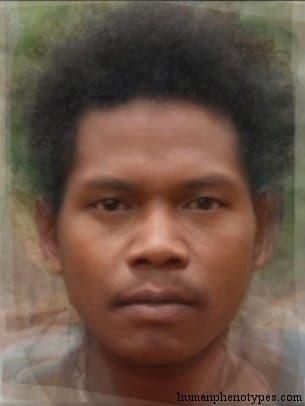
Composite source: Human Phenotypes — Jahai Semangid
Geographic Distribution
The reference center for Jahai Semangid sits near 4.8° N, 101.0° E in Southeast Asia. Around that anchor, prevalence falls off gradually — the type is not confined to one valley or one modern border, and the historical map should be read as a gradient rather than a boundary.
Physical Characteristics
Dark (copper) brown skin and kinky hair.
- Short, but taller than Semangids, mesoskelic
- Mesomorph to ectomorph, mesocephalic, hypsicranic, small-headed
- Mesorrhine, funnel-shaped nose
- The face is relatively short, but longer than in Semangid
- Features are more robust, especially the brow ridges
- The forehead is often shield-shaped
- Prognathism is often absent
Historical Background
Semangid variety, a Paleolithic relict of the original Malaysian forest population. Shows more Veddoid/Australoid features and is similar to Tapirid. Very rare with a few hundred individuals remaining. Typified by the Jahai tribe of the Semang, but also in Bateq and occasionally other Semang groups and even Jakudn. Loss of culture and forest destruction may wipe out this unique type soon.
Research History & Naming
The passage below traces who first defined Jahai Semangid, which rival names competed with it, and how later authors consolidated or disputed the classification — the raw material of any serious phenotype reference.
Detailed investigations were made by Skeat and Blagden (1906) and Schebesta (1927) , who called it australoid Semang type. This was adopted by Biasutti (1967) , who separated it out from the Semang-Aeta group as a distinct Jahai subrace.
Comparison With Nearby Phenotypes
Geography, not alphabet, ordered this table: the five phenotype centers closest to Jahai Semangid's, with the traits most likely to be mistaken for it (Semangid leads at 129 km). In gameplay, these five account for most of the wrong-but-nearby pins against Jahai Semangid.
| Phenotype | Region | Distance | Distinguishing trait |
|---|---|---|---|
| Semangid | Southeast Asia | 129 km | Dark (copper) brown skin and kinky hair. |
| Senoid | Southeast Asia | 556 km | Medium to dark brown skin, wavy to curly hair. |
| Khmerid | Southeast Asia | 721 km | Reddish medium brown skin with straight or wavy hair. |
| South Andamanid | South Asia | 1,142 km | Bluish brown-black skin, kinky or peppercorn hair. |
| North Andamanid | South Asia | 1,246 km | Brown-blackish skin, kinky or peppercorn hair, very short (males 147 cm), mesoskelic, ectomorph, body proportions show no sign of pygmyism. |
Jahai Semangid in the Game
In gameplay terms, Jahai Semangid rewards region-level recall: the score is computed from the distance between your pin and 4.8° N, 101.0° E. Players often confuse Jahai Semangid with Semangid (129 km out) in the comparison table above — those confusions are exactly what the distance penalty is designed to expose.
Jahai Semangid Phenotype FAQ
- Where does the Jahai Semangid phenotype come from?
- The reference coordinates for the Jahai Semangid phenotype sit near 4.8° N, 101.0° E, in Southeast Asia. That point marks the center of the Southeast Asia distribution documented roughly 1500 years ago — actual prevalence spread well beyond it, toward entries such as Semangid 129 km away, and modern migration has blurred those boundaries further.
- What does the Jahai Semangid phenotype look like?
- In the historical literature, dark (copper) brown skin and kinky hair. For Jahai Semangid these are statistical tendencies across a population, not a checklist every individual matches.
- Is the Jahai Semangid phenotype a race or a nationality?
- No. A phenotype is a recurring bundle of visible traits documented by historical anthropologists across a population — for Jahai Semangid, patterns such as dark (copper) brown skin and kinky hair. The Jahai Semangid entry is not a genetic ancestry, not a nationality, and not a statement about any individual person. Two people from the same country can match completely different phenotypes — one resembling Jahai Semangid, another closer to Semangid — and one phenotype can span many modern borders.
- How does Jahai Semangid appear in the game?
- In Classic Daily and Challenge Mode, the Jahai Semangid composite face appears without a label. Your task is to drop a pin on the world map where you think that face is historically most common — the scoring uses the distance between your pin and the reference coordinates near 4.8° N, 101.0° E. The post-round review then shows the correct location, your distance error, and this Jahai Semangid entry.
References & Literature
The Jahai Semangid phenotype entry above is compiled from the 3 academic references. Readers are encouraged to consult the original Jahai Semangid sources for verification and deeper context.
- Skeat, W.W. and C.O. Blagden. 1906. Pagan Races of the Malay Peninsula. Vol 1-2.Macmillan and Co. London.
- Schebesta, P. 1927. Bei den Urwaldzwergen von Malaya. Lipsia.
- Biasutti, R. 1967 (1941). Le Razze e i Popoli della terra. 4th Ed. Vol 1-4. U.T.E.T., Torino.
Related Phenotypes
If Jahai Semangid interested you, these neighboring phenotype entries cover adjacent parts of the map with distinctly different trait bundles.
Semangid
Southeast Asia · 129 km away
Paleolithic, Negriform phenotype found in the forests of the Malay Peninsula, similar to Aetid. Even older and rarer than the cohabitant Sen...
Senoid
Southeast Asia · 556 km away
East Veddid type, native to the forests of South-East Asia. Was more widespread in historic times and has probably pushed back the even olde...
Khmerid
Southeast Asia · 721 km away
Intermediate type between South Mongolid and Senoid native to Southern Indochina. The type is the result of intermixture followed by cultura...
South Andamanid
South Asia · 1,142 km away
Isolated type typical for the Little Andamanese people (Onge, Jarawa, Sentilese). After contact with Europeans in the 19th century populatio...
North Andamanid
South Asia · 1,246 km away
Almost extinct, isolated type endemic to the Andaman Islands. Particularly in Great Andamanese groups, rarer in other Andamanese. After cont...
Further Reading
Background articles from the blog that explain where the Jahai Semangid type fits, how these composites are built, and what a face can and cannot tell you.
Ethnicity Guesser Game: How the Answer Space Shapes a Round
A face-mapping game scores an answer three ways: a point on the map, a named catalogue entry, or a modern country.
Ethnoguessr: The Spelling, the Sites, and the Game
Ethnoguessr is a compressed spelling of "ethnicity guesser", and more than one site answers to it. Here is how to tell what you are...