Why Do East Asians Have Epicanthic Folds? Four Candidate Answers
An epicanthic fold is a fold of upper-eyelid skin over the inner corner of the eye, recorded across more than fifty degrees of latitude in eastern Asia. Four explanations are on the table, and none of them is settled.
The fold is skin, not bone
Start with what the fold is made of, because the name misleads. An epicanthic fold is a curtain of skin running from the upper eyelid down over the inner corner of the eye, partly covering the medial canthus. Its anatomical name is plica palpebronasalis, and it carries a formal identifier in both the Terminologia Anatomica and the Foundational Model of Anatomy. No bone is involved, and the fold is not the same thing as a monolid. In a monolid the supratarsal crease is absent and the tarsal plate is hidden; in an eye carrying a pronounced fold the plate usually stays visible toward the outer side.
Clinical descriptions sort the fold into four named configurations: epicanthus supraciliaris, which descends from the brow; epicanthus palpebralis, which begins above the tarsus; epicanthus tarsalis, the type recorded most often in East Asian samples; and epicanthus inversus, which runs the other way, from the lower lid upward. The explanations offered for its formation also disagree with one another. Three mechanisms have been proposed: a medial attachment of the levator aponeurosis that fails to reach the skin, hypertrophy of the preseptal part of the orbicularis oculi muscle, and an excess of skin relative to the tissue beneath it. Clinical writing tends to favour the muscle explanation, while histological work has complicated it by finding obliquely oriented orbicularis fibres running in the same direction as the fold rather than across it.
Every fetus starts with one
The question assumes the fold is something that appears. In development it is mostly something that disappears. The upper and lower eyelids fuse early in gestation and separate again around the fifth or sixth month, and folds of skin at the inner corner are a normal feature of that stage in every population. Most fetuses lose them before birth, and the ones who do not are born into families of any background. The fold is also common in young children generally, because the nasal bridge has not yet risen and the skin at the inner corner has somewhere to sit.
A flat infant bridge has a second consequence worth knowing. It produces pseudostrabismus, an apparent inward turn of the eye that is not a squint, because the extra skin at the medial canthus hides part of the white of the eye. The appearance resolves by itself as the midface grows and the bridge elevates, usually somewhere between the ages of three and six. So part of the honest answer to why the fold is common in eastern Asia is that it is common everywhere at one stage of life, and the real question is why it persists past that stage rather than why it exists.
The variant that keeps getting named
One genetic signal is named far more often than the rest. EDAR V370A, a single amino acid change in the receptor for ectodysplasin A, is close to fixed in many East Asian and Native American populations and rare elsewhere. Yana Kamberov and colleagues modelled it in mice and published the result in Cell in 2013. The knock-in animals grew thicker hair, and the work turned up effects the authors had not predicted: denser mammary glands, smaller fat pads around them, and differences in eccrine glands. In Han Chinese volunteers, carrying two copies of the variant was associated with a higher number of active eccrine glands.
Notice what is missing from that list. The eyelid is not among the traits the paper measured. The best-documented effects of the allele concern sweat glands, hair shafts and the shape of incisors, which is an odd set of findings to hang an answer about eyes on. That is not an argument that the variant is irrelevant to the fold. It is a reminder that the popular answer rests on proximity rather than on a measurement of eyelids taken from people who carry it. The same caution applies to the origin story: a simulation placed the allele's emergence in central China, and a simulation is not a photograph.
Two laboratories, two stories, one allele
Two research groups have offered competing accounts of what was actually selected, and they point in opposite directions. The first reading was thermoregulation: extra sweat glands would have been useful in a warm, humid setting, which leaves the eyelid as a passenger riding along with the gene. The second account moves north. Leslea Hlusko and colleagues argued in PNAS in 2018 that selection acted on the branching of mammary ducts during the Last Glacial Maximum, when a population was isolated in the Beringian refugium at latitudes where ultraviolet radiation is too weak for skin to manufacture vitamin D. More branching ducts, on this reading, meant more vitamin D and more fatty acids reaching an infant through milk.
Their evidence was dental rather than ocular. People were living in Arctic Beringia by thirty-two thousand years ago, the glacial maximum ran from roughly twenty-eight thousand to eighteen thousand years ago, and the incisor shovelling that the allele produces is unusually common in archaeological Native American remains, which places the variant in that ancestral northern population well before European contact. The same paper proposed that selection on the fatty acid desaturase cluster travelled alongside it. Neither account has been settled, and neither was built to explain an eyelid.
The record does not track the cold
The catalogue on this site stores a latitude with every entry, which makes the cold-hypothesis testable against its own text. Manchu-Korean, defined by Baelz in 1901 and concentrated in Manchuria and Korea at about 45 degrees north, is recorded with the Mongolian fold pronounced. Huanghoid, named by Liu in 1937 after the Yellow River, sits near 35 degrees north and is described with epicanthic folds pronounced. Changkiangid, also named by Liu in 1937, follows the Yangtze at about 30 degrees north and lists folds as common. Deutero Malayid, seven degrees south of the equator, records Mongolian folds in some individuals.
That is a span of more than fifty degrees of latitude with the fold documented at every step, from the Manchurian cold to the Indonesian tropics, which fits a feature tuned to temperature badly. A second observation sits awkwardly with a single switch as well: within one person the two lids need not match, with a well-formed fold on one side and little or none on the other. However EDAR is acting, it is not reading a thermometer.
What the clinical literature did with it
Because the fold is visible at birth, clinicians noticed it long before geneticists did, and they catalogued it as one feature among many in a set of conditions. Roughly sixty percent of people with Down syndrome have prominent folds. It appears in descriptions of fetal alcohol syndrome, Zellweger syndrome, Noonan syndrome, Turner syndrome and phenylketonuria. Epicanthus inversus belongs with blepharophimosis, ptosis and epicanthus inversus syndrome, an autosomal dominant condition traced to mutations in FOXL2. None of those associations makes the fold a sign of anything on its own, and every one of them concerns a rare presentation rather than an ordinary face.
The genetics of the common form is thinner than the public discussion suggests. One study genotyped two variants in 156 Chinese Han adults, split almost evenly between people with a fold and people without one. A change in HBEGF, rs2074612, tracked the ratio of the palpebral fissure's width to its height, but the fold itself showed no significant association with either variant in that sample, and the authors asked for larger studies. Broader clinical writing is blunter still: the reason the fold forms is not fully understood, and no common variant has been pinned to it. After more than a century of naming, that is where the question sits.
Why the question sounds different now
One contemporary fact changes how the question reads. Eyelid surgery became the most commonly performed cosmetic surgical procedure in the world in 2024, at 2,115,360 operations, according to the International Society of Aesthetic Plastic Surgery, whose annual survey drew responses from 2,975 board-certified plastic surgeons and projected them onto an estimated global workforce of 58,500. That was a rise of 13.4 percent in a single year and 72.6 percent since 2020, and it displaced liposuction from the top of the ranking. Epicanthoplasty, which opens the medial fold, is a separate operation often carried out alongside it. A documented trait is being revised in the present tense while a 1,500-year-old catalogue describes it.
There is a second reason to handle the question carefully as phrased. Asking why a named group of living people has a trait turns a regional average into a property of a people, and the record does not support that move. Entries such as Huanghoid and Changkiangid describe patterns that observers recorded in named places at named times, with the source listed and the edges left uneven. They answer where a documented appearance pattern was common and how it was described. They do not answer why the person in front of you looks the way they do, and they were never designed to.
Frequently Asked Questions
- Is an epicanthic fold the same as a monolid?
- No, and the two are routinely confused. A monolid has no visible supratarsal crease, so the tarsal plate is hidden along the whole length of the lid. An epicanthic fold is a separate curtain of skin at the inner corner, and it can occur with or without a crease; in most people who have a pronounced fold the tarsal plate remains visible toward the outer side. A person can have one, both or neither, and all four combinations turn up within the same population.
- Why do some people have the fold on only one side?
- The two eyelids need not match. One lid can carry a well-formed fold while the other has little or none, in the same person, with nothing else unusual about the face. That pattern is difficult to reconcile with a single genetic switch that reliably builds one structure, and it is part of why the search for responsible variants has moved slowly. Development is a process with timing, and timing can differ between the two sides of one face.
- Why do older papers call it the Mongolian fold?
- Because nineteenth and twentieth century observers named structures after the places they had seen them, and the name entered the anatomical literature and stayed there. The formal terms are epicanthus and plica palpebronasalis, and clinical writing still uses them. The catalogue on this site keeps the older wording wherever its sources used it, because an entry records what a named author wrote in a named year rather than translating it into today's vocabulary. Keeping the original phrasing is part of what makes the entry checkable.
Related Phenotypes
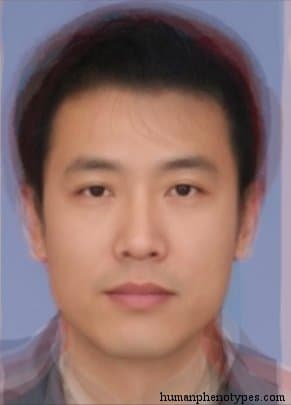
Faces from the encyclopedia that appear in this article. Open any entry for its full description, distribution, and references.
Huanghoid
East Asia
North Sinid type, named after the Huang Ho (Yellow) river in Northern China. Developed from loess and millet farmers. Usually regarded as th...
Changkiangid
East Asia
Sinid subtype, named after the Chang Kiang (Yangtze) river in Central China. Today the most populous human variety in the world. Developed f...
Manchu-Korean
East Asia
North Sinid subtype, significantly influenced by Tungid. Typified by Manchu and Koreans. Most common in Manchuria / North China, and Central...
Deutero Malayid
Southeast Asia
The insular counterpart of Shanids. Several components gave rise to this type in mainland Asia: Proto Malayid and Proto Sinid consumed other...
Test what you learned
Put your eye for regional faces to work in the daily quiz — a composite face, a world map, and your best guess.