Shillukid Phenotype - Face Features & Origin
Historical anthropology places the Shillukid phenotype in East Africa, with a documented center near 9.0° N, 33.0° E. Nilotid variety similar to Dinkaid, but with slightly modified features. The sections that follow unpack the Shillukid entry in practice: the composite face, the traits it summarizes, the naming history, and the sources.
Average Face
Averaging the portraits behind Shillukid leaves the features that repeat and erases the ones that do not. That is exactly how the Shillukid composite below was built: individual photographs were aligned and statistically merged, exaggerating shared structure into a single reference face that no actual person looks like.
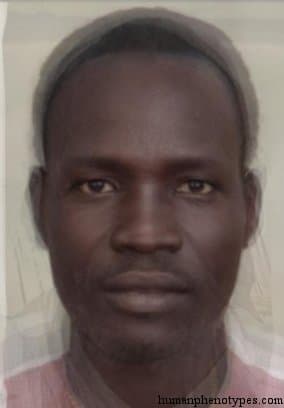
Composite source: Human Phenotypes — Shillukid
Geographic Distribution
Geographically, Shillukid anchors to 9.0° N, 33.0° E (East Africa). That is the point where historical anthropologists judged Shillukid most concentrated, not a hard edge; modern migration and intermarriage have long since softened whatever boundaries once existed.
Physical Characteristics
Black skin, usually kinky, sometimes tight-curly hair.
- (Very) tall, hyperbrachyskelic, strongly ectomorph
- Usually hyperdolichocephalic, hypsicranic
- The face is narrower and the skull even longer
- (Mildly) platyrrhine nose, forehead steep and very high
- The lips are relatively full
- Mongoloid eyes occur especially in women
- Prognathy very weak
Historical Background
Nilotid variety similar to Dinkaid, but with slightly modified features. Typically found in the savannahs of the Upper Nile of South Sudan. Extends to Western Ethiopia (e.g. Gambela). Most common in Shilluk, but also in Anuak. More mixed in other Nilotic people.
Research History & Naming
Typological names were coined, contested, and renamed repeatedly across the 20th century, and Shillukid is no exception. The extract below records the researchers who defined Shillukid, the alternative labels it accumulated, and where the modern consensus settled.
The Shillukid was named by Lundman (1967) as Nil(ot)id variety. Eickstedt (1934) considered them the result of a slight Ethiopid admix, just like Biasutti (1941, 1967) , who distinguished them from Dinka and Nuer as the Upper Nile variety. Detailed descriptions were made by Seligman (1932) , who described a Shilluk-Anuak group.
Comparison With Nearby Phenotypes
The five phenotypes whose documented centers lie closest to Shillukid, ranked by great-circle distance. They are the types players most often confuse with Shillukid in the quiz, precisely because their distributions overlap.
| Phenotype | Region | Distance | Distinguishing trait |
|---|---|---|---|
| Pre Nilotid | East Africa | 276 km | Black skin and kinky, sometimes tight-curly hair. |
| Dinkaid | East Africa | 289 km | Black skin and kinky hair. |
| Nilo Hamitic | East Africa | 388 km | Dark brown to black skin, usually kinky, sometimes tight-curly hair. |
| East Sudanid | East Africa | 414 km | Dark brown, sometimes black skin, usually kinky hair. |
| Omotic | East Africa | 531 km | Dark brown skin and kinky-curly hair. |
Shillukid in the Game
Shillukid is one of the faces that can appear in Classic Daily and Challenge Mode. When it does, the winning pin lands near 9.0° N, 33.0° E in East Africa — and because the scoring decays with distance, recognizing the region matters more than pixel-perfect placement.
Shillukid Phenotype FAQ
- Where does the Shillukid phenotype come from?
- Historical sources center the Shillukid phenotype on 9.0° N, 33.0° E (East Africa). Treat that as a rough anchor: the type appeared across a wider surrounding area — its nearest documented neighbors, Pre Nilotid and Dinkaid, sit 276 and 289 km from the reference point — and its present-day distribution no longer matches the historical map.
- What does the Shillukid phenotype look like?
- The composite emphasizes recurring traits: black skin, usually kinky, sometimes tight-curly hair. The full trait list for Shillukid appears in the physical characteristics section above.
- Is the Shillukid phenotype a race or a nationality?
- No — and the Shillukid naming history above shows why. Shillukid was defined, renamed, and regrouped repeatedly by different researchers, which is the opposite of how a fixed racial category would behave. A phenotype is a recurring bundle of visible traits recorded across a population; the Shillukid label says nothing about where any individual's ancestors were born.
- How does Shillukid appear in the game?
- When the Shillukid face comes up in Classic Daily or Challenge Mode, you pin the world map where you believe the type is historically most common, and the score decays with your distance to 9.0° N, 33.0° E. Fair warning: the nearest other entry in our dataset, Pre Nilotid, sits just 276 km away, so this face rewards precise placement — the right country alone is not always enough.
References & Literature
Every claim on this page traces back to the sources below — the researchers who defined, measured, and argued over the Shillukid type. The originals behind the Shillukid entry are worth consulting directly.
- Lundman, B. 1967. Geographische Anthropologie. Rassen und Völker der Erde. G. Fischer, Stuttgart
- Eickstedt, E. von. 1934. Rassenkunde und Rassengeschichte der Menschheit. Ferdinand Enke. Stuttgart.
- Biasutti, R. 1967 (1941). Le Razze e i Popoli della terra. 4th Ed. Vol 1-4. U.T.E.T., Torino.
- Seligman, C.G. and B. Seligman. 1932. Pagan Tribes of the Nilotic Sudan. George Routledge & Sons Ltd. London
Related Phenotypes
Other human phenotypes whose documented centers lie in the same part of the map as Shillukid.
Pre Nilotid
East Africa · 276 km away
Ancient type with Proto Nilotid traits, today still found in the border region of Sudan and Ethiopia. Common in Kwama, Uduk, Gumuz, Mao, and...
Dinkaid
East Africa · 289 km away
Nilotid proper that shows the most pronounced Nilotic features: the tallest, most long-legged and one of the darkest phenotypes in the world...
Nilo Hamitic
East Africa · 388 km away
Intermediate type between Nilotid and Ethiopid that is associated with the Nilo Hamites or Half Hamites. Similar to Maasai. Should not be co...
East Sudanid
East Africa · 414 km away
Isolated Sudanid variety of the Nuba mountains in Kurdufan / Sudan, native to the region at least since the Neolithic. Has resisted historic...
Omotic
East Africa · 531 km away
Isolated type of Southwestern Ethiopia and Northern Kenya, probably belonging to a group of ancient Ethiopids. Probably a relict of Pre-Neol...
Further Reading
Background articles from the blog that explain where the Shillukid type fits, how these composites are built, and what a face can and cannot tell you.
What Ethnicity Am I? Three Ways to Actually Answer It
The question is personal, but the answers arrive from three different places: records, DNA, and appearance. Each can tell you something...
Ethnoguessr: The Spelling, the Sites, and the Game
Ethnoguessr is a compressed spelling of "ethnicity guesser", and more than one site answers to it. Here is how to tell what you are...