Danakil Phenotype - Face Features & Origin
Historical anthropology places the Danakil phenotype in East Africa, with a documented center near 14.0° N, 40.6° E. Specialised Ethiopid type living in the hottest region of the world: the Danakil depression of Eritrea and Northern Ethiopia, with an annual average temperature of more than 34°C. The sections that follow unpack the Danakil entry in practice: the composite face, the traits it summarizes, the naming history, and the sources.
Average Face
Averaging the portraits behind Danakil leaves the features that repeat and erases the ones that do not. That is exactly how the Danakil composite below was built: individual photographs were aligned and statistically merged, exaggerating shared structure into a single reference face that no actual person looks like.
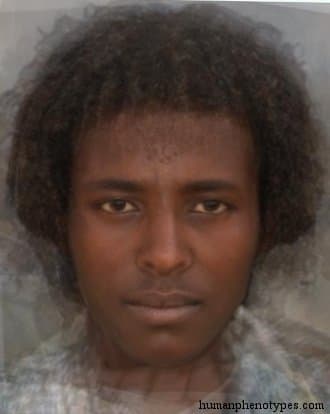
Composite source: Human Phenotypes — Danakil
Geographic Distribution
The reference center for Danakil sits near 14.0° N, 40.6° E in East Africa. Around that anchor, prevalence falls off gradually — the type is not confined to one valley or one modern border, and the historical map should be read as a gradient rather than a boundary.
Physical Characteristics
Very dark reddish-brown skin, tight-curly to kinky-curly hair.
- Endomorph to ectomorph and rather short, being the shortest of all Ethiopids
- Mesocephalic, sometimes dolichocephalic, orthocranic
- Relatively soft facial features
- The nose is mildly leptorrhine, narrower than in North Ethiopids, but wider than in East Ethiopids
- Lips are full and body hair is scant
Historical Background
Specialised Ethiopid type living in the hottest region of the world: the Danakil depression of Eritrea and Northern Ethiopia, with an annual average temperature of more than 34°C. Most common in the Afar people and southern tribes of the Saho (e.g. Hazu). Occasionally in Northern Somalia and across Ethiopia.
Research History & Naming
The passage below traces who first defined Danakil, which rival names competed with it, and how later authors consolidated or disputed the classification — the raw material of any serious phenotype reference.
The distinctiveness of the Danakil type was first observed by Santelli (1893) . Eickstedt (1934) later mentioned it as a stocky Ethiopid variety. Puccioni and Grotanelli (1967) called it the North Eritrean Ethiopid variant.
Comparison With Nearby Phenotypes
Ranked by great-circle distance from Danakil's reference center, these are the five nearest documented phenotypes — the closest being Central Ethiopid at 257 km. Overlapping distributions like these are exactly what makes the quiz hard, and the Central Ethiopid row is where to start looking.
| Phenotype | Region | Distance | Distinguishing trait |
|---|---|---|---|
| Central Ethiopid | East Africa | 257 km | Medium to dark reddish-brown skin, often tight-curly hair. |
| Proto Ethiopid | East Africa | 352 km | Dark, sometimes medium brown skin and kinky-curly hair. |
| North Ethiopid | East Africa | 360 km | Dark, sometimes medium (bronze) brown skin, tight-curly hair. |
| Pre Nilotid | East Africa | 775 km | Black skin and kinky, sometimes tight-curly hair. |
| Yemenid | Middle East | 823 km | Medium brown skin, wavy, sometimes curly, black hair. |
Danakil in the Game
When the Danakil composite shows up in the quiz, players who know the East Africa distribution pattern have the edge. The reference answer sits near 14.0° N, 40.6° E; pins on the wrong continent score close to zero, so even a rough regional instinct beats a precise but misdirected pin.
Danakil Phenotype FAQ
- Where does the Danakil phenotype come from?
- The reference coordinates for the Danakil phenotype sit near 14.0° N, 40.6° E, in East Africa. That point marks the center of the East Africa distribution documented roughly 1500 years ago — actual prevalence spread well beyond it, toward entries such as Central Ethiopid 257 km away, and modern migration has blurred those boundaries further.
- What does the Danakil phenotype look like?
- In the historical literature, very dark reddish-brown skin, tight-curly to kinky-curly hair. For Danakil these are statistical tendencies across a population, not a checklist every individual matches.
- Is the Danakil phenotype a race or a nationality?
- No. A phenotype is a recurring bundle of visible traits documented by historical anthropologists across a population — for Danakil, patterns such as very dark reddish-brown skin, tight-curly to kinky-curly hair. The Danakil entry is not a genetic ancestry, not a nationality, and not a statement about any individual person. Two people from the same country can match completely different phenotypes — one resembling Danakil, another closer to Central Ethiopid — and one phenotype can span many modern borders.
- How does Danakil appear in the game?
- In Classic Daily and Challenge Mode, the Danakil composite face appears without a label. Your task is to drop a pin on the world map where you think that face is historically most common — the scoring uses the distance between your pin and the reference coordinates near 14.0° N, 40.6° E. The post-round review then shows the correct location, your distance error, and this Danakil entry.
References & Literature
The Danakil phenotype entry above is compiled from the 3 academic references. Readers are encouraged to consult the original Danakil sources for verification and deeper context.
- Sarasin, F. 1893. Ergebnisse naturwissenschaftlicher forschungen auf Ceylon. Die Weddas von Ceylon und ihre Beziehungen zu den Nachbarschaften. Atlas. C.W. Kreidel's Verlag. Wiesbaden.
- Eickstedt, E. von. 1934. Rassenkunde und Rassengeschichte der Menschheit. Ferdinand Enke. Stuttgart.
- Puccioni, N. and V. L. Grottanelli. 1967. Gli Ethiopici Setterionali. In: Biasutti, R. Le Razze e i Popoli della terra. 4th Ed. Vol 1-4. U.T.E.T., Torino.
Related Phenotypes
More entries from the same region of the historical map as Danakil, each with its own composite and trait profile.
Central Ethiopid
East Africa · 257 km away
Ethiopid subtype of the central Ethiopian highlands and their surroundings. Found in its purest form among Oromos. Also in other Cushitic sp...
Proto Ethiopid
East Africa · 352 km away
Ancient type that inhabited the Southwestern Eritrean lowlands prior to the arrival of Ethiopids, and possibly resembles early "Out of Afric...
North Ethiopid
East Africa · 360 km away
Ethiopid subtype that is often regarded as a northern branch of East Ethiopid. Common along the Red Sea coast and the Nile Valley from Egypt...
Pre Nilotid
East Africa · 775 km away
Ancient type with Proto Nilotid traits, today still found in the border region of Sudan and Ethiopia. Common in Kwama, Uduk, Gumuz, Mao, and...
Yemenid
Middle East · 823 km away
Orientalid subtype that deviates in an Armenoid direction. Most common in South and Central Yemeni. Also in Oman, UAE, Socotra, and parts of...
Further Reading
Background articles from the blog that explain where the Danakil type fits, how these composites are built, and what a face can and cannot tell you.
AI Ethnicity Test: What a Measurement Would Require
A laboratory test has a reference standard, a defined construct and a published error bar. A face-based ethnicity tool owns none of...
Ethnicity Guesser Tools: Three Methods, Three Answers
One search term covers three unrelated tools: genetic ancestry estimation, photo classifiers, and documented phenotype catalogues.