Central Ethiopid Phenotype - Face Features & Origin
Historical anthropology places the Central Ethiopid phenotype in East Africa, with a documented center near 13.2° N, 38.4° E. Ethiopid subtype of the central Ethiopian highlands and their surroundings. The sections that follow unpack the Central Ethiopid entry in practice: the composite face, the traits it summarizes, the naming history, and the sources.
Average Face
Averaging the portraits behind Central Ethiopid leaves the features that repeat and erases the ones that do not. That is exactly how the Central Ethiopid composite below was built: individual photographs were aligned and statistically merged, exaggerating shared structure into a single reference face that no actual person looks like.
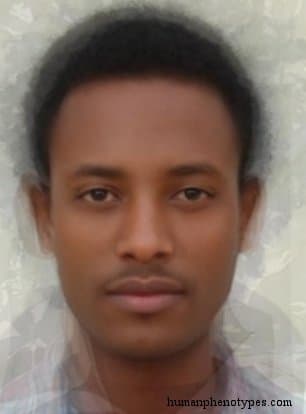
Composite source: Human Phenotypes — Central Ethiopid
Geographic Distribution
The reference center for Central Ethiopid sits near 13.2° N, 38.4° E in East Africa. Around that anchor, prevalence falls off gradually — the type is not confined to one valley or one modern border, and the historical map should be read as a gradient rather than a boundary.
Physical Characteristics
Medium to dark reddish-brown skin, often tight-curly hair.
- (Rather) tall, brachyskelic, ectomorph to mesomorph
- Mesocephalic, rarely brachycephalic, orthocranic
- Smaller-headed than North Ethiopid
- The straight or convex nose is lepto- mesorrhine and relatively high
- Lips are full, the chin strong, ears are small, prognathism usually absent
Historical Background
Ethiopid subtype of the central Ethiopian highlands and their surroundings. Found in its purest form among Oromos. Also in other Cushitic speakers like Somalis, Borana, Konso, and Sidama, here often more mixed. Some individuals of Shinasha or Borana tribes may show an extraordinarily fair skin tone, while the more western tribes are darker, usually due to Nilotid admixture. Traces reach to South Kenya (e.g. Kikuyu, Kamba).
Research History & Naming
Every label in the historical catalogue has an author and a date, and Central Ethiopid has accumulated its share of competing attributions. For Central Ethiopid, the literature extract below shows the naming chain — from the first definition through the later revisions that shaped the current entry.
The term was defined by Eickstedt ( 1934 , 1951 ), used by Baumann (1952) synonymously. Biasutti (1967) defined it as the Ethiopid subrace "Oromonica". Sometimes included in East Ethiopid, while "Central Ethiopid" was used for Saharan Ethiopids instead ( Eickstedt, 1943 ). Others regarded it mixed ( Lundman, 1967 ; Baker, 1981 ).
Comparison With Nearby Phenotypes
Geography, not alphabet, ordered this table: the five phenotype centers closest to Central Ethiopid's, with the traits most likely to be mistaken for it (Proto Ethiopid leads at 227 km). In gameplay, these five account for most of the wrong-but-nearby pins against Central Ethiopid.
| Phenotype | Region | Distance | Distinguishing trait |
|---|---|---|---|
| Proto Ethiopid | East Africa | 227 km | Dark, sometimes medium brown skin and kinky-curly hair. |
| Danakil | East Africa | 257 km | Very dark reddish-brown skin, tight-curly to kinky-curly hair. |
| North Ethiopid | East Africa | 307 km | Dark, sometimes medium (bronze) brown skin, tight-curly hair. |
| Pre Nilotid | East Africa | 519 km | Black skin and kinky, sometimes tight-curly hair. |
| Shillukid | East Africa | 752 km | Black skin, usually kinky, sometimes tight-curly hair. |
Central Ethiopid in the Game
In gameplay terms, Central Ethiopid rewards region-level recall: the score is computed from the distance between your pin and 13.2° N, 38.4° E. Players often confuse Central Ethiopid with Proto Ethiopid (227 km out) in the comparison table above — those confusions are exactly what the distance penalty is designed to expose.
Central Ethiopid Phenotype FAQ
- Where does the Central Ethiopid phenotype come from?
- The reference coordinates for the Central Ethiopid phenotype sit near 13.2° N, 38.4° E, in East Africa. That point marks the center of the East Africa distribution documented roughly 1500 years ago — actual prevalence spread well beyond it, toward entries such as Proto Ethiopid 227 km away, and modern migration has blurred those boundaries further.
- What does the Central Ethiopid phenotype look like?
- In the historical literature, medium to dark reddish-brown skin, often tight-curly hair. For Central Ethiopid these are statistical tendencies across a population, not a checklist every individual matches.
- Is the Central Ethiopid phenotype a race or a nationality?
- No — and the Central Ethiopid naming history above shows why. Central Ethiopid was defined, renamed, and regrouped repeatedly by different researchers, which is the opposite of how a fixed racial category would behave. A phenotype is a recurring bundle of visible traits recorded across a population; the Central Ethiopid label says nothing about where any individual's ancestors were born.
- How does Central Ethiopid appear in the game?
- In Classic Daily and Challenge Mode, the Central Ethiopid composite face appears without a label. Your task is to drop a pin on the world map where you think that face is historically most common — the scoring uses the distance between your pin and the reference coordinates near 13.2° N, 38.4° E. The post-round review then shows the correct location, your distance error, and this Central Ethiopid entry.
References & Literature
Primary sources for the Central Ethiopid entry, listed as cited in the historical literature. The naming and classification debates around Central Ethiopid referenced above run through these works.
- Eickstedt, E. von. 1934. Rassenkunde und Rassengeschichte der Menschheit. Ferdinand Enke. Stuttgart.
- Eickstedt, E. von 1951. Die Träger der Afrikanischen Kulturen. In: Bernatzik, H. Afrika. Handbuch der angewandten Völkerkunde. F. Bruckmann. München.
- Baumann, H.. 1952. Die Rassen Afrikas. In: Historia Mundi. Band 1, Munich, 167-174.
- Biasutti, R. 1967 (1941). Le Razze e i Popoli della terra. 4th Ed. Vol 1-4. U.T.E.T., Torino.
- Eickstedt, E. von. 1943. Völkerbiologische Probleme der Sahara. In: Beiträge zur Kolonialforschung. Tagungsband I, 169-240.
- Lundman, B. 1967. Geographische Anthropologie. Rassen und Völker der Erde. G. Fischer, Stuttgart
- Baker, J.R.. 1981. Race. Oxford Univ. Press. London.
Related Phenotypes
If Central Ethiopid interested you, these neighboring phenotype entries cover adjacent parts of the map with distinctly different trait bundles.
Proto Ethiopid
East Africa · 227 km away
Ancient type that inhabited the Southwestern Eritrean lowlands prior to the arrival of Ethiopids, and possibly resembles early "Out of Afric...
Danakil
East Africa · 257 km away
Specialised Ethiopid type living in the hottest region of the world: the Danakil depression of Eritrea and Northern Ethiopia, with an annual...
North Ethiopid
East Africa · 307 km away
Ethiopid subtype that is often regarded as a northern branch of East Ethiopid. Common along the Red Sea coast and the Nile Valley from Egypt...
Pre Nilotid
East Africa · 519 km away
Ancient type with Proto Nilotid traits, today still found in the border region of Sudan and Ethiopia. Common in Kwama, Uduk, Gumuz, Mao, and...
Shillukid
East Africa · 752 km away
Nilotid variety similar to Dinkaid, but with slightly modified features. Typically found in the savannahs of the Upper Nile of South Sudan. ...
Further Reading
Background articles from the blog that explain where the Central Ethiopid type fits, how these composites are built, and what a face can and cannot tell you.
What Ethnicity Do I Look Like? What a Face Can and Cannot Tell
The question assumes a face carries an ethnicity label. What it carries is a set of trait distributions that overlap heavily between...
What Country Do I Look Like: The Count Comes Before the Face
Which country a face resembles depends on which official list you are using, and the world publishes several that disagree on how many...