Sandawe Phenotype - Face Features & Origin
Historical anthropology places the Sandawe phenotype in East Africa, with a documented center near 6.2° S, 35.7° E. Distinctive East African type of the Tanzanian savannahs, especially the Dodoma region. The sections that follow unpack the Sandawe entry in practice: the composite face, the traits it summarizes, the naming history, and the sources.
Average Face
Averaging the portraits behind Sandawe leaves the features that repeat and erases the ones that do not. That is exactly how the Sandawe composite below was built: individual photographs were aligned and statistically merged, exaggerating shared structure into a single reference face that no actual person looks like.
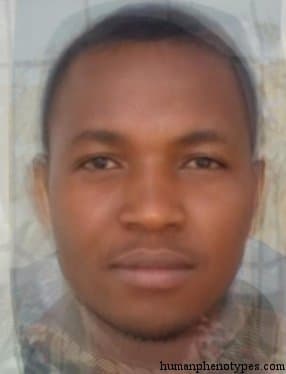
Composite source: Human Phenotypes — Sandawe
Geographic Distribution
Geographically, Sandawe anchors to 6.2° S, 35.7° E (East Africa). That is the point where historical anthropologists judged Sandawe most concentrated, not a hard edge; modern migration and intermarriage have long since softened whatever boundaries once existed.
Physical Characteristics
Usually medium brown skin and kinky or peppercorn hair.
- Medium height, brachyskelic, ectomorph to endomorph, occasionally steatopygic
- Often dolichocephalic, sometimes mesocephalic with a rather wide face and mesorrhine nose
- Body hair very scant
- Eyes appear narrow, sometimes pseudo-Mongoloid
- Mild prognathy possible
Historical Background
Distinctive East African type of the Tanzanian savannahs, especially the Dodoma region. A relict of Khoisanid populations that were more widespread prior to the Bantu expansion. Also linked to Maasai. Most common in the Sandawe, who still speak a click language. More mixed in Datooga, Turu, Mbugu, Burunge, Gogo, Bon, and Akie.
Research History & Naming
The passage below traces who first defined Sandawe, which rival names competed with it, and how later authors consolidated or disputed the classification — the raw material of any serious phenotype reference.
Early anthropologists rarely studied or classified the type like e.g. Dempwolff (1916) . Modern studies find them to be a distinct, genetic outlier ( Tishkoff et al., 2009 ; Schlebusch et al., 2012 ). Was often considered a Northeastern Khoisanid ( Eickstedt ,1934 ; Cole ,1965 ). Detailed physcial descriptions were given by Trevor (1947) .
Comparison With Nearby Phenotypes
The five phenotypes whose documented centers lie closest to Sandawe, ranked by great-circle distance. They are the types players most often confuse with Sandawe in the quiz, precisely because their distributions overlap.
| Phenotype | Region | Distance | Distinguishing trait |
|---|---|---|---|
| Hadza | East Africa | 296 km | Dark brown to black skin with kinky hair. |
| South Nilotid | East Africa | 633 km | Black skin and kinky hair. |
| North Bantuid | Sub-Saharan Africa | 745 km | Dark brown skin, usually kinky, sometimes peppercorn hair. |
| South Ethiopid | East Africa | 789 km | Dark brown, sometimes medium brown skin, tight-curly or kinky hair. |
| Katangid | Sub-Saharan Africa | 1,021 km | Medium to dark brown skin, curly to kinky hair. |
Sandawe in the Game
Sandawe is one of the faces that can appear in Classic Daily and Challenge Mode. When it does, the winning pin lands near 6.2° S, 35.7° E in East Africa — and because the scoring decays with distance, recognizing the region matters more than pixel-perfect placement.
Sandawe Phenotype FAQ
- Where does the Sandawe phenotype come from?
- Historical sources center the Sandawe phenotype on 6.2° S, 35.7° E (East Africa). Treat that as a rough anchor: the type appeared across a wider surrounding area — its nearest documented neighbors, Hadza and South Nilotid, sit 296 and 633 km from the reference point — and its present-day distribution no longer matches the historical map.
- What does the Sandawe phenotype look like?
- The composite emphasizes recurring traits: usually medium brown skin and kinky or peppercorn hair. The full trait list for Sandawe appears in the physical characteristics section above.
- Is the Sandawe phenotype a race or a nationality?
- No. Phenotypes like Sandawe are descriptive averages, not ancestry groups. Sandawe is one of several types documented in and around East Africa — see the comparison table above — and the same individual can carry traits associated with several of them at once. The Sandawe entry describes a statistical pattern, not a group of people and not a nationality.
- How does Sandawe appear in the game?
- When the Sandawe face comes up in Classic Daily or Challenge Mode, you pin the world map where you believe the type is historically most common, and the score decays with your distance to 6.2° S, 35.7° E. Fair warning: the nearest other entry in our dataset, Hadza, sits just 296 km away, so this face rewards precise placement — the right country alone is not always enough.
References & Literature
The Sandawe phenotype entry above is compiled from the 6 academic references. Readers are encouraged to consult the original Sandawe sources for verification and deeper context.
- D16
- Tishkoff et al. 2009. The genetic structure and history of Africans and African Americans. Science. 324,1035-1044.
- S12
- Eickstedt, E. von. 1934. Rassenkunde und Rassengeschichte der Menschheit. Ferdinand Enke. Stuttgart.
- Cole, S. 1965. Races of Man. Butler & Tanner Ltd. Frome and London.
- Trevor, J.C. 1947. The physical characters of the Sandawe, JRAI LXXVII.
Related Phenotypes
More entries from the same region of the historical map as Sandawe, each with its own composite and trait profile.
Hadza
East Africa · 296 km away
Ancient type of the Tanzanian Bushmen, living close to Lake Eyasi. Very distinct from any other type in the world and has probably long been...
South Nilotid
East Africa · 633 km away
Type common to the southern branch of Nilotic people of Lake Albert south to Lake Victoria, in South Sudan, Uganda, and Western Kenya. In so...
North Bantuid
Sub-Saharan Africa · 745 km away
Widespread Bantuid variety of East Africa with relatively narrow noses, possibly due to Ethiopid influence. Found from South Somalia to Keny...
South Ethiopid
East Africa · 789 km away
The southernmost Ethiopid, common between Lake Victoria and Lake Tanganyika, especially in Rwanda, Burundi, but also Uganda, Tanzania, and E...
Katangid
Sub-Saharan Africa · 1,021 km away
Very ancient Australiform African type. Probably more widespread during the Paleolithic, only survives as a rare minority element. May still...
Further Reading
Background articles from the blog that explain where the Sandawe type fits, how these composites are built, and what a face can and cannot tell you.
Guess My Ethnicity: What One Guess Can Carry
When someone types guess my ethnicity, they are asking a stranger to place a bet, and the odds depend far more on the list of labels...
What Country Do I Look Like: The Count Comes Before the Face
Which country a face resembles depends on which official list you are using, and the world publishes several that disagree on how many...