Katangid Phenotype - Face Features & Origin
Very ancient Australiform African type. The entry below collects the Katangid composite face, its documented distribution around 10.6° S, 27.6° E in Sub-Saharan Africa, its physical characteristics, the research history behind the name, and the academic references that support all of it.
Average Face
The Katangid composite below is not a photograph of a real person. Historical anthropologists aligned multiple individual portraits from the Katangid reference population and averaged them into one image, so recurring structures — skull outline, nose form, lip thickness, brow position — dominate while individual idiosyncrasies cancel out.
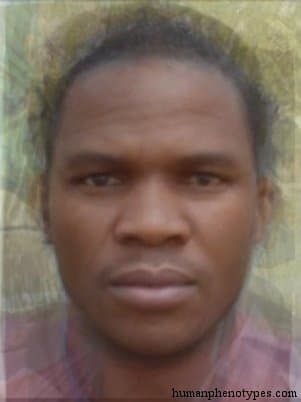
Composite source: Human Phenotypes — Katangid
Geographic Distribution
Katangid is documented across Sub-Saharan Africa, with its historical reference center near 10.6° S, 27.6° E. The coordinates mark where the type was most characteristic roughly 1500 years ago; population movements since then have scattered and blended the distribution far beyond that point.
Physical Characteristics
Medium to dark brown skin, curly to kinky hair.
- Rather tall and mesomorph
- Dolicho- mesocephalic with wide and very robust (facial) features
- Deep-set eyes, heavy brow ridges, heavy jaw
- Strongly platyrrhine
- Face very wide, forehead is sloping
- Chin is receding, hairiness is relatively strong
Historical Background
Very ancient Australiform African type. Probably more widespread during the Paleolithic, only survives as a rare minority element. May still be found in a few individuals in Zambia, Mozambique, DR Congo, Zimbabwe, South Africa, and Botswana. Korana have been reported to have this kind of admixture as well as Zulus, Xhosa, and others.
Research History & Naming
Typological names were coined, contested, and renamed repeatedly across the 20th century, and Katangid is no exception. The extract below records the researchers who defined Katangid, the alternative labels it accumulated, and where the modern consensus settled.
The type was named by Lebzelter (1928) after the Katanga hills at the Congo/Zambia border, where similar prehistoric skeletal remains were found. Eickstedt (1934) called it Rhodesoid, Broom (1929) and Dennan (1929) Australoid. However like Eickstedt, Biasutti (1967) emphasised that "Australiform" is more correct.
Comparison With Nearby Phenotypes
The five phenotypes whose documented centers lie closest to Katangid, ranked by great-circle distance. They are the types players most often confuse with Katangid in the quiz, precisely because their distributions overlap.
| Phenotype | Region | Distance | Distinguishing trait |
|---|---|---|---|
| Central Bantuid | Sub-Saharan Africa | 898 km | Dark brown, sometimes black skin, usually kinky, sometimes peppercorn hair. |
| South Ethiopid | East Africa | 996 km | Dark brown, sometimes medium brown skin, tight-curly or kinky hair. |
| Sandawe | East Africa | 1,021 km | Usually medium brown skin and kinky or peppercorn hair. |
| Hadza | East Africa | 1,140 km | Dark brown to black skin with kinky hair. |
| South Nilotid | East Africa | 1,193 km | Black skin and kinky hair. |
Katangid in the Game
Katangid is one of the faces that can appear in Classic Daily and Challenge Mode. When it does, the winning pin lands near 10.6° S, 27.6° E in Sub-Saharan Africa — and because the scoring decays with distance, recognizing the region matters more than pixel-perfect placement.
Katangid Phenotype FAQ
- Where does the Katangid phenotype come from?
- Historical sources center the Katangid phenotype on 10.6° S, 27.6° E (Sub-Saharan Africa). Treat that as a rough anchor: the type appeared across a wider surrounding area — its nearest documented neighbors, Central Bantuid and South Ethiopid, sit 898 and 996 km from the reference point — and its present-day distribution no longer matches the historical map.
- What does the Katangid phenotype look like?
- The composite emphasizes recurring traits: medium to dark brown skin, curly to kinky hair. The full trait list for Katangid appears in the physical characteristics section above.
- Is the Katangid phenotype a race or a nationality?
- No — and the Katangid naming history above shows why. Katangid was defined, renamed, and regrouped repeatedly by different researchers, which is the opposite of how a fixed racial category would behave. A phenotype is a recurring bundle of visible traits recorded across a population; the Katangid label says nothing about where any individual's ancestors were born.
- How does Katangid appear in the game?
- When the Katangid face comes up in Classic Daily or Challenge Mode, you pin the world map where you believe the type is historically most common, and the score decays with your distance to 10.6° S, 27.6° E. The nearest documented type, Central Bantuid, lies about 898 km away, so regional placement usually carries most of the score.
References & Literature
Every claim on this page traces back to the sources below — the researchers who defined, measured, and argued over the Katangid type. The originals behind the Katangid entry are worth consulting directly.
- Lebzelter, V. 1928. Bericht über meine Studien- und Forschungsreise nach Südafrika. Anthr. Anz. V. 360-362.
- Eickstedt, E. von. 1934. Rassenkunde und Rassengeschichte der Menschheit. Ferdinand Enke. Stuttgart.
- Broom, R. 1929. Australoid element in Koranas. Nature 124. 507.
- Drennan, M.R. 1929. An Australoid skull from the Cape Flats. Jorn. Anthr. Inst. 59. 417-427.
- Biasutti, R. 1967 (1941). Le Razze e i Popoli della terra. 4th Ed. Vol 1-4. U.T.E.T., Torino.
Related Phenotypes
If Katangid interested you, these neighboring phenotype entries cover adjacent parts of the map with distinctly different trait bundles.
Central Bantuid
Sub-Saharan Africa · 898 km away
Bantuid variety, characterised by elongated features and strong dolichocephaly. Found especially in Mozambique and Zimbabwe, also Malawi, Na...
South Ethiopid
East Africa · 996 km away
The southernmost Ethiopid, common between Lake Victoria and Lake Tanganyika, especially in Rwanda, Burundi, but also Uganda, Tanzania, and E...
Sandawe
East Africa · 1,021 km away
Distinctive East African type of the Tanzanian savannahs, especially the Dodoma region. A relict of Khoisanid populations that were more wid...
Hadza
East Africa · 1,140 km away
Ancient type of the Tanzanian Bushmen, living close to Lake Eyasi. Very distinct from any other type in the world and has probably long been...
South Nilotid
East Africa · 1,193 km away
Type common to the southern branch of Nilotic people of Lake Albert south to Lake Victoria, in South Sudan, Uganda, and Western Kenya. In so...
Further Reading
Background articles from the blog that explain where the Katangid type fits, how these composites are built, and what a face can and cannot tell you.
AI Ethnicity Test: What a Measurement Would Require
A laboratory test has a reference standard, a defined construct and a published error bar. A face-based ethnicity tool owns none of...
Geography Games Like GeoGuessr: Six Kinds of Clue
Street panoramas, country outlines and average faces all answer one question. Here are six geography games sorted by the clue they hand...