North Australid Phenotype - Face Features & Origin
Australid type of Northern and Central Australia typical for the Gulf of Carpentaria. The entry below collects the North Australid composite face, its documented distribution around 14.4° S, 141.5° E in Australia, its physical characteristics, the research history behind the name, and the academic references that support all of it.
Average Face
The North Australid composite below is not a photograph of a real person. Historical anthropologists aligned multiple individual portraits from the North Australid reference population and averaged them into one image, so recurring structures — skull outline, nose form, lip thickness, brow position — dominate while individual idiosyncrasies cancel out.
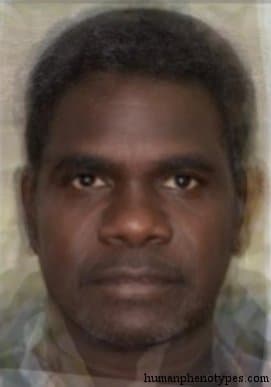
Composite source: Human Phenotypes — North Australid
Geographic Distribution
North Australid is documented across Australia, with its historical reference center near 14.4° S, 141.5° E. The coordinates mark where the type was most characteristic roughly 1500 years ago; population movements since then have scattered and blended the distribution far beyond that point.
Physical Characteristics
Dark brown, sometimes black skin with wavy or curly hair.
- (Rather) tall, hyperbrachyskelic, ectomorph
- (Hyper-) dolichocephalic, mildly hypsicranic (in contrast to other Australids)
- Nose (hyper-)platyrrhine, high with a depressed root
- Supraorbital arches relatively strong, deep-set eyes, facial features robust
- Forehead and chin receding, prognathy pronounced, lips full, body hair medium to sparse
Historical Background
Australid type of Northern and Central Australia typical for the Gulf of Carpentaria. Shows some similarities to Paleo Melanesids. By some associated with prehistoric immigrants from India (Veddoids). In its purest form in the Gulf of Carpentaria and Arnhem Land, but dominant all over Northern Australia. Occasionally in Melanesia (especially New Caledonia) and Southern New Guinea.
Research History & Naming
Every label in the historical catalogue has an author and a date, and North Australid has accumulated its share of competing attributions. For North Australid, the literature extract below shows the naming chain — from the first definition through the later revisions that shaped the current entry.
The type was identified as Carpentarian by Birdsell (1942) . This was adopted by other authors ( Hooton, 1946 ; Coon et al, 1950 ; Cole, 1965 ). Lundman ( 1967 , 1988 ) named it North Australid / Carpentarid. Biasutti (1967) regarded it the proper Australid. Recent research supports migrations from India ( Pugacha et al., 2013 ).
Comparison With Nearby Phenotypes
Geography, not alphabet, ordered this table: the five phenotype centers closest to North Australid's, with the traits most likely to be mistaken for it (Barrinean leads at 546 km). In gameplay, these five account for most of the wrong-but-nearby pins against North Australid.
| Phenotype | Region | Distance | Distinguishing trait |
|---|---|---|---|
| Barrinean | Australia | 546 km | Dark brown skin with curly or tight-curly brown-black hair. |
| Brachio Melanesid | Melanesia | 788 km | Dark reddish-brown skin. |
| Neo Melanesid | Melanesia | 907 km | Dark brown, sometimes medium brown skin. |
| Tapirid | Melanesia | 984 km | Dark to medium brown, yellowish-reddish skin. |
| Mountain Melanesid | Melanesia | 1,011 km | Usually dark, sometimes light brown skin. |
North Australid in the Game
In gameplay terms, North Australid rewards region-level recall: the score is computed from the distance between your pin and 14.4° S, 141.5° E. Players often confuse North Australid with Barrinean (546 km out) in the comparison table above — those confusions are exactly what the distance penalty is designed to expose.
North Australid Phenotype FAQ
- Where does the North Australid phenotype come from?
- Historical sources center the North Australid phenotype on 14.4° S, 141.5° E (Australia). Treat that as a rough anchor: the type appeared across a wider surrounding area — its nearest documented neighbors, Barrinean and Brachio Melanesid, sit 546 and 788 km from the reference point — and its present-day distribution no longer matches the historical map.
- What does the North Australid phenotype look like?
- The composite emphasizes recurring traits: dark brown, sometimes black skin with wavy or curly hair. The full trait list for North Australid appears in the physical characteristics section above.
- Is the North Australid phenotype a race or a nationality?
- No — and the North Australid naming history above shows why. North Australid was defined, renamed, and regrouped repeatedly by different researchers, which is the opposite of how a fixed racial category would behave. A phenotype is a recurring bundle of visible traits recorded across a population; the North Australid label says nothing about where any individual's ancestors were born.
- How does North Australid appear in the game?
- When the North Australid face comes up in Classic Daily or Challenge Mode, you pin the world map where you believe the type is historically most common, and the score decays with your distance to 14.4° S, 141.5° E. The nearest documented type, Barrinean, lies about 546 km away, so regional placement usually carries most of the score.
References & Literature
Primary sources for the North Australid entry, listed as cited in the historical literature. The naming and classification debates around North Australid referenced above run through these works.
- Birdsell, J. B. 1942. The Trihybrid Origin of the Australian Aborigine. Harvard University.
- Hooton, E.A. 1946. Up from the Ape. Rev. ed. Macmillan Company . New York.
- Coon, C. S., Garn, S. M. and Birdsell, J. B. 1950. Races: a Study of Race formation in Man. Charles C. Thomas. Springfield.
- Cole, S. 1965. Races of Man. Butler & Tanner Ltd. Frome and London.
- Lundman, B. 1967. Geographische Anthropologie. Rassen und Völker der Erde. G. Fischer, Stuttgart
- Lundman, B. 1988. Jordens folkstammar. Huddinge.
- Biasutti, R. 1967 (1941). Le Razze e i Popoli della terra. 4th Ed. Vol 1-4. U.T.E.T., Torino.
- P13
Related Phenotypes
Other human phenotypes whose documented centers lie in the same part of the map as North Australid.
Barrinean
Australia · 546 km away
Australid subtype of the forest belt associated with the Australian pygmies. Could be the remnant of an ancient Negrito strain that once occ...
Brachio Melanesid
Melanesia · 788 km away
Atypical brachycephalic Melanesid variety native to Melanesia and New Guinea. In its most pronounced form in the Kerewo of Goaribari Island ...
Neo Melanesid
Melanesia · 907 km away
Melanesid subtype of New Guinea. Found especially in lowlands and river plains, with its highest concentration in the south of the island. M...
Tapirid
Melanesia · 984 km away
Pygmy Melanesian type. In difference to many other Pygmies, it shares a common history with its taller neighbours and probably represents a ...
Mountain Melanesid
Melanesia · 1,011 km away
Melanesian mountain variety, relatively ancient with similarities to Paleo Melanesid. Found mainly among New Guinean highlanders like Dani, ...
Further Reading
Background articles from the blog that explain where the North Australid type fits, how these composites are built, and what a face can and cannot tell you.
What Ethnicity Am I? Three Ways to Actually Answer It
The question is personal, but the answers arrive from three different places: records, DNA, and appearance. Each can tell you something...
AI Ethnicity Guesser: What the Tools Really Return
An AI ethnicity guesser returns a label from a fixed list rather than a measurement of ancestry. Here is what the models are trained on...