Yemenid Phenotype - Face Features & Origin
Orientalid subtype that deviates in an Armenoid direction. Its reference coordinates sit near 16.3° N, 47.9° E in Middle East. Rather than a single portrait, the Yemenid composite below is a statistical average, and the surrounding sections — traits, distribution, research history, references — give that average its context.
Average Face
What you see below is a statistical construction of the Yemenid reference population. Faces recorded from the Yemenid sample were overlaid and merged; the result keeps the features most members shared and discards personal variation. It reads like a Yemenid portrait, but it works like a histogram.
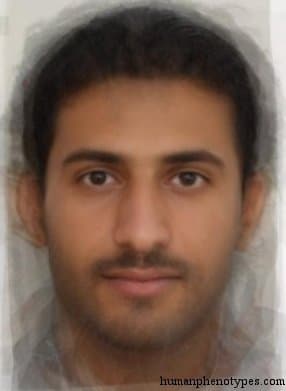
Composite source: Human Phenotypes — Yemenid
Geographic Distribution
Geographically, Yemenid anchors to 16.3° N, 47.9° E (Middle East). That is the point where historical anthropologists judged Yemenid most concentrated, not a hard edge; modern migration and intermarriage have long since softened whatever boundaries once existed.
Physical Characteristics
Medium brown skin, wavy, sometimes curly, black hair.
- Rather short, mesocranic, ectomorph
- Brachycephalic, mildly hypsicranic with a flat occiput and a small head
- Hyperleptorrhine, often convex or hooked nose
- Face narrow with fine features, eyes almond-shaped, lips full
- Prognathy absent
Historical Background
Orientalid subtype that deviates in an Armenoid direction. Most common in South and Central Yemeni. Also in Oman, UAE, Socotra, and parts of Saudi Arabia. Ancient migrations and tradesmen brought it to Northern and Eastern Africa, e.g. it has a long history of admixture in Sudanese Arabs, Rashaida, Kababish, Banguini, Malagasies, and along the Red Sea. Even in India and Iran.
Research History & Naming
The passage below traces who first defined Yemenid, which rival names competed with it, and how later authors consolidated or disputed the classification — the raw material of any serious phenotype reference.
Described and illustrated as Yemenid by Wissmann (1941) , based on unpublished material of H. Pöch. Lundman (1988) called it South Arabid. He emphasised the combination of Arabid and Armenid like Eickstedt (1934) . Coon (1939) called it the fine Yemenic Mediterranean and noted additional Veddoid influence. Haddon (1925) named it Himyaritic type. Detailed descriptions by Huzayyin (1936) .
Comparison With Nearby Phenotypes
The five phenotypes whose documented centers lie closest to Yemenid, ranked by great-circle distance. They are the types players most often confuse with Yemenid in the quiz, precisely because their distributions overlap.
| Phenotype | Region | Distance | Distinguishing trait |
|---|---|---|---|
| Arabid | Middle East | 690 km | Light, sometimes medium brown skin. |
| Arabian Veddoid | Middle East | 709 km | Dark brown skin, curly (ringlet) black hair, rather short, macroskelic, endomorph to ectomorph. |
| Danakil | East Africa | 823 km | Very dark reddish-brown skin, tight-curly to kinky-curly hair. |
| East Ethiopid | East Africa | 897 km | Dark reddish-brown skin, curly to tight-curly hair. |
| North Ethiopid | East Africa | 1,057 km | Dark, sometimes medium (bronze) brown skin, tight-curly hair. |
Yemenid in the Game
Yemenid is one of the faces that can appear in Classic Daily and Challenge Mode. When it does, the winning pin lands near 16.3° N, 47.9° E in Middle East — and because the scoring decays with distance, recognizing the region matters more than pixel-perfect placement.
Yemenid Phenotype FAQ
- Where does the Yemenid phenotype come from?
- Historical sources center the Yemenid phenotype on 16.3° N, 47.9° E (Middle East). Treat that as a rough anchor: the type appeared across a wider surrounding area — its nearest documented neighbors, Arabid and Arabian Veddoid, sit 690 and 709 km from the reference point — and its present-day distribution no longer matches the historical map.
- What does the Yemenid phenotype look like?
- The composite emphasizes recurring traits: medium brown skin, wavy, sometimes curly, black hair. The full trait list for Yemenid appears in the physical characteristics section above.
- Is the Yemenid phenotype a race or a nationality?
- No — and the Yemenid naming history above shows why. Yemenid was defined, renamed, and regrouped repeatedly by different researchers, which is the opposite of how a fixed racial category would behave. A phenotype is a recurring bundle of visible traits recorded across a population; the Yemenid label says nothing about where any individual's ancestors were born.
- How does Yemenid appear in the game?
- When the Yemenid face comes up in Classic Daily or Challenge Mode, you pin the world map where you believe the type is historically most common, and the score decays with your distance to 16.3° N, 47.9° E. The nearest documented type, Arabid, lies about 690 km away, so regional placement usually carries most of the score.
References & Literature
The Yemenid phenotype entry above is compiled from the 6 academic references. Readers are encouraged to consult the original Yemenid sources for verification and deeper context.
- Wissmann, H von. 1941. Arabien und seine kolonialen Ausstrahlungen. In: Lebensraumfragen europäischer Völker 2. 374-488. Leipzig.
- Lundman, B. 1988. Jordens folkstammar. Huddinge.
- Eickstedt, E. von. 1934. Rassenkunde und Rassengeschichte der Menschheit. Ferdinand Enke. Stuttgart.
- Coon, C.S.. 1939.. The Races of Europe. The Macmillan Company. New York.
- Haddon, A.C.. 1925. The Races of Man and their distribution. Cambridge at the University Press. London.
- Huzayyin, S. A. 1936. Bitat al-Gamia al-Misriya 'ila 'l-Yaman wa-Hadramaut.
Related Phenotypes
If Yemenid interested you, these neighboring phenotype entries cover adjacent parts of the map with distinctly different trait bundles.
Arabid
Middle East · 690 km away
Orientalid proper, the most common type of the Arabian Peninsula, often found with Semitic languages. Originally restricted to Arabia, ancie...
Arabian Veddoid
Middle East · 709 km away
Ancient Vedda-like type of the Arabian Peninsula and South Iran, often heavily mixed. Found in the Mehri of South Oman, around Hadramaut in ...
Danakil
East Africa · 823 km away
Specialised Ethiopid type living in the hottest region of the world: the Danakil depression of Eritrea and Northern Ethiopia, with an annual...
East Ethiopid
East Africa · 897 km away
Ethiopid proper, showing the most pronounced Ethiopid characters of all. Common around the Horn of Africa, in its purest form in the inland ...
North Ethiopid
East Africa · 1,057 km away
Ethiopid subtype that is often regarded as a northern branch of East Ethiopid. Common along the Red Sea coast and the Nile Valley from Egypt...
Further Reading
Background articles from the blog that explain where the Yemenid type fits, how these composites are built, and what a face can and cannot tell you.
Ethnicity Guesser Tools: Three Methods, Three Answers
One search term covers three unrelated tools: genetic ancestry estimation, photo classifiers, and documented phenotype catalogues.
Can You Really Guess Ethnicity From a Face? What the Research Says
Humans beat chance at coarse region-guessing from faces - but fall apart at anything finer. The other-race effect, confusable neighbors...