Arabian Veddoid Phenotype - Face Features & Origin
Ancient Vedda-like type of the Arabian Peninsula and South Iran, often heavily mixed. The entry below collects the Arabian Veddoid composite face, its documented distribution around 18.4° N, 54.2° E in Middle East, its physical characteristics, the research history behind the name, and the academic references that support all of it.
Average Face
The Arabian Veddoid composite below is not a photograph of a real person. Historical anthropologists aligned multiple individual portraits from the Arabian Veddoid reference population and averaged them into one image, so recurring structures — skull outline, nose form, lip thickness, brow position — dominate while individual idiosyncrasies cancel out.
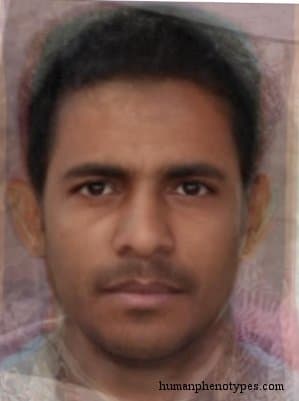
Composite source: Human Phenotypes — Arabian Veddoid
Geographic Distribution
Arabian Veddoid is documented across Middle East, with its historical reference center near 18.4° N, 54.2° E. The coordinates mark where the type was most characteristic roughly 1500 years ago; population movements since then have scattered and blended the distribution far beyond that point.
Physical Characteristics
Dark brown skin, curly (ringlet) black hair, rather short, macroskelic, endomorph to ectomorph.
- Meso- brachycephalic, very small-headed, mildly hypsicranic with a mildly leptorrhine and low nose
- Deep set eyes, beard strong, and prognathism only mild
Historical Background
Ancient Vedda-like type of the Arabian Peninsula and South Iran, often heavily mixed. Found in the Mehri of South Oman, around Hadramaut in Yemen, Iranians of Susa, Makran, and Socotrans. Sometimes in Mesopotamia and even Nubia. This type could be linked to the ancestral Arabian population as well as the Dravidians of India.
Research History & Naming
Typological names were coined, contested, and renamed repeatedly across the 20th century, and Arabian Veddoid is no exception. The extract below records the researchers who defined Arabian Veddoid, the alternative labels it accumulated, and where the modern consensus settled.
Coon (1939) , who named the type, linked it to Veddoids of Sri Lanka. Wissmann (1941) and Grohmann (1963) called it South Arabian race, based on material of H. Pöch. Lundman (1967) reports it in ancient Elamites. Field (1949) recognized it in Iraq, Eickstedt ( 1934 , 1952 ) in South Iran and Hadramaut. Biasutti (1967) mentioned a "Dravidoid" type from Hadramaut.
Comparison With Nearby Phenotypes
The five phenotypes whose documented centers lie closest to Arabian Veddoid, ranked by great-circle distance. They are the types players most often confuse with Arabian Veddoid in the quiz, precisely because their distributions overlap.
| Phenotype | Region | Distance | Distinguishing trait |
|---|---|---|---|
| Arabid | Middle East | 663 km | Light, sometimes medium brown skin. |
| Yemenid | Middle East | 709 km | Medium brown skin, wavy, sometimes curly, black hair. |
| East Ethiopid | East Africa | 1,246 km | Dark reddish-brown skin, curly to tight-curly hair. |
| Danakil | East Africa | 1,532 km | Very dark reddish-brown skin, tight-curly to kinky-curly hair. |
| Proto Iranid | Middle East | 1,585 km | Fair to light brown skin, straight or wavy, light brown to black hair. |
Arabian Veddoid in the Game
Arabian Veddoid is one of the faces that can appear in Classic Daily and Challenge Mode. When it does, the winning pin lands near 18.4° N, 54.2° E in Middle East — and because the scoring decays with distance, recognizing the region matters more than pixel-perfect placement.
Arabian Veddoid Phenotype FAQ
- Where does the Arabian Veddoid phenotype come from?
- The reference coordinates for the Arabian Veddoid phenotype sit near 18.4° N, 54.2° E, in Middle East. That point marks the center of the Middle East distribution documented roughly 1500 years ago — actual prevalence spread well beyond it, toward entries such as Arabid 663 km away, and modern migration has blurred those boundaries further.
- What does the Arabian Veddoid phenotype look like?
- In the historical literature, dark brown skin, curly (ringlet) black hair, rather short, macroskelic, endomorph to ectomorph. For Arabian Veddoid these are statistical tendencies across a population, not a checklist every individual matches.
- Is the Arabian Veddoid phenotype a race or a nationality?
- No. Phenotypes like Arabian Veddoid are descriptive averages, not ancestry groups. Arabian Veddoid is one of several types documented in and around Middle East — see the comparison table above — and the same individual can carry traits associated with several of them at once. The Arabian Veddoid entry describes a statistical pattern, not a group of people and not a nationality.
- How does Arabian Veddoid appear in the game?
- In Classic Daily and Challenge Mode, the Arabian Veddoid composite face appears without a label. Your task is to drop a pin on the world map where you think that face is historically most common — the scoring uses the distance between your pin and the reference coordinates near 18.4° N, 54.2° E. The post-round review then shows the correct location, your distance error, and this Arabian Veddoid entry.
References & Literature
Every claim on this page traces back to the sources below — the researchers who defined, measured, and argued over the Arabian Veddoid type. The originals behind the Arabian Veddoid entry are worth consulting directly.
- Coon, C.S.. 1939.. The Races of Europe. The Macmillan Company. New York.
- Wissmann, H von. 1941. Arabien und seine kolonialen Ausstrahlungen. In: Lebensraumfragen europäischer Völker 2. 374-488. Leipzig.
- Grohmann, A. 1963. Handbuch der Altertumswissenschaft 3. Kulturgeschichte des Alten Orients, Arabien. C.H.Beck. München.
- l67
- Field, H. 1949. The anthropology of Iraq. The Lower Euphrates-Tigris Region, 30(1).
- Eickstedt, E. von. 1934. Rassenkunde und Rassengeschichte der Menschheit. Ferdinand Enke. Stuttgart.
- Eickstedt, E. von. 1952. Biodynamik der Europiden. In: Historia Mundi. Band 1, Munich, 115-134.
- Biasutti, R. 1967 (1941). Le Razze e i Popoli della terra. 4th Ed. Vol 1-4. U.T.E.T., Torino.
Related Phenotypes
Other human phenotypes whose documented centers lie in the same part of the map as Arabian Veddoid.
Arabid
Middle East · 663 km away
Orientalid proper, the most common type of the Arabian Peninsula, often found with Semitic languages. Originally restricted to Arabia, ancie...
Yemenid
Middle East · 709 km away
Orientalid subtype that deviates in an Armenoid direction. Most common in South and Central Yemeni. Also in Oman, UAE, Socotra, and parts of...
East Ethiopid
East Africa · 1,246 km away
Ethiopid proper, showing the most pronounced Ethiopid characters of all. Common around the Horn of Africa, in its purest form in the inland ...
Danakil
East Africa · 1,532 km away
Specialised Ethiopid type living in the hottest region of the world: the Danakil depression of Eritrea and Northern Ethiopia, with an annual...
Proto Iranid
Middle East · 1,585 km away
Coarse type of Iran and Asia Minor, that can be considered an eastern Eurafricanid variety. More ancient than the more gracile Iranids and P...
Further Reading
Background articles from the blog that explain where the Arabian Veddoid type fits, how these composites are built, and what a face can and cannot tell you.
Can You Really Guess Ethnicity From a Face? What the Research Says
Humans beat chance at coarse region-guessing from faces - but fall apart at anything finer. The other-race effect, confusable neighbors...
Ethnicity Guesser Tools: Three Methods, Three Answers
One search term covers three unrelated tools: genetic ancestry estimation, photo classifiers, and documented phenotype catalogues.