Proto Iranid Phenotype - Face Features & Origin
Historical anthropology places the Proto Iranid phenotype in Middle East, with a documented center near 32.6° N, 54.6° E. Coarse type of Iran and Asia Minor, that can be considered an eastern Eurafricanid variety. The sections that follow unpack the Proto Iranid entry in practice: the composite face, the traits it summarizes, the naming history, and the sources.
Average Face
Averaging the portraits behind Proto Iranid leaves the features that repeat and erases the ones that do not. That is exactly how the Proto Iranid composite below was built: individual photographs were aligned and statistically merged, exaggerating shared structure into a single reference face that no actual person looks like.
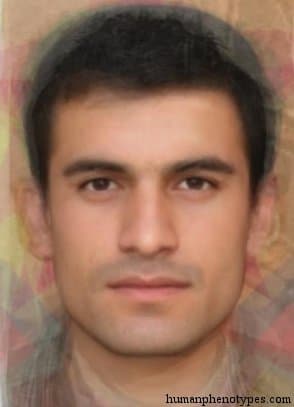
Composite source: Human Phenotypes — Proto Iranid
Geographic Distribution
The reference center for Proto Iranid sits near 32.6° N, 54.6° E in Middle East. Around that anchor, prevalence falls off gradually — the type is not confined to one valley or one modern border, and the historical map should be read as a gradient rather than a boundary.
Physical Characteristics
Fair to light brown skin, straight or wavy, light brown to black hair.
- Rather tall, mesoskelic, ectomorph to mesomorph
- Dolicho- mesocephalic with a straight, mildly leptorrhine nose
- The face is wider than in Pontids and Iranids, the nose broader, and the chin more squared
- Some individuals show strong Cromagniform features
Historical Background
Coarse type of Iran and Asia Minor, that can be considered an eastern Eurafricanid variety. More ancient than the more gracile Iranids and Pontids of the region with several Cromagniform features. Transitional to Berberid in the West (e.g. Southern Turkey). An important element from Eastern Turkey to Northern Iran. Found especially in Kurds and North Persians, sometimes in Lebanese, Caucasus, and Balkans.
Research History & Naming
The passage below traces who first defined Proto Iranid, which rival names competed with it, and how later authors consolidated or disputed the classification — the raw material of any serious phenotype reference.
Eickstedt (1961) coined the term Proto Iranid based on a work of Keith (1928) . Others mentioned Atlanto Mediterranid or Eurafrikanid from the region ( Sergi, 1901 ), where the type can be included. Field (1939) described it as a robust East Mediterranid. Preserves elements of the Protomediterranid described by Vallois (1940) .
Comparison With Nearby Phenotypes
Ranked by great-circle distance from Proto Iranid's reference center, these are the five nearest documented phenotypes — the closest being Iranid at 231 km. Overlapping distributions like these are exactly what makes the quiz hard, and the Iranid row is where to start looking.
| Phenotype | Region | Distance | Distinguishing trait |
|---|---|---|---|
| Iranid | Middle East | 231 km | Light brown skin, straight or wavy, brown or black hair. |
| Transcaspian | Central Asia | 865 km | Light brown skin, straight dark hair. |
| Assyroid | Middle East | 954 km | Light brown, sometimes fair skin, straight or wavy, usually dark brown, sometimes blonde curly-wavy hair. |
| East Alpinid | Middle East | 1,185 km | Light brown skin, straight or wavy, light brown to black hair. |
| Indo Iranid | South Asia | 1,212 km | Light to medium brown skin, straight or wavy, brown-black, plentiful hair. |
Proto Iranid in the Game
When the Proto Iranid composite shows up in the quiz, players who know the Middle East distribution pattern have the edge. The reference answer sits near 32.6° N, 54.6° E; pins on the wrong continent score close to zero, so even a rough regional instinct beats a precise but misdirected pin.
Proto Iranid Phenotype FAQ
- Where does the Proto Iranid phenotype come from?
- The reference coordinates for the Proto Iranid phenotype sit near 32.6° N, 54.6° E, in Middle East. That point marks the center of the Middle East distribution documented roughly 1500 years ago — actual prevalence spread well beyond it, toward entries such as Iranid 231 km away, and modern migration has blurred those boundaries further.
- What does the Proto Iranid phenotype look like?
- In the historical literature, fair to light brown skin, straight or wavy, light brown to black hair. For Proto Iranid these are statistical tendencies across a population, not a checklist every individual matches.
- Is the Proto Iranid phenotype a race or a nationality?
- No. Phenotypes like Proto Iranid are descriptive averages, not ancestry groups. Proto Iranid is one of several types documented in and around Middle East — see the comparison table above — and the same individual can carry traits associated with several of them at once. The Proto Iranid entry describes a statistical pattern, not a group of people and not a nationality.
- How does Proto Iranid appear in the game?
- In Classic Daily and Challenge Mode, the Proto Iranid composite face appears without a label. Your task is to drop a pin on the world map where you think that face is historically most common — the scoring uses the distance between your pin and the reference coordinates near 32.6° N, 54.6° E. The post-round review then shows the correct location, your distance error, and this Proto Iranid entry.
References & Literature
The Proto Iranid phenotype entry above is compiled from the 5 academic references. Readers are encouraged to consult the original Proto Iranid sources for verification and deeper context.
- Eickstedt, E. von. 1961. Türken, Kurden und Iraner seit dem Altertum: Probleme einer anthropologischen Reise. Gustav Fischer Verlag, Stuttgart.
- Keith, A. 1928. Report on the human remains. 214-240. In: Hale ad Wooley, Ur Excavation I. Al Ubaid. Oxford.
- Sergi, G.. 1901. The Mediterranean Race: a study of the origin of the European peoples. London.
- Field, H. 1939. Contributions to the anthropology of Iran. Field Museum of National History, 29(1).
- Vallois, H. V. 1940. Les ossements humains de Sialk; contribution à l'étude de l'histoire raciale de l'Iran ancien, in R. Ghirshman: Fouilles de Sialk, Parigi.
Related Phenotypes
Other human phenotypes whose documented centers lie in the same part of the map as Proto Iranid.
Iranid
Middle East · 231 km away
Distinctive type of the Iranian Plateau. One of the main elements in Persians, especially in Southwestern Iran. An important element in Kurd...
Transcaspian
Central Asia · 865 km away
West-Central Asian Orientalid with Aralid admixture, particularly common in Turkmens. Significantly differs from other Central Asians by lon...
Assyroid
Middle East · 954 km away
Semitic type that unites Armenoid with Arabid features. Historically important in the ancient Hittite Kingdom and the Assyrian civilisation....
East Alpinid
Middle East · 1,185 km away
West Asian type that is anthropometrically and morphologically very similar to European Alpinids. Most common in the mountain zones of Anato...
Indo Iranid
South Asia · 1,212 km away
Relatively recent contact type with a position intermediate between Indo Brachid and Iranid. Widespread in Pakistan, Iran, and Afghanistan, ...
Further Reading
Background articles from the blog that explain where the Proto Iranid type fits, how these composites are built, and what a face can and cannot tell you.
Ethnicity Guesser Tools: Three Methods, Three Answers
One search term covers three unrelated tools: genetic ancestry estimation, photo classifiers, and documented phenotype catalogues.
Can You Really Guess Ethnicity From a Face? What the Research Says
Humans beat chance at coarse region-guessing from faces - but fall apart at anything finer. The other-race effect, confusable neighbors...