Indo Brachid Phenotype - Face Features & Origin
Indo Brachid proper, relatively recent Indid-Turano-Armenid contact type, probably the result of old Pashto, Saka, and Scythian migrations. The entry below collects the Indo Brachid composite face, its documented distribution around 25.5° N, 69.0° E in South Asia, its physical characteristics, the research history behind the name, and the academic references that support all of it.
Average Face
The Indo Brachid composite below is not a photograph of a real person. Historical anthropologists aligned multiple individual portraits from the Indo Brachid reference population and averaged them into one image, so recurring structures — skull outline, nose form, lip thickness, brow position — dominate while individual idiosyncrasies cancel out.
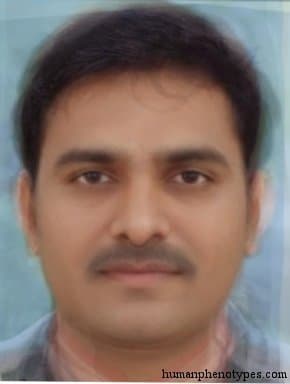
Composite source: Human Phenotypes — Indo Brachid
Geographic Distribution
Indo Brachid is documented across South Asia, with its historical reference center near 25.5° N, 69.0° E. The coordinates mark where the type was most characteristic roughly 1500 years ago; population movements since then have scattered and blended the distribution far beyond that point.
Physical Characteristics
Light to medium brown skin, straight or wavy hair.
- Medium height, mesoskelic, endomorph to ectomorph
- Mildly brachycephalic, mildly hypsicranic with a flat occiput
- Often convex, mildly leptorrhine nose
- Face short
- Overall similar to Indo Iranid, but less hairy, larger-headed, flatter-faced, higher-nosed, and shorter-statured, body hair scanter
- Sometimes mildly slanting eyes and strong cheek bones
Historical Background
Indo Brachid proper, relatively recent Indid-Turano-Armenid contact type, probably the result of old Pashto, Saka, and Scythian migrations. Common from Southwestern India to Afghanistan, especially Gujarati, Maharashtra, and Eastern Pakistan. Typical in Nagar Brahmin, Kayastha, Kannada, Jat and Mir-Jat, South Baluchistan, sometimes Baloch, sporadically Indochina and Sumatra. Romani brought it to Europe.
Research History & Naming
Typological names were coined, contested, and renamed repeatedly across the 20th century, and Indo Brachid is no exception. The extract below records the researchers who defined Indo Brachid, the alternative labels it accumulated, and where the modern consensus settled.
First named Homo indicus brachimorphus by Giuffrida-Ruggeri (1912) . Risley (1917) called it Scytho-Dravidian, Eickstedt ( 1931 , 1934 ) West (Indo-)Brachid, noting Turanid influence, Bernhard (1993) and Knussmann (1996) call it Indo Brachid. Lundman (1967) , Giuffrida-Ruggeri (1921) and Biasutti (1967) linked it to Armenoid, so did Vallois (1971) as Alpo-Dinaric (his Anatolian / Armenoid).
Comparison With Nearby Phenotypes
Ranked by great-circle distance from Indo Brachid's reference center, these are the five nearest documented phenotypes — the closest being Indo Iranid at 407 km. Overlapping distributions like these are exactly what makes the quiz hard, and the Indo Iranid row is where to start looking.
| Phenotype | Region | Distance | Distinguishing trait |
|---|---|---|---|
| Indo Iranid | South Asia | 407 km | Light to medium brown skin, straight or wavy, brown-black, plentiful hair. |
| North Indid | South Asia | 877 km | Light to medium brown skin, straight or wavy, brown or black hair. |
| South Gondid | South Asia | 882 km | Medium to dark brown skin, wavy, sometimes curly hair, short, brachyskelic, ectomorph. |
| Mountain Indid | South Asia | 1,071 km | Light brown skin, straight or wavy hair. |
| Gracile Indid | South Asia | 1,136 km | Light to medium brown skin, straight to wavy hair. |
Indo Brachid in the Game
When the Indo Brachid composite shows up in the quiz, players who know the South Asia distribution pattern have the edge. The reference answer sits near 25.5° N, 69.0° E; pins on the wrong continent score close to zero, so even a rough regional instinct beats a precise but misdirected pin.
Indo Brachid Phenotype FAQ
- Where does the Indo Brachid phenotype come from?
- The reference coordinates for the Indo Brachid phenotype sit near 25.5° N, 69.0° E, in South Asia. That point marks the center of the South Asia distribution documented roughly 1500 years ago — actual prevalence spread well beyond it, toward entries such as Indo Iranid 407 km away, and modern migration has blurred those boundaries further.
- What does the Indo Brachid phenotype look like?
- In the historical literature, light to medium brown skin, straight or wavy hair. For Indo Brachid these are statistical tendencies across a population, not a checklist every individual matches.
- Is the Indo Brachid phenotype a race or a nationality?
- No. Phenotypes like Indo Brachid are descriptive averages, not ancestry groups. Indo Brachid is one of several types documented in and around South Asia — see the comparison table above — and the same individual can carry traits associated with several of them at once. The Indo Brachid entry describes a statistical pattern, not a group of people and not a nationality.
- How does Indo Brachid appear in the game?
- In Classic Daily and Challenge Mode, the Indo Brachid composite face appears without a label. Your task is to drop a pin on the world map where you think that face is historically most common — the scoring uses the distance between your pin and the reference coordinates near 25.5° N, 69.0° E. The post-round review then shows the correct location, your distance error, and this Indo Brachid entry.
References & Literature
Every claim on this page traces back to the sources below — the researchers who defined, measured, and argued over the Indo Brachid type. The originals behind the Indo Brachid entry are worth consulting directly.
- Giuffrida-Ruggeri, V. 1912. Schema di Classificazione degli hominidae attuali. Arch. per l'A. e l'Etn. XLII.
- R17
- E341
- Eickstedt, E. von. 1934. Rassenkunde und Rassengeschichte der Menschheit. Ferdinand Enke. Stuttgart.
- Bernhard, W. 1993. Anthropologie von Südwestasien. In.: Schwidetzky, I.: Rassengeschichte der Menschheit 14, Asien 4. Oldenbourg.
- Knussmann, R. 1996. Vergleichende Biologie des Menschen: Lehrbuch der Anthropologie und Humangenetik. 2ed. Spektrum Akademischer Verlag.
- Lundman, B. 1967. Geographische Anthropologie. Rassen und Völker der Erde. G. Fischer, Stuttgart
- Giuffrida-Ruggeri, V. 1921. The first outlines of a Systematic Anthropology of Asia. Calcutta University Press.
- Biasutti, R. 1967 (1941). Le Razze e i Popoli della terra. 4th Ed. Vol 1-4. U.T.E.T., Torino.
- Vallois, H. V. 1971. Las races humaines. 8 Ed. Grammont.
Related Phenotypes
More entries from the same region of the historical map as Indo Brachid, each with its own composite and trait profile.
Indo Iranid
South Asia · 407 km away
Relatively recent contact type with a position intermediate between Indo Brachid and Iranid. Widespread in Pakistan, Iran, and Afghanistan, ...
North Indid
South Asia · 877 km away
Indid subtype of Pakistan and Northwestern India, often associated with ancient Indo-Aryan migrations from the North. Common in Punjab, wher...
South Gondid
South Asia · 882 km away
Gracile Gondid variety of Central India that shares many similarities with Gondids proper, except for a variety of features that puts them m...
Mountain Indid
South Asia · 1,071 km away
(Gracile) Indid variety native to the valleys south of the Western Himalaya and in the Hindu Kush. Once the principal element of the Khas an...
Gracile Indid
South Asia · 1,136 km away
The most widespread and frequent Indid subtype, one of the most populous phenotypes in the world. Common along the Ganges river and Deccan, ...
Further Reading
Background articles from the blog that explain where the Indo Brachid type fits, how these composites are built, and what a face can and cannot tell you.
Guess My Ethnicity: What One Guess Can Carry
When someone types guess my ethnicity, they are asking a stranger to place a bet, and the odds depend far more on the list of labels...
Geography Games Like GeoGuessr: Six Kinds of Clue
Street panoramas, country outlines and average faces all answer one question. Here are six geography games sorted by the clue they hand...