Guess My Nationality: The Clues Were Added After Birth
A nationality guess leans on spectacles, haircuts, dental work and collars: markers added after birth that date a photo better than they describe a person.
The question hides a second question
Guess my nationality sounds like a request for one fact, the state whose passport someone holds. A photograph cannot carry that fact. What it carries is a set of visible regularities, and the ones that decide most rounds were not there at birth. A frame of spectacles, a haircut, a collar, a set of straightened teeth, a particular way of holding the mouth for the camera: none of these is inherited, and all of them are legible in a passport-sized image. Players credit anatomy for a score that institutions largely produced.
That split is worth naming because the two layers age at different speeds. This site's catalogue documents appearance patterns with historical distributions, a baseline around 1500 years ago, and it stores what observers could see and measure: skin, hair form, nose shape, cranial proportions. A modern photograph also carries a second layer, added by schools, opticians, barbers and dentists. The catalogue has no field for that layer. It is nevertheless the layer a guessing game often reads, which is why a quiz can feel accurate while saying very little about ancestry.
Spectacles are a school statistic
The clearest case is eyewear. A 2012 study of 23,616 nineteen-year-old male conscripts living in Seoul found myopia in 96.54 percent of them, with 21.62 percent worse than minus six dioptres (Jung and colleagues, Investigative Ophthalmology and Visual Science). Rural Jeju was measured at 83.3 percent against Seoul's 96.5 in the same line of work, and a Chinese comparison put 78.4 percent of urban children against 36.8 percent of rural ones. In the United States, myopia among people aged 12 to 54 rose from 25.0 percent in 1971-72 to 41.6 percent in 1999-2004, in NHANES data analysed by Vitale and colleagues in 2009.
Those numbers describe classrooms more than they describe faces. Two districts of one country can differ by more than forty percentage points, and the gap follows years of schooling and hours spent indoors rather than ancestry. A player who learns glasses as a regional cue has learned a statistic about school systems, and a recent one. Any photograph taken before mass secondary education will show a different density of eyewear in the same place, which makes the cue a clock as much as a map.
The Alaskan families who changed in one generation
A survey from 1969 makes the point sharply. Researchers examined Inuit families in northern Alaska and found myopia in only 2 of 131 adults who had grown up in isolated settlements with little schooling. Among their children and grandchildren, raised after settlement, formal schooling and a change in near work, more than half were myopic. A population's genes cannot reorganise in thirty years. The prevalence curve did, and it moved by more than forty percentage points.
The global version of the same movement is easy to measure. Pooled myopia among children and adolescents went from 24.32 percent in 1990 to 35.81 percent in 2023, in a meta-analysis of 276 studies covering more than five million participants. For a guessing game, the consequence is that eyewear is a dated cue. A 1970 portrait and a 2020 portrait of the same town differ in spectacle density, and neither is a statement about descent. The cue answers when the photograph was taken, and only weakly where.
Hair form is recorded, the cut is not
Hair is where the two layers are easiest to confuse. The catalogue does store hair form, straight against wavy, curly against kinky, and occasionally colour, because the observers it draws on recorded those categories. Hair form has a real genetic component: a derived variant of EDAR, V370A, is near fixation in East Asian populations and was shown in mouse models to thicken hair shafts and raise eccrine gland density (Kamberov and colleagues, Cell, 2013). That is the recorded layer, and it changes on a timescale of millennia.
A haircut is not in the catalogue, and a haircut is usually what a player is reading. Bangs, a bob, a military crop, a ponytail, a fade: these are cheap, reversible, and they move through schools, armies and pop music in a few years. The most reliable cue in many rounds therefore has the shortest half-life of any feature on the face. A reference work built from nineteenth and twentieth century print has nothing to say about it, which is a useful reminder of what kind of object the reference work is.
What the catalogue stores instead
The entries are regional, not national, and their names usually say so. Sudanid proper takes its name from the Sudan region of West Africa, a savannah belt, and its recorded core lies among Mossi, Lobi, Dagaaba and Senufo speakers, none of which is a state. Strandid comes from the Norwegian word for beach and is recorded mainly in southwestern Norway, and the entry adds that the type is not numerous and often mixed. A name that reads like a place name is a description of terrain and settlement, not of a passport office.
Others record movement. Mountain Indid was described as the principal element of the Khas and widespread across the North Indian plains, and is recorded today among Garhwali and Pahari communities in Himalayan valleys. Xhosaid is explicitly a contact type produced by the Bantu expansion, with modern recombinations described as common. Each of those sentences is a claim about a documented sample at a documented time. None converts into an answer to what nationality am I, because nationality is assigned by a state and these entries were drawn by observers.
The acquired layer is converging
The layer that makes the game work is also the layer homogenising fastest. School uniforms, hoodies, contact lenses, earbuds, the same four haircuts in every city: a 2020s photograph of a campus in Jakarta, Lagos and Lima shares more acquired markers than a 1920s photograph of the same three cities would. Meanwhile the recorded layer changes slowly enough that the catalogue's content stays legible. The quiz therefore gets harder at the top of its range while the reference material holds still, which is an unusual kind of decay.
The archive problem runs the other way. The catalogue's reference list holds 1,465 citations, 1,367 of them carrying a year, with a median year of 1956; only 34 were published in 2000 or later and five since 2010. The photographic record a quiz draws on, by contrast, is almost entirely recent. A player is matching a 2020s image against a mid-century description, and the acquired cues in the image have moved much further than the described features have. That mismatch is the honest limit of the exercise.
Read the photograph for its decade
A better use of the acquired layer is dating rather than identifying. Spectacle density, dental work, collar shape and hair silhouette place an image in a period and a school system with reasonable confidence. Only then does the documented layer come in, and it can say something narrower: that a set of features was recorded as common in a region at a particular time. The question what nationality am I still has no facial answer, because the answer is a legal status held by a person, not a pattern held by a face.
The game remains playable, and that is the part worth keeping. It trains attention to clothing, dental care, lighting and print conventions, all of which are real and all of which are historical artefacts. What it cannot train is the ability to read descent off a face, because the variable deciding a round is mostly not descent. A player who notices where the cues come from has learned something more durable than a score, and rather more transferable to the next photograph.
Frequently Asked Questions
- Can you really guess someone's nationality from a photo?
- Nationality is a legal status granted by a state, and a photograph contains no legal information at all. What a photograph does contain is a mixture of documented appearance patterns and acquired markers such as eyewear, grooming and clothing. The second group is often more diagnostic in practice, and it reflects schools, clinics and fashion rather than ancestry. A guess can be right about the region where a set of features was recorded and still be wrong about the state that issued a passport.
- Why do so many guesses depend on glasses and haircuts?
- Because those markers are dense, recent and legible at thumbnail size. Myopia among nineteen-year-old men in Seoul reached 96.54 percent in a 2012 study, while rural districts in the same countries measure decades behind, and the gap follows schooling rather than ancestry. Haircuts move faster still, spreading through schools, armies and popular music within a few years. A quiz operates at exactly the resolution where a spectacle frame or a fringe is visible, so players learn these cues whether or not they intend to.
- Does the phenotype catalogue answer nationality questions?
- No, and its own entries explain why. Names such as Sudanid proper refer to the Sudan region of West Africa rather than to the country, and Strandid to a Norwegian word for beach. Distributions are described for historical samples, with citations whose median year is 1956. Those entries record where certain documented features were common, against a baseline roughly fifteen centuries old. They do not record which state a living person belongs to, and no wording in the entries claims otherwise.
Related Phenotypes
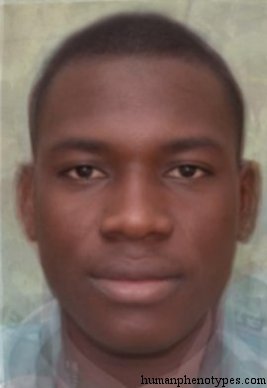
Faces from the encyclopedia that appear in this article. Open any entry for its full description, distribution, and references.
Sudanid (proper)
West Africa
Sudanid proper. Widespread savannah type named after the Sudan region of West Africa. Found in its purest form among Mossi, Lobi, Dagaaba, S...
Strandid
Northern Europe
Alpinoid North European type most common in Southwestern Norway. The name derives from the Norwegian word for beach ("Strand"). Probably a r...
Mountain Indid
South Asia
(Gracile) Indid variety native to the valleys south of the Western Himalaya and in the Hindu Kush. Once the principal element of the Khas an...
Xhosaid
Sub-Saharan Africa
Bantuid-Khoisan contact type that developed as a result of the Bantu expansion some millennia ago when Bantu assimilated older Khoisan group...
Test what you learned
Put your eye for regional faces to work in the daily quiz — a composite face, a world map, and your best guess.