Sudanid (proper) Phenotype - Face Features & Origin
Sudanid proper. Its reference coordinates sit near 12.1° N, 1.7° W in West Africa. Rather than a single portrait, the Sudanid (proper) composite below is a statistical average, and the surrounding sections — traits, distribution, research history, references — give that average its context.
Average Face
What you see below is a statistical construction of the Sudanid (proper) reference population. Faces recorded from the Sudanid (proper) sample were overlaid and merged; the result keeps the features most members shared and discards personal variation. It reads like a Sudanid (proper) portrait, but it works like a histogram.
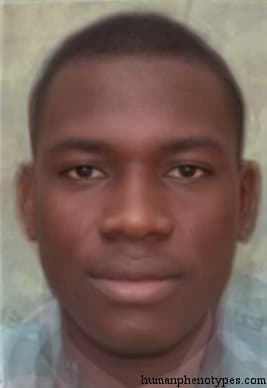
Composite source: Human Phenotypes — Sudanid (proper)
Geographic Distribution
Geographically, Sudanid (proper) anchors to 12.1° N, 1.7° W (West Africa). That is the point where historical anthropologists judged Sudanid (proper) most concentrated, not a hard edge; modern migration and intermarriage have long since softened whatever boundaries once existed.
Physical Characteristics
Dark brown, sometimes ebony black skin, usually kinky hair.
- (Rather) tall, (hyper)brachyskelic and mesomorph
- Mostly dolichocephalic or mildly mesocephalic, mildly hypsicranic
- (Hyper-)platyrrhine
- The face is large with big eyes and massive, bulging lips
- Occiput and prognathy are usually pronounced
- Body hair extremely weak
Historical Background
Sudanid proper. Widespread savannah type named after the Sudan region of West Africa. Found in its purest form among Mossi, Lobi, Dagaaba, Senufo, Northern Malinke, Gurunsi, Songhai, and Bambara. More mixed across many regions of Western Africa, e.g. Southern Haussa, Ashanti, North Igbo, Yoruba, Moors, and many more.
Research History & Naming
The passage below traces who first defined Sudanid (proper), which rival names competed with it, and how later authors consolidated or disputed the classification — the raw material of any serious phenotype reference.
Sergi (1908) first described the type as Homo sudanensis. Many authors then called the type Sudanid (Eickstedt, 1934 , 1952b ; Fleischhacker, 1975 ; Baker, 1981 ; Knussmann, 1996 ) or Sudanian ( Alexeev, 1979 ). The typical variety of Pales' (1953) and Vallois' (1971) Soudanaise and Biasutti's (1967) Sudanese.
Comparison With Nearby Phenotypes
Ranked by great-circle distance from Sudanid (proper)'s reference center, these are the five nearest documented phenotypes — the closest being Bobo at 301 km. Overlapping distributions like these are exactly what makes the quiz hard, and the Bobo row is where to start looking.
| Phenotype | Region | Distance | Distinguishing trait |
|---|---|---|---|
| Bobo | West Africa | 301 km | Dark brown, sometimes black skin, usually kinky hair. |
| Sudano Guinesid | West Africa | 455 km | Dark brown skin, kinky hair. |
| Guineo Camerunian | West Africa | 622 km | Usually dark, sometimes medium brown skin. |
| Guinesid | West Africa | 1,212 km | Usually dark brown skin, sometimes light brown. |
| Moorish | North Africa | 1,215 km | Bronze brown skin, wavy to tight-curly hair. |
Sudanid (proper) in the Game
When the Sudanid (proper) composite shows up in the quiz, players who know the West Africa distribution pattern have the edge. The reference answer sits near 12.1° N, 1.7° W; pins on the wrong continent score close to zero, so even a rough regional instinct beats a precise but misdirected pin.
Sudanid (proper) Phenotype FAQ
- Where does the Sudanid (proper) phenotype come from?
- Historical sources center the Sudanid (proper) phenotype on 12.1° N, 1.7° W (West Africa). Treat that as a rough anchor: the type appeared across a wider surrounding area — its nearest documented neighbors, Bobo and Sudano Guinesid, sit 301 and 455 km from the reference point — and its present-day distribution no longer matches the historical map.
- What does the Sudanid (proper) phenotype look like?
- The composite emphasizes recurring traits: dark brown, sometimes ebony black skin, usually kinky hair. The full trait list for Sudanid (proper) appears in the physical characteristics section above.
- Is the Sudanid (proper) phenotype a race or a nationality?
- No. Phenotypes like Sudanid (proper) are descriptive averages, not ancestry groups. Sudanid (proper) is one of several types documented in and around West Africa — see the comparison table above — and the same individual can carry traits associated with several of them at once. The Sudanid (proper) entry describes a statistical pattern, not a group of people and not a nationality.
- How does Sudanid (proper) appear in the game?
- When the Sudanid (proper) face comes up in Classic Daily or Challenge Mode, you pin the world map where you believe the type is historically most common, and the score decays with your distance to 12.1° N, 1.7° W. Fair warning: the nearest other entry in our dataset, Bobo, sits just 301 km away, so this face rewards precise placement — the right country alone is not always enough.
References & Literature
The Sudanid (proper) phenotype entry above is compiled from the 10 academic references. Readers are encouraged to consult the original Sudanid (proper) sources for verification and deeper context.
- Sergi, G. 1908. Di una classificatione razionale dei gruppi umani. Att Soc. Ital. progr. Sci. Rome.
- Eickstedt, E. von. 1934. Rassenkunde und Rassengeschichte der Menschheit. Ferdinand Enke. Stuttgart.
- Eickstedt, E. von. 1952b. Die prioritätsgerechten Bezeichnungen der menschlichen Varitäten. In: Historia Mundi. Band 1, Munich, 223-226.
- Fleischhacker, H.. 1975. Die Anthropologie der Bewohner Afrikas. In: Baumann, H.: Die Völker Afrikas und ihre traditionellen Kulturen. Wiesbaden. 41-134.
- Baker, J.R.. 1981. Race. Oxford Univ. Press. London.
- Knussmann, R. 1996. Vergleichende Biologie des Menschen: Lehrbuch der Anthropologie und Humangenetik. 2ed. Spektrum Akademischer Verlag.
- Alexeev, V. P. 1979. The Differential Geography of Races. In: Stini, W. A. Physiological and Morphological Adaptation and Evolution. De Gruyter.
- Pales, L. and T. de St-Péreuse. 1953. Raciologie comparative des populations de l'Afrique occidentale.Bull. et Mém. de la Société d'anthropologie de Paris X. 185-497.
- Vallois, H. V. 1971. Las races humaines. 8 Ed. Grammont.
- Biasutti, R. 1967 (1941). Le Razze e i Popoli della terra. 4th Ed. Vol 1-4. U.T.E.T., Torino.
Related Phenotypes
If Sudanid (proper) interested you, these neighboring phenotype entries cover adjacent parts of the map with distinctly different trait bundles.
Bobo
West Africa · 301 km away
Sudanid variety with shorter skulls than Sudanids proper, and several other unique features that set it apart from other neighbouring groups...
Sudano Guinesid
West Africa · 455 km away
Transitional type between Sudanid and Guinesid, common in West Africa. Although it is just a contact type, it is sometimes separated from th...
Guineo Camerunian
West Africa · 622 km away
West African type, the shorter-skulled counterpart of Guinesids. May constitute the transition to Congolesids. Common in forest regions of C...
Guinesid
West Africa · 1,212 km away
West African forest type native to the littoral of the Gulf of Guinea. Extends from Guinea all the way to Cameroon and sporadically even to ...
Moorish
North Africa · 1,215 km away
Relatively recent contact type of the Western Sahara. Probably formed during Antiquity when aboriginal Berber populations mixed with older W...
Further Reading
Background articles from the blog that explain where the Sudanid (proper) type fits, how these composites are built, and what a face can and cannot tell you.
Ethnicity Guesser Photo: What Happens to the File First
A photo handed to a face tool stops being a photograph almost at once: the file is decoded, rotated, colour-converted and resized before...
Ethnicity Quiz: Five Question Types Behind the Label
A face quiz, a census form, a reaction-time experiment, a surname model and an ancestry report all answer to the same phrase.