Xhosaid Phenotype - Face Features & Origin
Bantuid-Khoisan contact type that developed as a result of the Bantu expansion some millennia ago when Bantu assimilated older Khoisan groups. The entry below collects the Xhosaid composite face, its documented distribution around 32.2° S, 26.6° E in Sub-Saharan Africa, its physical characteristics, the research history behind the name, and the academic references that support all of it.
Average Face
The Xhosaid composite below is not a photograph of a real person. Historical anthropologists aligned multiple individual portraits from the Xhosaid reference population and averaged them into one image, so recurring structures — skull outline, nose form, lip thickness, brow position — dominate while individual idiosyncrasies cancel out.
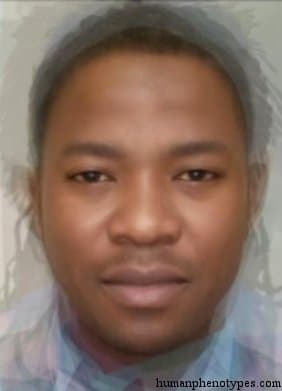
Composite source: Human Phenotypes — Xhosaid
Geographic Distribution
The reference center for Xhosaid sits near 32.2° S, 26.6° E in Sub-Saharan Africa. Around that anchor, prevalence falls off gradually — the type is not confined to one valley or one modern border, and the historical map should be read as a gradient rather than a boundary.
Physical Characteristics
Medium to dark yellowish-brown skin with kinky or peppercorn hair.
- Medium height, meso- brachyskelic with a variable body type
- Dolichocephalic, chamae- orthocranic with lower vaults than all Bantuid types
- The nose is (strongly) platyrrhine
- Prognathy is mild, chin sometimes receding
- Slanting eyes are common
Historical Background
Bantuid-Khoisan contact type that developed as a result of the Bantu expansion some millennia ago when Bantu assimilated older Khoisan groups. Found especially in the eastern parts of South Africa. Common in Xhosa, Southern Sotho, and Shangana, occasionally in Chopi, Bhaca, and Tswana, rare in Zulu and others. Modern recombinations are common.
Research History & Naming
The passage below traces who first defined Xhosaid, which rival names competed with it, and how later authors consolidated or disputed the classification — the raw material of any serious phenotype reference.
The type was defined by Dart (1962) as "Group E", typical for Xhosa, Southern Sotho, and Shangana. Chopi-Tswana (his Group C) and Fengu-Pondo (his Group D) are similar, but more Bantuid influenced. Eickstedt (1934) describes the group as the "easternmost Bantuid vanguard against the Khoisanids".
Comparison With Nearby Phenotypes
Ranked by great-circle distance from Xhosaid's reference center, these are the five nearest documented phenotypes — the closest being Fengu-Pondo at 215 km. Overlapping distributions like these are exactly what makes the quiz hard, and the Fengu-Pondo row is where to start looking.
| Phenotype | Region | Distance | Distinguishing trait |
|---|---|---|---|
| Fengu-Pondo | Sub-Saharan Africa | 215 km | Yellowish dark, sometimes medium brown skin, usually kinky, sometimes peppercorn hair. |
| Karroid | Sub-Saharan Africa | 343 km | Yellowish light or medium brown skin, heavily wrinkled in old age, peppercorn hair. |
| South Bantuid | Sub-Saharan Africa | 580 km | Dark, sometimes medium brown skin, usually kinky, sometimes peppercorn hair. |
| Chopi-Tswana | Sub-Saharan Africa | 1,026 km | Yellowish dark, sometimes medium brown skin, usually kinky, sometimes peppercorn hair. |
| Kalaharid | Sub-Saharan Africa | 1,122 km | Yellowish/reddish medium brown skin, wrinkled in old age, peppercorn hair (< 15 mm). |
Xhosaid in the Game
When the Xhosaid composite shows up in the quiz, players who know the Sub-Saharan Africa distribution pattern have the edge. The reference answer sits near 32.2° S, 26.6° E; pins on the wrong continent score close to zero, so even a rough regional instinct beats a precise but misdirected pin.
Xhosaid Phenotype FAQ
- Where does the Xhosaid phenotype come from?
- The reference coordinates for the Xhosaid phenotype sit near 32.2° S, 26.6° E, in Sub-Saharan Africa. That point marks the center of the Sub-Saharan Africa distribution documented roughly 1500 years ago — actual prevalence spread well beyond it, toward entries such as Fengu-Pondo 215 km away, and modern migration has blurred those boundaries further.
- What does the Xhosaid phenotype look like?
- In the historical literature, medium to dark yellowish-brown skin with kinky or peppercorn hair. For Xhosaid these are statistical tendencies across a population, not a checklist every individual matches.
- Is the Xhosaid phenotype a race or a nationality?
- No. A phenotype is a recurring bundle of visible traits documented by historical anthropologists across a population — for Xhosaid, patterns such as medium to dark yellowish-brown skin with kinky or peppercorn hair. The Xhosaid entry is not a genetic ancestry, not a nationality, and not a statement about any individual person. Two people from the same country can match completely different phenotypes — one resembling Xhosaid, another closer to Fengu-Pondo — and one phenotype can span many modern borders.
- How does Xhosaid appear in the game?
- In Classic Daily and Challenge Mode, the Xhosaid composite face appears without a label. Your task is to drop a pin on the world map where you think that face is historically most common — the scoring uses the distance between your pin and the reference coordinates near 32.2° S, 26.6° E. The post-round review then shows the correct location, your distance error, and this Xhosaid entry.
References & Literature
The Xhosaid phenotype entry above is compiled from the 2 academic references. Readers are encouraged to consult the original Xhosaid sources for verification and deeper context.
- Dart, R.A. 1962. Racial Origins. In: Schapera, I.. The Bantu Speaking Tribes of South Africa. Routledge & Kegan Paul. London.
- Eickstedt, E. von. 1934. Rassenkunde und Rassengeschichte der Menschheit. Ferdinand Enke. Stuttgart.
Related Phenotypes
Other human phenotypes whose documented centers lie in the same part of the map as Xhosaid.
Fengu-Pondo
Sub-Saharan Africa · 215 km away
Bantuid variety, similar to South Bantuid, but with weak Khoisan influence, placing it closer to Xhosaid. Developed as a result of the Bantu...
Karroid
Sub-Saharan Africa · 343 km away
Sanid variety, named after the Karoo desert. Very ancient and distinct with many unique features. Was dominant in Southern Africa some centu...
South Bantuid
Sub-Saharan Africa · 580 km away
Bantuid variety, characterised by relatively wide skulls and robust faces. Especially found in the Kwazulu Natal / Transkei regions of South...
Chopi-Tswana
Sub-Saharan Africa · 1,026 km away
Bantuid variety, overall similar to Central Bantuid, but with weak Khoisan influence, placing it closer to Xhosaid. Developed as a result of...
Kalaharid
Sub-Saharan Africa · 1,122 km away
Sanid variety, native to the Kalahari. Very ancient and distinct, specialised desert type with many unique features. Typical for the Norther...
Further Reading
Background articles from the blog that explain where the Xhosaid type fits, how these composites are built, and what a face can and cannot tell you.
AI Ethnicity Test: What a Measurement Would Require
A laboratory test has a reference standard, a defined construct and a published error bar. A face-based ethnicity tool owns none of...
Geography Games Like GeoGuessr: Six Kinds of Clue
Street panoramas, country outlines and average faces all answer one question. Here are six geography games sorted by the clue they hand...