Ethnicity Guesser Alternatives: A Classroom Is the Test
Alternatives to a face-guessing quiz are usually compared on modes, but the constraint that decides it is whether a pupil's photograph has to leave the room.
The substitution nobody states
A search for alternatives to a face-guessing site rarely says who will be doing the guessing. At home the choice is between menus, and the cost of picking badly is a dull evening. In a classroom the same search is a procurement question with a legal edge to it: the room contains minors, the school is answerable for what happens to their data, and somebody will eventually have to explain to a parent why a photograph of their child went to a company the school cannot name.
That difference is worth stating before any comparison of modes, because it reorders the field. A site with six modes and a leaderboard is not thereby better or worse than one with a single daily draw. What separates them for a teacher is narrower and harder: whether any photograph of a living person has to be uploaded at all, and whether the correct answers can be read and checked before the lesson rather than revealed after it.
What a classroom asks of a site
Four requirements follow from the room rather than from taste. No account, because registering a person under thirteen is precisely the act that children's privacy law regulates. No upload, because thirty pupils cannot supply thirty volunteers with thirty consents. One fixed set of faces for the day, so that a discussion has a common object instead of thirty different screens. And an answer key that exists as text, so a teacher can read it on Sunday night and decide whether the labels are defensible in front of a class.
Cost sits underneath all four. A per-seat licence for thirty pupils is a budget line somebody has to argue for, while a free browser page costs a decision and nothing else. That asymmetry is why free options dominate in schools even when a paid one is better made, and it is also why the free options deserve scrutiny rather than the benefit of the doubt.
The line at thirteen and at sixteen
In the United States the Children's Online Privacy Protection Act of 1998 reaches services directed at children under thirteen, and general-audience services that have actual knowledge of collecting from a child under thirteen. Verifiable parental consent is required before collection, and the civil penalty has been adjusted for inflation to 53,088 dollars per violation. The rule was amended in 2025, effective 23 June, with full compliance required by 22 April 2026, and the amendments moved biometric identifiers into the definition of personal information while requiring a written retention limit.
Europe sets the default higher. Article 8 of the GDPR fixes sixteen as the age at which a child may consent to an information society service on their own account, and lets member states lower it, though not below thirteen. Eighteen did; nine kept sixteen, among them Germany, Ireland, the Netherlands and Poland, while Belgium, Denmark, Estonia, Finland, Latvia, Malta, Portugal and Sweden chose thirteen. A British classroom is covered by a third instrument: the Age Appropriate Design Code, fifteen standards that took effect on 2 September 2020 and became enforceable a year later, applying to any service likely to be accessed by anyone under eighteen.
Why the photo tool is hardest to defend
A classifier cannot work without an image, which makes the upload the product's input rather than a side effect of using it. Once a school instructs pupils to submit their own faces, the school stops being a bystander. In the United States, records an institution creates about its students fall under the Family Educational Rights and Privacy Act of 1974, and the directory-information exception that covers a yearbook portrait does not describe a face sent to a third-party model. The questions a teacher should ask are short ones: is the file stored, for how long, is it used to train or improve a model, and can it be deleted on request.
The composite is the one image with no sitter
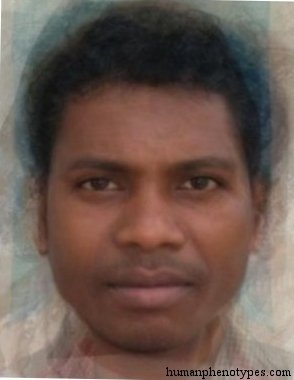
A different arrangement removes the problem instead of managing it. An average face is assembled by scaling many archived portraits into a common frame and warping them onto the mean, so the output depicts nobody who was ever photographed. That is not a legal technicality; it is the reason the format can be projected in a room at all. The label belongs to a documented centre written down before the image existed, and the answer a pupil gives is a name rather than a person.
Those names also have edges that can be shown, which matters more in a lesson than a score does. North Gondid covers north-central India up to the Himalaya and is recorded among Gond, Kurukh, Bhil, Juang and Baiga. Palaungid takes its name from a Burmese phrase for mountain people and reaches from the central Burmese hills into Yunnan, southern Tibet, Thailand and parts of India. West Bambutid was once spread more widely than the Cameroon, Gabon, Congo and Central African Republic forests where it is still recorded. Plains Pamirid runs from Uzbekistan across the Fergana Valley into Xinjiang. A teacher can point at where each label stops, and a pupil can see that the edge is a judgement rather than a border.
The map the class is actually looking at
The catalogue these entries belong to describes distributions as they stood roughly fifteen hundred years ago, which is the part a class is most likely to miss. Since then the Bantu expansion reached southern Africa, Mapuche and then European settlement displaced the Patagonian pattern, and the twentieth century moved more people further than any century before it. A pupil whose family arrived in the country twenty years ago is therefore not looking at a map of their own household. Said once, before the first round, that sentence stops the exercise from teaching the opposite of what it intends.
There is also a version of the lesson that needs no game at all, and for a tight timetable it is the better alternative. Hand out four entry descriptions and a blank outline map, and ask the class to shade where each pattern was recorded and to mark where its name came from. The gap between those two marks is the whole subject: North Gondid is named for a people but described as a regional type, Palaungid names a tribe in one valley and is recorded across four countries. Twenty minutes of shading does what a leaderboard cannot, because the disagreement is about a map rather than a score.
Which option fits which room
For an after-school club that wants variety, a multi-mode menu is the better fit, and one competitor's contributed-photograph mode is a real advantage no catalogue of composites can match: the person in the frame chose to appear and supplied the answer themselves. For a research task the catalogue is the better fit, because each of its 209 entries carries a region, a period and a source that can be opened. For a demonstration of what a classifier does, the honest form is one volunteer's image with a stated retention rule, not thirty pupils' faces.
This site runs a quiz built on composites, so its preference for that arrangement is not a neutral verdict. The rule that survives the comparison is simpler than a feature table. If the answer to whether any pupil's face must be uploaded is yes, the option is not an alternative for a classroom; it is a different activity with a different consent problem. Choose the one whose answer key you can read aloud before the lesson starts.
Frequently Asked Questions
- Are ethnicity guesser alternatives safe to use in a classroom?
- Safety turns on one structural question: whether a pupil's photograph has to be uploaded. Options built on averaged composite faces never receive a real face, so the data-protection problem is smaller and the answer key is a written label with a source attached. Photo tools need an image to function, which puts the school in the position of controller for a pupil's data. Neither kind is automatically appropriate for a lesson, but the one that never collects a face is far easier to explain to a parent or an inspector.
- Does a class of fourteen-year-olds need parental consent?
- In the United States no, because the Children's Online Privacy Protection Act stops at thirteen. In the European Union it depends on the member state: Article 8 of the GDPR sets sixteen but permits a lower age down to thirteen, and eight countries took the lower option while nine kept sixteen. The United Kingdom applies its Age Appropriate Design Code to services likely to be accessed by anyone under eighteen. A teacher working across borders should assume the strictest applicable age rather than the local one.
- What does a composite face actually show a class?
- It shows a mean rather than a person. Many archived portraits are aligned on brow, orbit, nostril and mouth corner, then warped onto an average, so the result is a diagram of shared architecture and no individual can be picked out of it. The label attached to that image is a documented pattern with a region, a period and a citation. That combination is what makes the format teachable: pupils argue about where a pattern was recorded, not about who somebody is.
Related Phenotypes
Faces from the encyclopedia that appear in this article. Open any entry for its full description, distribution, and references.
North Gondid
South Asia
Ancient phenotype native to North Central India, found up to the Himalaya. Gondid proper type, the robust counterpart of South Gondids. Comm...
Palaungid
Southeast Asia
The proper Palaungid variety, typical for the Central Burmese hill tribes, also in Yunnan, Himalaya, South Tibet, Thailand, and parts of Ind...
West Bambutid
West Africa
Type of the West African Pygmies, that split from East Bambutid during the late Paleolithic. Shows a strong rainforest adaption. Historicall...
Plains Pamirid
Central Asia
The most widespread Pamirid variety, typical for the steppes and lowlands from Uzbekistan to Xinjiang and the Ferghana Valley. Somewhat infl...
Test what you learned
Put your eye for regional faces to work in the daily quiz — a composite face, a world map, and your best guess.