West Bambutid Phenotype - Face Features & Origin
Historical anthropology places the West Bambutid phenotype in West Africa, with a documented center near 4.6° N, 13.2° E. Type of the West African Pygmies, that split from East Bambutid during the late Paleolithic. The sections that follow unpack the West Bambutid entry in practice: the composite face, the traits it summarizes, the naming history, and the sources.
Average Face
Averaging the portraits behind West Bambutid leaves the features that repeat and erases the ones that do not. That is exactly how the West Bambutid composite below was built: individual photographs were aligned and statistically merged, exaggerating shared structure into a single reference face that no actual person looks like.
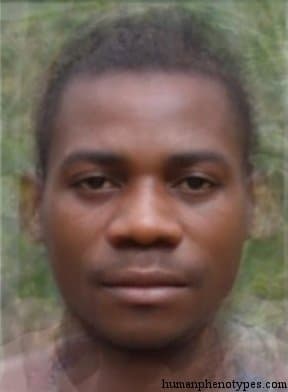
Composite source: Human Phenotypes — West Bambutid
Geographic Distribution
The reference center for West Bambutid sits near 4.6° N, 13.2° E in West Africa. Around that anchor, prevalence falls off gradually — the type is not confined to one valley or one modern border, and the historical map should be read as a gradient rather than a boundary.
Physical Characteristics
Medium to dark, sometimes light (yellowish) brown skin with (reddish) brown-black peppercorn hair.
- (Very) short, (hyper-) macroskelic, mesomorph, occasionally hairy body
- Rarely steatopygic
- Meso- brachycephalic, orthocranic, rather small-headed
- (Hyper-)platyrrhine
- Compared to East Bambutids bodies are taller, faces longer, nasal roots higher, and prognathy stronger
Historical Background
Type of the West African Pygmies, that split from East Bambutid during the late Paleolithic. Shows a strong rainforest adaption. Historically more widespread, still found in the forests of Cameroon, Gabon, Congo, and Central African Republic. Typified by the Baka, Aka, Bongo, Gyele, and Kola. Loss of culture and forest destruction could make this unique type vanish forever soon.
Research History & Naming
Every label in the historical catalogue has an author and a date, and West Bambutid has accumulated its share of competing attributions. For West Bambutid, the literature extract below shows the naming chain — from the first definition through the later revisions that shaped the current entry.
Detailed studies were made by Lalouel (1950) , Schebesta (1952) and Froment (1993) . Gusinde (1950 called them western Twids. Eickstedt (1934) included them in Bambutid like Baker (1981) and Knussmann (1996) . Biasutti (1967) separated the BaMbuti and the BaBinga group like Cole (1965) , who called it the West Negrillo type. The split from East Bambutid occurred some 20k years ago ( Patin, 2009 ).
Comparison With Nearby Phenotypes
Ranked by great-circle distance from West Bambutid's reference center, these are the five nearest documented phenotypes — the closest being Equatorial Sudanid at 133 km. Overlapping distributions like these are exactly what makes the quiz hard, and the Equatorial Sudanid row is where to start looking.
| Phenotype | Region | Distance | Distinguishing trait |
|---|---|---|---|
| Equatorial Sudanid | West Africa | 133 km | Dark brown, sometimes black skin, kinky hair. |
| West Congolesid | West Africa | 291 km | Dark brown, sometimes black skin, kinky hair. |
| Shari | West Africa | 759 km | (Bluish/greyish) black skin, usually kinky hair. |
| Congolesid | Sub-Saharan Africa | 783 km | Dark brown, sometimes light brown skin. |
| Twa-Cwa | Sub-Saharan Africa | 943 km | Usually dark brown, sometimes light brown skin with peppercorn hair. |
West Bambutid in the Game
When the West Bambutid composite shows up in the quiz, players who know the West Africa distribution pattern have the edge. The reference answer sits near 4.6° N, 13.2° E; pins on the wrong continent score close to zero, so even a rough regional instinct beats a precise but misdirected pin.
West Bambutid Phenotype FAQ
- Where does the West Bambutid phenotype come from?
- The reference coordinates for the West Bambutid phenotype sit near 4.6° N, 13.2° E, in West Africa. That point marks the center of the West Africa distribution documented roughly 1500 years ago — actual prevalence spread well beyond it, toward entries such as Equatorial Sudanid 133 km away, and modern migration has blurred those boundaries further.
- What does the West Bambutid phenotype look like?
- In the historical literature, medium to dark, sometimes light (yellowish) brown skin with (reddish) brown-black peppercorn hair. For West Bambutid these are statistical tendencies across a population, not a checklist every individual matches.
- Is the West Bambutid phenotype a race or a nationality?
- No. Phenotypes like West Bambutid are descriptive averages, not ancestry groups. West Bambutid is one of several types documented in and around West Africa — see the comparison table above — and the same individual can carry traits associated with several of them at once. The West Bambutid entry describes a statistical pattern, not a group of people and not a nationality.
- How does West Bambutid appear in the game?
- In Classic Daily and Challenge Mode, the West Bambutid composite face appears without a label. Your task is to drop a pin on the world map where you think that face is historically most common — the scoring uses the distance between your pin and the reference coordinates near 4.6° N, 13.2° E. The post-round review then shows the correct location, your distance error, and this West Bambutid entry.
References & Literature
Primary sources for the West Bambutid entry, listed as cited in the historical literature. The naming and classification debates around West Bambutid referenced above run through these works.
- Lalouel, J. 1950. Les Babingas du Bas-Oubangui, Ivi. Se. 10a, I.
- Schebesta, P. 1952. Die Pygmäenvölker der Erde. Wissenschaftliche Ergebnisse der Forschungen Paul Schebestas unter den Pygmäen Afrikas und Asiens. 3 Bd. Wien.
- Froment, A. 1993. Adaptation biologique et variation dans l'espèce humaine : le cas des Pygmées d'Afrique. Bull. et Mémo. de la Soc. d'anthropologie de Paris, 5 (3-4), 417-448.
- Gusinde, M. 1950. Bemerkungen über die negriden Rasseformen im Afrikanischen Tropenwald. Paideuma 4. 255-263.
- Eickstedt, E. von. 1934. Rassenkunde und Rassengeschichte der Menschheit. Ferdinand Enke. Stuttgart.
- Baker, J.R.. 1981. Race. Oxford Univ. Press. London.
- Knussmann, R. 1996. Vergleichende Biologie des Menschen: Lehrbuch der Anthropologie und Humangenetik. 2ed. Spektrum Akademischer Verlag.
- Biasutti, R. 1967 (1941). Le Razze e i Popoli della terra. 4th Ed. Vol 1-4. U.T.E.T., Torino.
- Cole, S. 1965. Races of Man. Butler & Tanner Ltd. Frome and London.
- Patin et al. 2009. Inferring the Demographic History of African Farmers and Pygmy Hunter-Gatherers. In: Di Rienzo, A. PLoS Genetics 5 (4): e1000448.
Related Phenotypes
Other human phenotypes whose documented centers lie in the same part of the map as West Bambutid.
Equatorial Sudanid
West Africa · 133 km away
Central African variety with Sudanid and Congolid elements, living in the Savanna regions of East Cameroon, Central African Republic, South ...
West Congolesid
West Africa · 291 km away
African forest type, intermediate between Congolesid, Guinesid, and Sudanid, but with a variety of unique features. Common in Southern Camer...
Shari
West Africa · 759 km away
Special type named after the Chari river of Chad. Intermediate between Sudanid and Nilotid, but with several unique features that have long ...
Congolesid
Sub-Saharan Africa · 783 km away
Widespread type of the Congo forest basin, common from Gabon to DR Congo, Central African Republic, Angola, and Zambia. Typical for Western ...
Twa-Cwa
Sub-Saharan Africa · 943 km away
Pygmoid type of the Congo forests intermediate between Bambutid and Congolesid. Important groups in DR Congo are Mongo Cwa close to the Mai-...
Further Reading
Background articles from the blog that explain where the West Bambutid type fits, how these composites are built, and what a face can and cannot tell you.
Ethnicity Guesser Photo: What Happens to the File First
A photo handed to a face tool stops being a photograph almost at once: the file is decoded, rotated, colour-converted and resized before...
Ethnicity Quiz: Five Question Types Behind the Label
A face quiz, a census form, a reaction-time experiment, a surname model and an ancestry report all answer to the same phrase.