Twa-Cwa Phenotype - Face Features & Origin
Pygmoid type of the Congo forests intermediate between Bambutid and Congolesid. Its reference coordinates sit near 2.1° S, 18.3° E in Sub-Saharan Africa. Rather than a single portrait, the Twa-Cwa composite below is a statistical average, and the surrounding sections — traits, distribution, research history, references — give that average its context.
Average Face
What you see below is a statistical construction of the Twa-Cwa reference population. Faces recorded from the Twa-Cwa sample were overlaid and merged; the result keeps the features most members shared and discards personal variation. It reads like a Twa-Cwa portrait, but it works like a histogram.
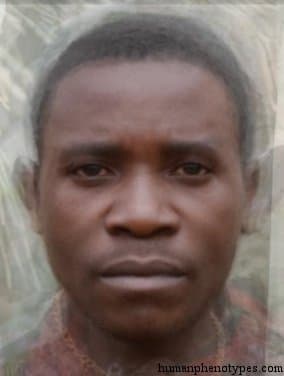
Composite source: Human Phenotypes — Twa-Cwa
Geographic Distribution
Twa-Cwa is documented across Sub-Saharan Africa, with its historical reference center near 2.1° S, 18.3° E. The coordinates mark where the type was most characteristic roughly 1500 years ago; population movements since then have scattered and blended the distribution far beyond that point.
Physical Characteristics
Usually dark brown, sometimes light brown skin with peppercorn hair.
- Short, but taller than Bambutid with larger heads, mesoskelic with an ectomorph to mesomorph, sometimes hairy body with strong buttocks
- Mesocephalic, orthocranic
- (Hyper-)platyrrhine
- Face short and broad, interorbital distance great, prognathy moderate
Historical Background
Pygmoid type of the Congo forests intermediate between Bambutid and Congolesid. Important groups in DR Congo are Mongo Cwa close to the Mai-Ndombe and Tumba Lakes, as well as Kasai Cwa of the Lomani River. Also typical in Ba Twa around Lake Kivu in Rwanda and Burundi. Mixed in other Pygmy and Congo populations.
Research History & Naming
Typological names were coined, contested, and renamed repeatedly across the 20th century, and Twa-Cwa is no exception. The extract below records the researchers who defined Twa-Cwa, the alternative labels it accumulated, and where the modern consensus settled.
Schebesta and Lebzelter (1933) as well as Schebesta and Gusinde ( 1949 , 1956 ), included them in Twid. Biasutti (1967) defined them as a separate Non-Pygmy Ba Twa subrace, Cole (1965) as the Central Negrillo type. Eickstedt (1934) called them Central Bambutid and regarded them as Congolesid admixed. Analysed by Froment (1993) . Modern research confirms Bantu admixture ( Patin, 2009 ).
Comparison With Nearby Phenotypes
The five phenotypes whose documented centers lie closest to Twa-Cwa, ranked by great-circle distance. They are the types players most often confuse with Twa-Cwa in the quiz, precisely because their distributions overlap.
| Phenotype | Region | Distance | Distinguishing trait |
|---|---|---|---|
| Congolesid | Sub-Saharan Africa | 182 km | Dark brown, sometimes light brown skin. |
| Equatorial Sudanid | West Africa | 820 km | Dark brown, sometimes black skin, kinky hair. |
| West Bambutid | West Africa | 943 km | Medium to dark, sometimes light (yellowish) brown skin with (reddish) brown-black peppercorn hair. |
| West Congolesid | West Africa | 975 km | Dark brown, sometimes black skin, kinky hair. |
| Mundu Mangbeto | Sub-Saharan Africa | 1,165 km | Dark, sometimes medium reddish-brown skin, kinky hair. |
Twa-Cwa in the Game
Twa-Cwa is one of the faces that can appear in Classic Daily and Challenge Mode. When it does, the winning pin lands near 2.1° S, 18.3° E in Sub-Saharan Africa — and because the scoring decays with distance, recognizing the region matters more than pixel-perfect placement.
Twa-Cwa Phenotype FAQ
- Where does the Twa-Cwa phenotype come from?
- The reference coordinates for the Twa-Cwa phenotype sit near 2.1° S, 18.3° E, in Sub-Saharan Africa. That point marks the center of the Sub-Saharan Africa distribution documented roughly 1500 years ago — actual prevalence spread well beyond it, toward entries such as Congolesid 182 km away, and modern migration has blurred those boundaries further.
- What does the Twa-Cwa phenotype look like?
- In the historical literature, usually dark brown, sometimes light brown skin with peppercorn hair. For Twa-Cwa these are statistical tendencies across a population, not a checklist every individual matches.
- Is the Twa-Cwa phenotype a race or a nationality?
- No. Phenotypes like Twa-Cwa are descriptive averages, not ancestry groups. Twa-Cwa is one of several types documented in and around Sub-Saharan Africa — see the comparison table above — and the same individual can carry traits associated with several of them at once. The Twa-Cwa entry describes a statistical pattern, not a group of people and not a nationality.
- How does Twa-Cwa appear in the game?
- In Classic Daily and Challenge Mode, the Twa-Cwa composite face appears without a label. Your task is to drop a pin on the world map where you think that face is historically most common — the scoring uses the distance between your pin and the reference coordinates near 2.1° S, 18.3° E. The post-round review then shows the correct location, your distance error, and this Twa-Cwa entry.
References & Literature
Every claim on this page traces back to the sources below — the researchers who defined, measured, and argued over the Twa-Cwa type. The originals behind the Twa-Cwa entry are worth consulting directly.
- Schebesta, P. and V, Lebzelter. 1933. Anthropology of the Central African Pygmies in the Belgian Congo
- Gusinde, M. 1949. Die Twa-Pymäen in Ruanda.
- Gusinde, M. 1956. Die Twiden. Pygmäen und Pygmoide im tropischen Afrika. Museum Völkerkunde, Wien.
- E67
- Cole, S. 1965. Races of Man. Butler & Tanner Ltd. Frome and London.
- Eickstedt, E. von. 1934. Rassenkunde und Rassengeschichte der Menschheit. Ferdinand Enke. Stuttgart.
- Froment, A. 1993. Adaptation biologique et variation dans l'espèce humaine : le cas des Pygmées d'Afrique. Bull. et Mémo. de la Soc. d'anthropologie de Paris, 5 (3-4), 417-448.
- Patin et al. 2009. Inferring the Demographic History of African Farmers and Pygmy Hunter-Gatherers. In: Di Rienzo, A. PLoS Genetics 5 (4): e1000448.
Related Phenotypes
If Twa-Cwa interested you, these neighboring phenotype entries cover adjacent parts of the map with distinctly different trait bundles.
Congolesid
Sub-Saharan Africa · 182 km away
Widespread type of the Congo forest basin, common from Gabon to DR Congo, Central African Republic, Angola, and Zambia. Typical for Western ...
Equatorial Sudanid
West Africa · 820 km away
Central African variety with Sudanid and Congolid elements, living in the Savanna regions of East Cameroon, Central African Republic, South ...
West Bambutid
West Africa · 943 km away
Type of the West African Pygmies, that split from East Bambutid during the late Paleolithic. Shows a strong rainforest adaption. Historicall...
West Congolesid
West Africa · 975 km away
African forest type, intermediate between Congolesid, Guinesid, and Sudanid, but with a variety of unique features. Common in Southern Camer...
Mundu Mangbeto
Sub-Saharan Africa · 1,165 km away
Intermediate type of the Northeastern Congo forest. Unique in connecting elements of the tallest (Nilo-Hamitic) and shortest (Bambutid) phen...
Further Reading
Background articles from the blog that explain where the Twa-Cwa type fits, how these composites are built, and what a face can and cannot tell you.
AI Ethnicity Test: What a Measurement Would Require
A laboratory test has a reference standard, a defined construct and a published error bar. A face-based ethnicity tool owns none of...
Geography Games Like GeoGuessr: Six Kinds of Clue
Street panoramas, country outlines and average faces all answer one question. Here are six geography games sorted by the clue they hand...