Neanderthal DNA and physical traits: what transfers
Neanderthal alleles do reach skin, hair and immunity, but not the cranial and facial traits a phenotype catalogue actually records.
A thin coat, cut into short pieces
Outside Africa, the archaic share of the genome sits at roughly one to two percent, a figure that has barely moved since the first draft sequence in 2010. The percentage is less informative than the physical arrangement of the material. When Sankararaman and colleagues screened 1,004 present-day genomes in 2014, they found that individual Neanderthal segments are usually shorter than a hundred kilobases, broken apart by tens of thousands of years of recombination.
Across all living people, about 20 percent of the Neanderthal genome survives somewhere. Inside any one person, almost none of it sits in a long continuous block. There is no intact archaic chromosome to inherit, which is the first reason a percentage cannot be read as a package of traits. A trait that needs several coordinated variants to appear cannot be reassembled from fragments scattered across a genome and across a species.
The traits that carry a named allele
The surviving fragments are not randomly placed, and the pattern is the useful part. Sankararaman's scan found Neanderthal ancestry enriched in genes affecting keratin filaments, the proteins in skin, hair and nails, and depleted near genes expressed in the testis, with an approximately five-fold reduction across the X chromosome. Vernot and Akey reached the same 20 percent total in the same year from 665 genomes, using a method that did not start from the Neanderthal sequence, which is why the agreement carried weight.
Two pigmentation alleles became the standard examples. The Neanderthal version of BNC2 occurs in roughly 70 percent of Europeans, and the Neanderthal version of POU2F3 in roughly 66 percent of East Asians, both inside the keratin-rich set. The wider survey came in 2017, when Dannemann and Kelso tested archaic alleles against traits recorded for more than 112,000 UK Biobank participants and published in the American Journal of Human Genetics. Skin tone, ease of tanning, hair colour, chronotype and smoking behaviour all produced associations.
Effect sizes are the part usually left out. An association of this kind shifts a trait by a small fraction of its variation, and the same locus often fails to reproduce in a differently composed sample, which is why the careful phrasing is associated with rather than causes. The list is also worth reading closely: pigment, sleep timing, a habit. Facial breadth, cranial proportions and body build are absent from it.
Light and dark from the same source
One finding from the 2017 survey unsettles the popular version of the story. Some Neanderthal alleles were associated with lighter skin and hair; others were associated with darker. Dannemann's own reading was that Neanderthals probably varied in pigmentation much as living people do, which removes the premise behind claims that one archaic allele explains one modern complexion. The survey also tied some variants to being a night person and others to smoking, both behaviours with large environmental components.
The shape of the evidence matters more than any single result. A biobank association is a statistical signal at a locus in a particular sample, measured against a self-reported or instrumented trait. It is not a portrait, and it does not travel to a population that was not in the sample. Anyone who moves from an allele frequency to a description of a face has crossed a gap the data does not bridge.
The red hair nobody inherited
The cleanest test of the inheritance assumption comes from 2007. Lalueza-Fox, Römpler and colleagues recovered MC1R from two Neanderthal individuals, one about 43,000 years old from El Sidrón in Spain and one about 50,000 years old from Monti Lessini in Italy. Both carried a variant that reduced receptor activity in a cell assay, the class of change that produces red hair and pale skin in living people, and that variant appears in none of the roughly 3,700 modern humans the team screened.
The authors estimated that at least one in a hundred Neanderthals carried two copies. Neanderthals plausibly had red hair. They did not pass it on, because the allele is simply absent from living populations. Similar appearance arose twice, along separate paths, which is the single most useful fact for reading any claim that a modern trait is an archaic inheritance.
What the catalogue measures instead
Here the catalogue and the genome stop describing the same object. All 209 entries are written in cephalic index terms, 206 use the nasal classes leptorrhine, mesorrhine or platyrrhine, and 200 record a skelic ratio of sitting height to standing height. These are caliper variables, collected by observers working between the 1880s and the 1980s. Only 12 entries mention brow ridges at all, and none of the 209 mentions Neanderthals.
Borreby makes the gap concrete. It is a heavy-boned, broad-skulled northern variety, named by Coon in 1939 after some of the Neolithic Borreby crania of Denmark, with a note that some authors emphasised a resemblance to Cro-Magnons. That resemblance is a morphological comparison from the 1930s between two sets of skulls. No Neanderthal allele has been shown to produce it, and the introgression literature has never proposed one.
Catalogue antiquity is not genomic antiquity
Typological writing uses the word ancient in a different sense from genetics. Aetid is described as an ancient type, probably developed during the Paleolithic, and Gracile Mediterranid as appearing first in Mesolithic Natufian groups. Both statements concern the oldest specimen in which an observer believed the pattern was visible. That is a claim about the archaeological record and about the observer's eye, not about the age of any allele.
A genome keeps its own clock and the two clocks do not run together. A pattern first described in a Mesolithic burial can be assembled from variants that are common everywhere and old in the species, while an allele inherited from Neanderthals can sit inside a population whose documented appearance pattern was named in 1950. Reading one chronology onto the other produces confident sentences that no dataset supports.
What the evidence supports
Two claims survive the literature intact. Introgression contributed functional variation, most convincingly in immunity and in skin and hair biology, and some of it was retained because it helped in latitudes with less ultraviolet light. And introgression did not create types. A scattered one to two percent, pruned near genes and cut into fragments under a hundred kilobases, cannot supply the coordinated suite of cranial and facial characters that a catalogue entry describes.
The chromosome 3 haplotype traced by Zeberg and Pääbo in 2020 is the model case for how this evidence behaves. Eleven of its thirteen variants were found in a 50,000-year-old individual from Vindija Cave, it raises the risk of severe COVID-19, and it is carried by about 16 percent of Europeans and roughly half of South Asians. Real, replicated, medically consequential, and entirely silent about how anyone looks.
Frequently Asked Questions
- Do Neanderthal genes affect how a person looks today?
- They affect pigmentation, which is a visible trait, and the effect is modest. Neanderthal alleles near BNC2 and POU2F3 associate with skin tone, tanning and hair colour in large biobank samples, and some push toward lighter pigmentation while others push toward darker. Nothing in that literature associates archaic alleles with cranial shape, facial breadth or body proportions, the variables a phenotype catalogue records. An allele frequency is not a portrait, and the associations are statistical signals rather than descriptions.
- Why do the estimates for Neanderthal ancestry differ between studies?
- They are measuring slightly different things on different samples. The first draft genome in 2010 gave a range of roughly one to four percent, later work narrowed it to about one to two percent outside Africa, and sub-Saharan African populations show around 0.3 percent arriving through back-migration from Eurasia. The 20 percent figure refers to something else entirely: how much of the Neanderthal genome survives somewhere in the living human population. That is a total across everyone, not a share carried by any individual.
- Why does the phenotype catalogue never mention Neanderthals?
- Because its vocabulary predates the evidence. Every entry was written in caliper variables, chiefly cephalic and nasal indices and skeletal proportions, by observers working between the 1880s and the 1980s, and a check of all 209 descriptions finds no mention of Neanderthals and only 12 references to brow ridges. The catalogue records what those observers described, and it is presented as a historical document for that reason rather than as a statement about ancestry.
Related Phenotypes
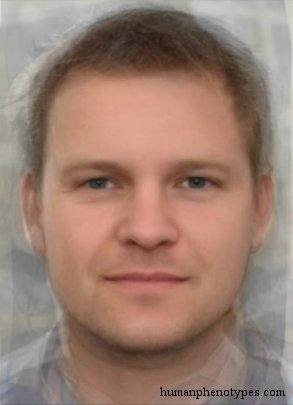
Faces from the encyclopedia that appear in this article. Open any entry for its full description, distribution, and references.
Borreby
Central Europe
Ancient Northern European variety. Named after some of the Neolithic Borreby skulls of Denmark (not all!). Some emphasised resemblance with ...
Aetid
Southeast Asia
Ancient type found in the mountains of the Philippine islands of Luzon, Mindandao and Palawan. Probably developed during the Paleolithic. Si...
Gracile Mediterranid
Southern Europe
Mediterranid proper, smaller than other Mediterranids: the most gracile type of Europe. Appears first in Mesolithic groups of Palestine (Nat...
Test what you learned
Put your eye for regional faces to work in the daily quiz — a composite face, a world map, and your best guess.