Bering Sea Phenotype - Face Features & Origin
Historical anthropology places the Bering Sea phenotype in Siberia, with a documented center near 65.8° N, 169.4° W. Western Eskimid variety common in Alaska and along the Bering Strait, esp. The sections that follow unpack the Bering Sea entry in practice: the composite face, the traits it summarizes, the naming history, and the sources.
Average Face
Averaging the portraits behind Bering Sea leaves the features that repeat and erases the ones that do not. That is exactly how the Bering Sea composite below was built: individual photographs were aligned and statistically merged, exaggerating shared structure into a single reference face that no actual person looks like.
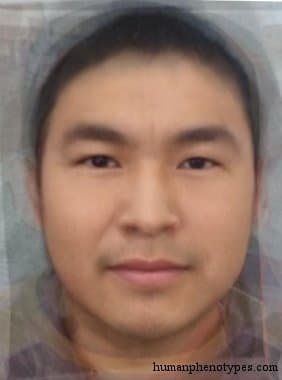
Composite source: Human Phenotypes — Bering Sea
Geographic Distribution
Bering Sea is documented across Siberia, with its historical reference center near 65.8° N, 169.4° W. The coordinates mark where the type was most characteristic roughly 1500 years ago; population movements since then have scattered and blended the distribution far beyond that point.
Physical Characteristics
Light yellowish/reddish-brown skin with light or wavy black hair.
- Rather short to medium height, (hyper-)macroskelic, short-limbed, endomorph, muscular
- Mesocephalic, ortho-, sometimes chamaecranic
- (Mildly) leptorrhine, straight nose
- Taller, wider-nosed and wider-skulled than Inuid
- Cranial capacity very large, cheekbones prominent, hairiness moderate, Mongolian folds frequent
Historical Background
Western Eskimid variety common in Alaska and along the Bering Strait, esp. St. Lawrence Island. The result of a relatively late migration to America. Eskimids show the most extreme adaptions to Arctic climate in the world. Typified by Alaskan and Siberian Yupik, sometimes in Alutiiq, Inuit, Aleuts, and coastal Chuckis, rarer in Kutchin and Ingalik. Native from Siberia to Greenland.
Research History & Naming
Every label in the historical catalogue has an author and a date, and Bering Sea has accumulated its share of competing attributions. For Bering Sea, the literature extract below shows the naming chain — from the first definition through the later revisions that shaped the current entry.
Debets (1951) and Levin (1963) identified it in Asia as the Bering Sea type, an Arctic subtype. The latter separates Western and Eastern Eskimo following earlier works (e.g. Hrdlicka, 1930 ; Shapiro, 1931 ). Biasutti (1967) called it the Alaskan Eskimo subtype.
Comparison With Nearby Phenotypes
Ranked by great-circle distance from Bering Sea's reference center, these are the five nearest documented phenotypes — the closest being Chukchid at 954 km. Overlapping distributions like these are exactly what makes the quiz hard, and the Chukchid row is where to start looking.
| Phenotype | Region | Distance | Distinguishing trait |
|---|---|---|---|
| Chukchid | Siberia | 954 km | Light yellowish/reddish-brown skin with straight or wavy black, sometimes lighter hair. |
| Athabaskid | North America | 1,613 km | Light yellowish-brown skin, straight, sometimes wavy dark brown, occasionally lighter hair. |
| Pacifid (proper) | North America | 2,643 km | Light yellowish-brown skin, straight or wavy, dark brown, occasionally lighter hair. |
| Amur-Sakhalin | Siberia | 3,188 km | Light yellowish-brown skin with coarse straight to wavy, usually black hair and mostly dark eyes. |
| Katanga | Siberia | 3,193 km | Light yellowish-brown skin, darker than the Baykal type, coarse straight hair. |
Bering Sea in the Game
When the Bering Sea composite shows up in the quiz, players who know the Siberia distribution pattern have the edge. The reference answer sits near 65.8° N, 169.4° W; pins on the wrong continent score close to zero, so even a rough regional instinct beats a precise but misdirected pin.
Bering Sea Phenotype FAQ
- Where does the Bering Sea phenotype come from?
- Historical sources center the Bering Sea phenotype on 65.8° N, 169.4° W (Siberia). Treat that as a rough anchor: the type appeared across a wider surrounding area — its nearest documented neighbors, Chukchid and Athabaskid, sit 954 and 1,613 km from the reference point — and its present-day distribution no longer matches the historical map.
- What does the Bering Sea phenotype look like?
- The composite emphasizes recurring traits: light yellowish/reddish-brown skin with light or wavy black hair. The full trait list for Bering Sea appears in the physical characteristics section above.
- Is the Bering Sea phenotype a race or a nationality?
- No. Phenotypes like Bering Sea are descriptive averages, not ancestry groups. Bering Sea is one of several types documented in and around Siberia — see the comparison table above — and the same individual can carry traits associated with several of them at once. The Bering Sea entry describes a statistical pattern, not a group of people and not a nationality.
- How does Bering Sea appear in the game?
- When the Bering Sea face comes up in Classic Daily or Challenge Mode, you pin the world map where you believe the type is historically most common, and the score decays with your distance to 65.8° N, 169.4° W. The nearest documented type, Chukchid, lies about 954 km away, so regional placement usually carries most of the score.
References & Literature
Primary sources for the Bering Sea entry, listed as cited in the historical literature. The naming and classification debates around Bering Sea referenced above run through these works.
- Debets, G. F. 1951. Zaselenie Juznoj i Perednej Azii po dannym antropologii. Trudy Inst. Ethnograf. AN SSSR 16. 355-370.
- Levin, M. G. 1963. Ethnic origins of the people of Northeastern Asia. Arctic Inst. North America, Anthropology of the North. Translations from Russian sources 3. Toronto.
- Hrdlicka, A. 1930. Anthropological Survey in Alaska. Ann. Report Bur. Am. Ethnol. 46. 19-374.
- Shapiro, H. L. 1931. The Alaskan Eskimo. Anthrop. Papers Am. Mus. Nat. Hist. 31, 6, 346-384.
- Biasutti, R. 1967 (1941). Le Razze e i Popoli della terra. 4th Ed. Vol 1-4. U.T.E.T., Torino.
Related Phenotypes
More entries from the same region of the historical map as Bering Sea, each with its own composite and trait profile.
Chukchid
Siberia · 954 km away
Far Eastern Sibirid variety, influenced by Eskimid, adapted to one of the coldest inhabitable places on Earth: the Arctic tundra of Chukotka...
Athabaskid
North America · 1,613 km away
Northern Pacifid variety, heavily influenced by Sibirid and Eskimid admixture. Developed by relatively late migrations from Asia some millen...
Pacifid (proper)
North America · 2,643 km away
American type, native to the moist forests of the North Pacific coast, from Aleuts across South Alaska, British Columbia to Oregon. Purest i...
Amur-Sakhalin
Siberia · 3,188 km away
Distinctive Tungid variety, probably split from neighbouring types at the end of the Paleolithic. Native to parts of the Sakhalin-Amur regio...
Katanga
Siberia · 3,193 km away
Western Tungid variety, influenced by Sibirid, but with several distinctive features differentiating it from both. Named after the Khatanga ...
Further Reading
Background articles from the blog that explain where the Bering Sea type fits, how these composites are built, and what a face can and cannot tell you.
Ethnic Guesser: Which Facial Cues Actually Decide a Round
A round of the game turns on a handful of facial cues, and they are not equal. Here is how pigment, the epicanthic fold, nasal shape...
How AI Guesses Ethnicity From a Face: Eigenfaces, Landmarks, and Neural Networks
From Turk and Pentland's eigenfaces in 1991 to modern convolutional networks, face-classification AI has one core trick: reduce a face...