Chukchid Phenotype - Face Features & Origin
Far Eastern Sibirid variety, influenced by Eskimid, adapted to one of the coldest inhabitable places on Earth: the Arctic tundra of Chukotka and Kamchatka. Its reference coordinates sit near 66.0° N, 169.5° E in Siberia. Rather than a single portrait, the Chukchid composite below is a statistical average, and the surrounding sections — traits, distribution, research history, references — give that average its context.
Average Face
What you see below is a statistical construction of the Chukchid reference population. Faces recorded from the Chukchid sample were overlaid and merged; the result keeps the features most members shared and discards personal variation. It reads like a Chukchid portrait, but it works like a histogram.
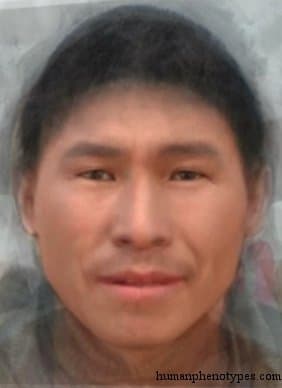
Composite source: Human Phenotypes — Chukchid
Geographic Distribution
Geographically, Chukchid anchors to 66.0° N, 169.5° E (Siberia). That is the point where historical anthropologists judged Chukchid most concentrated, not a hard edge; modern migration and intermarriage have long since softened whatever boundaries once existed.
Physical Characteristics
Light yellowish/reddish-brown skin with straight or wavy black, sometimes lighter hair.
- (Rather) short, endomorph, muscular, strongly macroskelic with short limbs
- Mesocephalic, occasionally brachycephalic, chamae- orthocranic
- Mildly leptorrhine, relatively high rooted, sometimes convex nose (especially in men)
- Face is short, rather narrow and high with robust features and a massive jaw
- Body hair scant, eyes slanting sometimes with epicanthus
Historical Background
Far Eastern Sibirid variety, influenced by Eskimid, adapted to one of the coldest inhabitable places on Earth: the Arctic tundra of Chukotka and Kamchatka. In its purest form in Koryak and Reindeer Chukchis. Has an Itelmen subvariety that is heavily mixed with Russian blood today. Sometimes in coastal Chukchis, Evens, Yukaghirs, Aleutians, and Native Americans of the Northern Pacific coast, e.g. Haida.
Research History & Naming
Typological names were coined, contested, and renamed repeatedly across the 20th century, and Chukchid is no exception. The extract below records the researchers who defined Chukchid, the alternative labels it accumulated, and where the modern consensus settled.
The name was coined by Lundman (1967) who regarded it a Beringid subtype together with Eskimid. Debets ( 1951 , 1974 ) and Levin (1963) called it Kamchatka type, others named it East Sibirid ( Eickstedt, 1952 ; Knussmann, 1996 ). Biasutti (1967) regarded it the Camciadala variety of Paleo Sibirid. Detailed study by Jochelson-Brodsky (1906) .
Comparison With Nearby Phenotypes
Geography, not alphabet, ordered this table: the five phenotype centers closest to Chukchid's, with the traits most likely to be mistaken for it (Bering Sea leads at 954 km). In gameplay, these five account for most of the wrong-but-nearby pins against Chukchid.
| Phenotype | Region | Distance | Distinguishing trait |
|---|---|---|---|
| Bering Sea | Siberia | 954 km | Light yellowish/reddish-brown skin with light or wavy black hair. |
| Amur-Sakhalin | Siberia | 2,315 km | Light yellowish-brown skin with coarse straight to wavy, usually black hair and mostly dark eyes. |
| Katanga | Siberia | 2,536 km | Light yellowish-brown skin, darker than the Baykal type, coarse straight hair. |
| Athabaskid | North America | 2,546 km | Light yellowish-brown skin, straight, sometimes wavy dark brown, occasionally lighter hair. |
| Manchu-Korean | East Asia | 3,381 km | Pale yellow to dusky yellow brown skin with coarse straight, sometimes wavy hair. |
Chukchid in the Game
In gameplay terms, Chukchid rewards region-level recall: the score is computed from the distance between your pin and 66.0° N, 169.5° E. Players often confuse Chukchid with Bering Sea (954 km out) in the comparison table above — those confusions are exactly what the distance penalty is designed to expose.
Chukchid Phenotype FAQ
- Where does the Chukchid phenotype come from?
- Historical sources center the Chukchid phenotype on 66.0° N, 169.5° E (Siberia). Treat that as a rough anchor: the type appeared across a wider surrounding area — its nearest documented neighbors, Bering Sea and Amur-Sakhalin, sit 954 and 2,315 km from the reference point — and its present-day distribution no longer matches the historical map.
- What does the Chukchid phenotype look like?
- The composite emphasizes recurring traits: light yellowish/reddish-brown skin with straight or wavy black, sometimes lighter hair. The full trait list for Chukchid appears in the physical characteristics section above.
- Is the Chukchid phenotype a race or a nationality?
- No. A phenotype is a recurring bundle of visible traits documented by historical anthropologists across a population — for Chukchid, patterns such as light yellowish/reddish-brown skin with straight or wavy black, sometimes lighter hair. The Chukchid entry is not a genetic ancestry, not a nationality, and not a statement about any individual person. Two people from the same country can match completely different phenotypes — one resembling Chukchid, another closer to Bering Sea — and one phenotype can span many modern borders.
- How does Chukchid appear in the game?
- When the Chukchid face comes up in Classic Daily or Challenge Mode, you pin the world map where you believe the type is historically most common, and the score decays with your distance to 66.0° N, 169.5° E. The nearest documented type, Bering Sea, lies about 954 km away, so regional placement usually carries most of the score.
References & Literature
Every claim on this page traces back to the sources below — the researchers who defined, measured, and argued over the Chukchid type. The originals behind the Chukchid entry are worth consulting directly.
- Lundman, B. 1967. Geographische Anthropologie. Rassen und Völker der Erde. G. Fischer, Stuttgart
- Debets, G. F. 1951. Zaselenie Juznoj i Perednej Azii po dannym antropologii. Trudy Inst. Ethnograf. AN SSSR 16. 355-370.
- Debets, G. 1974. Essay on the Graphical Presentation of the Genealogical Classification of Human Races. In: Bromley, Y. Soviet Ethnology and Anthropology Today. Mouton & Co.
- Levin, M. G. 1963. Ethnic origins of the people of Northeastern Asia. Arctic Inst. North America, Anthropology of the North. Translations from Russian sources 3. Toronto.
- Eickstedt, E. von. 1952. Biodynamik der Europiden. In: Historia Mundi. Band 1, Munich, 115-134.
- Knussmann, R. 1996. Vergleichende Biologie des Menschen: Lehrbuch der Anthropologie und Humangenetik. 2ed. Spektrum Akademischer Verlag.
- Biasutti, R. 1967 (1941). Le Razze e i Popoli della terra. 4th Ed. Vol 1-4. U.T.E.T., Torino.
- Jochelson-Brodsky, D. 1906. Zur Topographie des weiblichen Körpers nordostsibirischer Völker. Braunschweig.
Related Phenotypes
Other human phenotypes whose documented centers lie in the same part of the map as Chukchid.
Bering Sea
Siberia · 954 km away
Western Eskimid variety common in Alaska and along the Bering Strait, esp. St. Lawrence Island. The result of a relatively late migration to...
Amur-Sakhalin
Siberia · 2,315 km away
Distinctive Tungid variety, probably split from neighbouring types at the end of the Paleolithic. Native to parts of the Sakhalin-Amur regio...
Katanga
Siberia · 2,536 km away
Western Tungid variety, influenced by Sibirid, but with several distinctive features differentiating it from both. Named after the Khatanga ...
Athabaskid
North America · 2,546 km away
Northern Pacifid variety, heavily influenced by Sibirid and Eskimid admixture. Developed by relatively late migrations from Asia some millen...
Manchu-Korean
East Asia · 3,381 km away
North Sinid subtype, significantly influenced by Tungid. Typified by Manchu and Koreans. Most common in Manchuria / North China, and Central...
Further Reading
Background articles from the blog that explain where the Chukchid type fits, how these composites are built, and what a face can and cannot tell you.
Ethnicity Guesser vs hbd.gg: Two Ways to Ask a Face
Two sites ask a face to name a place. Here is what each one shows you, where breadth and provenance actually differ, and how to tell...
How AI Guesses Ethnicity From a Face: Eigenfaces, Landmarks, and Neural Networks
From Turk and Pentland's eigenfaces in 1991 to modern convolutional networks, face-classification AI has one core trick: reduce a face...