Andronovo-Turanid Phenotype - Face Features & Origin
Historical anthropology places the Andronovo-Turanid phenotype in Central Asia, with a documented center near 53.2° N, 50.1° E. Northern Turanid variant, has probably been more widespread prior to the Tungid expansion of Hunnic, Avar, and Chasar tribes. The sections that follow unpack the Andronovo-Turanid entry in practice: the composite face, the traits it summarizes, the naming history, and the sources.
Average Face
Averaging the portraits behind Andronovo-Turanid leaves the features that repeat and erases the ones that do not. That is exactly how the Andronovo-Turanid composite below was built: individual photographs were aligned and statistically merged, exaggerating shared structure into a single reference face that no actual person looks like.
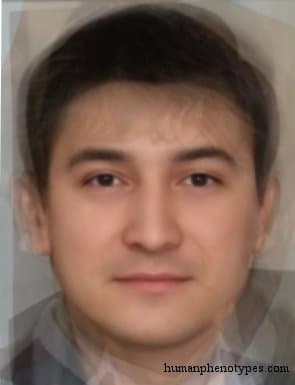
Composite source: Human Phenotypes — Andronovo-Turanid
Geographic Distribution
Geographically, Andronovo-Turanid anchors to 53.2° N, 50.1° E (Central Asia). That is the point where historical anthropologists judged Andronovo-Turanid most concentrated, not a hard edge; modern migration and intermarriage have long since softened whatever boundaries once existed.
Physical Characteristics
Light brown skin, straight or wavy brown-black hair with dark or greenish eyes.
- Rather tall, mesoskelic, ectomorph to mesomorph
- Mildly brachycephalic, mildly hypsicranic
- Leptorrhine, sometimes convex nose
- Face and angle of the mandible is wide, features robust, eyes mildly slanting, body hair relatively strong, the forehead steep
Historical Background
Northern Turanid variant, has probably been more widespread prior to the Tungid expansion of Hunnic, Avar, and Chasar tribes. Influenced by the old Andronovo type, possibly even early Nordids and Pontids. May be regarded as North Pamirid. Probably common in the Neolithic Samara culture. Today most common in the Kazan Tatars, but also in other Turkic people.
Research History & Naming
Typological names were coined, contested, and renamed repeatedly across the 20th century, and Andronovo-Turanid is no exception. The extract below records the researchers who defined Andronovo-Turanid, the alternative labels it accumulated, and where the modern consensus settled.
Henkey and Horvath (1998) , who investigated Kazakh, defined the type as Andronovo Turanid, Tóth (1992) found traces in Hungarians. Described as Sarmatian / Eurasian steppe type by Ginsburg (1968) and Bunak (1976) , who noted presence in Kazan Tatars. Drontschilow (1915) and Battaglia (1967b) mention traces in Bulgaria. Vondernach (2008) classifies ancient Sarmatians as pred. Pamirid.
Comparison With Nearby Phenotypes
Ranked by great-circle distance from Andronovo-Turanid's reference center, these are the five nearest documented phenotypes — the closest being Volgid at 502 km. Overlapping distributions like these are exactly what makes the quiz hard, and the Volgid row is where to start looking.
| Phenotype | Region | Distance | Distinguishing trait |
|---|---|---|---|
| Volgid | Eastern Europe | 502 km | Fair skin, usually straight, sometimes wavy, brown to black hair, often, but not always dark eyes. |
| Aralid | Central Asia | 1,162 km | Light yellowish-brown skin, straight, sometimes wavy hair. |
| Mtebid | Caucasus | 1,249 km | Light brown skin, straight or wavy, usually brown hair. |
| Ladogan | Eastern Europe | 1,393 km | Pale to fair skin, usually straight, sometimes wavy, blonde to dark brown hair, mixed eyes. |
| Uralid | Siberia | 1,459 km | Light brown skin, straight or wavy, usually brown, sometimes red, blonde, or black hair and mixed eyes. |
Andronovo-Turanid in the Game
When the Andronovo-Turanid composite shows up in the quiz, players who know the Central Asia distribution pattern have the edge. The reference answer sits near 53.2° N, 50.1° E; pins on the wrong continent score close to zero, so even a rough regional instinct beats a precise but misdirected pin.
Andronovo-Turanid Phenotype FAQ
- Where does the Andronovo-Turanid phenotype come from?
- The reference coordinates for the Andronovo-Turanid phenotype sit near 53.2° N, 50.1° E, in Central Asia. That point marks the center of the Central Asia distribution documented roughly 1500 years ago — actual prevalence spread well beyond it, toward entries such as Volgid 502 km away, and modern migration has blurred those boundaries further.
- What does the Andronovo-Turanid phenotype look like?
- In the historical literature, light brown skin, straight or wavy brown-black hair with dark or greenish eyes. For Andronovo-Turanid these are statistical tendencies across a population, not a checklist every individual matches.
- Is the Andronovo-Turanid phenotype a race or a nationality?
- No. A phenotype is a recurring bundle of visible traits documented by historical anthropologists across a population — for Andronovo-Turanid, patterns such as light brown skin, straight or wavy brown-black hair with dark or greenish eyes. The Andronovo-Turanid entry is not a genetic ancestry, not a nationality, and not a statement about any individual person. Two people from the same country can match completely different phenotypes — one resembling Andronovo-Turanid, another closer to Volgid — and one phenotype can span many modern borders.
- How does Andronovo-Turanid appear in the game?
- In Classic Daily and Challenge Mode, the Andronovo-Turanid composite face appears without a label. Your task is to drop a pin on the world map where you think that face is historically most common — the scoring uses the distance between your pin and the reference coordinates near 53.2° N, 50.1° E. The post-round review then shows the correct location, your distance error, and this Andronovo-Turanid entry.
References & Literature
Every claim on this page traces back to the sources below — the researchers who defined, measured, and argued over the Andronovo-Turanid type. The originals behind the Andronovo-Turanid entry are worth consulting directly.
- Haeckel, E. 1898. Natürliche Schöpfungsgeschichte. 9. Ed. Berlin.
- Tóth, T. 1992. Somatology and paleoanthropology of the Hungarians (to the problems of their origin). - Anthrop. hung. 22: 17-39.
- Ginsburg, V. V. 1968. An anthropological characterization of the Sarmatians in the Volga area. Annales Historico-Naturales Musei Nationalis Hungarici Parts anthropologica. 60. Leningrad.
- Bunak, V. V. 1976. Rassengeschichte Osteuropas. In: Schwidetzky, I.: Rassengeschichte der Menschheit, Ost- und Nordeuropa. R. Odenbourg. München. Wien.
- Drontschilow, K. 1915. Beiträge zur Anthropologie der Bulgaren. AFA. 14.
- Biasutti, R. and J. Gomez-Tabanera. 1967. L'Asia Centrale. In: Biasutti, R. Le Razze e i Popoli della terra. 4th Ed. Vol 1-4. U.T.E.T., Torino.
- Vonderach, A. 2008. Anthropologie Europas. Völker, Typen und Gene vom Neandertaler bis zur Gegenwart. Ares Verlag. Graz.
Related Phenotypes
Other human phenotypes whose documented centers lie in the same part of the map as Andronovo-Turanid.
Volgid
Eastern Europe · 502 km away
Eurasian type, especially common west of the Ural in the basins of Sura and Moksha Rivers of Russia. Found in Mari, Chuvash, Volga-Finns. Mo...
Aralid
Central Asia · 1,162 km away
West Tungid variety of the vast Central Asian steppes, influenced by Turanid. Developed in ancient times when Hunnic, Avar, and Chasar expan...
Mtebid
Caucasus · 1,249 km away
Regional type of the Caucasus Mountains. Probably an Alpinised Dinaro-Armenid adapted to life in mountainous regions. Mtebids are typical of...
Ladogan
Eastern Europe · 1,393 km away
Ancient, mostly Europid type of Northeastern Europe and Western Siberia associated with the ancient Kammkeramik culture. Probably played a r...
Uralid
Siberia · 1,459 km away
West Sibirid subtype, especially common in the basin of the Ob River among Khanty and Mansi people. Sometimes in Altai and Khakassia. Due to...
Further Reading
Background articles from the blog that explain where the Andronovo-Turanid type fits, how these composites are built, and what a face can and cannot tell you.
The Daily Face Quiz: How Classic Daily Works (and How to Get Better)
Ten composite faces, one world map, the same ten questions for every player each day, up to 5,000 points. The mechanics of the daily...
Ethnicity Do I Look: A Question About Observers
The phrase is a fragment of a longer question, and its verb points at an observer, not at you. Perception research shows what observers...