Aralid Phenotype - Face Features & Origin
Historical anthropology places the Aralid phenotype in Central Asia, with a documented center near 45.1° N, 60.2° E. West Tungid variety of the vast Central Asian steppes, influenced by Turanid. The sections that follow unpack the Aralid entry in practice: the composite face, the traits it summarizes, the naming history, and the sources.
Average Face
Averaging the portraits behind Aralid leaves the features that repeat and erases the ones that do not. That is exactly how the Aralid composite below was built: individual photographs were aligned and statistically merged, exaggerating shared structure into a single reference face that no actual person looks like.
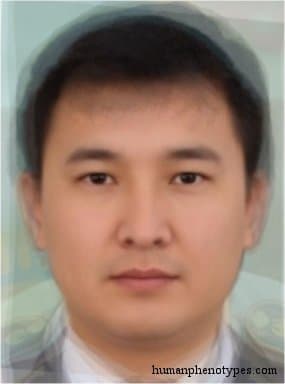
Composite source: Human Phenotypes — Aralid
Geographic Distribution
Aralid is documented across Central Asia, with its historical reference center near 45.1° N, 60.2° E. The coordinates mark where the type was most characteristic roughly 1500 years ago; population movements since then have scattered and blended the distribution far beyond that point.
Physical Characteristics
Light yellowish-brown skin, straight, sometimes wavy hair.
- Medium height, macroskelic, endomorph
- Mildly leptorrhine, sometimes concave nose
- (Hyper-)brachycephalic, chamae- orthocranic
- Cheek bones very prominent, face and jaw broad, forehead slanted, eyebrows thick
- Mongolian fold and facial flatness moderate
Historical Background
West Tungid variety of the vast Central Asian steppes, influenced by Turanid. Developed in ancient times when Hunnic, Avar, and Chasar expansions replaced older Turanid, Mediterranid, and Nordid populations. Today most common in Kazakhs, but also in other Turkic people like Kyrgyz, Uzbeks, and Tatars. In lower frequencies in Yakuts, Nenets, Uyghurs, Mongols, and many others.
Research History & Naming
Every label in the historical catalogue has an author and a date, and Aralid has accumulated its share of competing attributions. For Aralid, the literature extract below shows the naming chain — from the first definition through the later revisions that shaped the current entry.
Originally named Turko-Tatar ( Deniker, 1900 ). After Schwidetzky's (1950) study Eickstedt (1952b) and Biasutti (1967) placed it closer to Tungid as "Aralid". Lundman (1967) named it Kumid. Oshanin's (1964) northwestern and Alexeev's (1979) Kazakhstanian South Siberian variety roughly identical. South Siberian or Altai-Caspian is also used by Levin (1963) and Bunak (1976) .
Comparison With Nearby Phenotypes
Geography, not alphabet, ordered this table: the five phenotype centers closest to Aralid's, with the traits most likely to be mistaken for it (Transcaspian leads at 638 km). In gameplay, these five account for most of the wrong-but-nearby pins against Aralid.
| Phenotype | Region | Distance | Distinguishing trait |
|---|---|---|---|
| Transcaspian | Central Asia | 638 km | Light brown skin, straight dark hair. |
| Plains Pamirid | Central Asia | 1,018 km | Light brown skin, often straight, brown or black hair, eyes sometimes mixed. |
| Andronovo-Turanid | Central Asia | 1,162 km | Light brown skin, straight or wavy brown-black hair with dark or greenish eyes. |
| East Pamirid | Central Asia | 1,231 km | Light brown skin, straight or wavy, often brown hair, and mixed eyes. |
| Central Pamirid | Central Asia | 1,249 km | Light brown skin, straight or wavy, brown-black hair. |
Aralid in the Game
In gameplay terms, Aralid rewards region-level recall: the score is computed from the distance between your pin and 45.1° N, 60.2° E. Players often confuse Aralid with Transcaspian (638 km out) in the comparison table above — those confusions are exactly what the distance penalty is designed to expose.
Aralid Phenotype FAQ
- Where does the Aralid phenotype come from?
- Historical sources center the Aralid phenotype on 45.1° N, 60.2° E (Central Asia). Treat that as a rough anchor: the type appeared across a wider surrounding area — its nearest documented neighbors, Transcaspian and Plains Pamirid, sit 638 and 1,018 km from the reference point — and its present-day distribution no longer matches the historical map.
- What does the Aralid phenotype look like?
- The composite emphasizes recurring traits: light yellowish-brown skin, straight, sometimes wavy hair. The full trait list for Aralid appears in the physical characteristics section above.
- Is the Aralid phenotype a race or a nationality?
- No — and the Aralid naming history above shows why. Aralid was defined, renamed, and regrouped repeatedly by different researchers, which is the opposite of how a fixed racial category would behave. A phenotype is a recurring bundle of visible traits recorded across a population; the Aralid label says nothing about where any individual's ancestors were born.
- How does Aralid appear in the game?
- When the Aralid face comes up in Classic Daily or Challenge Mode, you pin the world map where you believe the type is historically most common, and the score decays with your distance to 45.1° N, 60.2° E. The nearest documented type, Transcaspian, lies about 638 km away, so regional placement usually carries most of the score.
References & Literature
Primary sources for the Aralid entry, listed as cited in the historical literature. The naming and classification debates around Aralid referenced above run through these works.
- F00
- Schwidetzky, I. 1950. Turaniden-Studien. Verl. d. Akademie d. Wissenschaften u.d. Literatur.
- Eickstedt, E. von. 1952b. Die prioritätsgerechten Bezeichnungen der menschlichen Varitäten. In: Historia Mundi. Band 1, Munich, 223-226.
- Biasutti, R. 1967 (1941). Le Razze e i Popoli della terra. 4th Ed. Vol 1-4. U.T.E.T., Torino.
- Lundman, B. 1967. Geographische Anthropologie. Rassen und Völker der Erde. G. Fischer, Stuttgart
- Oshanin, L. V. 1964. Anthropological Composition of the Population of Central Asia, and the ethnogenesis of its Peoples. Vol 1-3.
- Alexeev, V. P. 1979. The Differential Geography of Races. In: Stini, W. A. Physiological and Morphological Adaptation and Evolution. De Gruyter.
- Levin, M. G. 1963. Ethnic origins of the people of Northeastern Asia. Arctic Inst. North America, Anthropology of the North. Translations from Russian sources 3. Toronto.
- Bunak, V. V. 1976. Rassengeschichte Osteuropas. In: Schwidetzky, I.: Rassengeschichte der Menschheit, Ost- und Nordeuropa. R. Odenbourg. München. Wien.
Related Phenotypes
More entries from the same region of the historical map as Aralid, each with its own composite and trait profile.
Transcaspian
Central Asia · 638 km away
West-Central Asian Orientalid with Aralid admixture, particularly common in Turkmens. Significantly differs from other Central Asians by lon...
Plains Pamirid
Central Asia · 1,018 km away
The most widespread Pamirid variety, typical for the steppes and lowlands from Uzbekistan to Xinjiang and the Ferghana Valley. Somewhat infl...
Andronovo-Turanid
Central Asia · 1,162 km away
Northern Turanid variant, has probably been more widespread prior to the Tungid expansion of Hunnic, Avar, and Chasar tribes. Influenced by ...
East Pamirid
Central Asia · 1,231 km away
The most Europoid Pamirid subtype. Most common in Pamiri speakers of the Pamir Mountains in Eastern Tajikistan and Northern Afghanistan, esp...
Central Pamirid
Central Asia · 1,249 km away
The most typical Pamirid variety, also called Mountain Pamirid. Often considered the most typical Turanid. Most common in highland Tajiks, w...
Further Reading
Background articles from the blog that explain where the Aralid type fits, how these composites are built, and what a face can and cannot tell you.
The Daily Face Quiz: How Classic Daily Works (and How to Get Better)
Ten composite faces, one world map, the same ten questions for every player each day, up to 5,000 points. The mechanics of the daily...
Ethnicity Guesser AI: Two Model Families, Two Kinds of Error
Tools sold under the same name behave nothing alike. One prints a label from a fixed list; the other writes a sentence.