Sites Like hbd.gg: Four Ways an Answer Gets Made
Sites that look like hbd.gg differ less in branding than in what an answer is made of: an averaged photograph, a trained model, or a cited description.
Two domains, one word in the tab
Open hbd.gg and the browser tab reads EthnoGuessr. Open ethnoguessr.org, a separate domain, and the tab reads the same word followed by a claim of 350+ ethnic groups and 195 countries. Both list a mode called DoggoGuessr, both run a daily challenge beside a classic mode, and both build rounds on composite faces. Two products, one name in the tab, which is why a search for sites like hbd.gg returns pages that look interchangeable until you ask what each one actually answers with.
The difference that survives contact is supply rather than branding. hbd.gg runs six modes, among them a World Cup bracket and a Genomes mode that accepts a submitted photograph, and that breadth is real: a statically exported site cannot accept an upload at all. ethnoguessr.org claims a wider answer space than the 48 country faces here. Neither figure tells you what an answer is made of, and the material is the only thing that changes how a result should be read.
The composite is a per-pixel mean
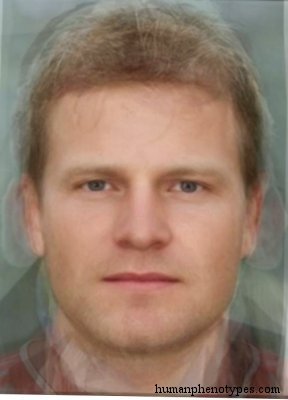
Francis Galton presented composite portraits to the Anthropological Institute in 1878, stacking successive photographic exposures of several sitters onto a single plate. Digital compositing performs the same arithmetic in RGB after the faces have been aligned on fixed landmarks, so that every eye and every mouth lands on the same pixels. The output is the mean colour of each pixel across the set, and the procedure is designed to subtract precisely what makes an individual face recognisable. What remains is a face that is statistically typical of its sample and photographically typical of nobody in it.
The arithmetic has a second consequence that shows up in the picture. Random variation at each pixel falls with the square root of the number of faces, so a composite of 48 portraits carries about one seventh of the single-face noise, since the square root of 48 is 6.9. Individual asymmetries cancel in the same way. Composites look strikingly symmetrical not because the sample was symmetrical, but because half of every deviation points the other direction and averages toward zero.
What averaging removes from the key
Judith Langlois and Lori Roggman reported in Psychological Science in 1990 that faces built by averaging many individual photographs were rated more attractive than the faces they were made from. The result has been repeated often enough to count as settled in face perception, and it matters here for a plain reason. The answer key in a composite-based round is systematically smoother, more symmetrical and better proportioned than any real face in its own sample. A player is not matching a photograph. They are matching an artefact of an averaging procedure that sits near the attractive end of the distribution it was drawn from.
Averaging also fails in a specific way when a sample is broad. Take two clusters and compute their mean, and the result lands between them, at the point where the fewest members of either cluster sit. The wider the sample, the less the composite resembles anyone inside it. That is not a defect in the software. It is what a mean is, and it is why a composite of a whole continent is a weaker clue than a composite of a single valley.
When a model supplies the label
A photo-upload tool answers with a label, and the label set is a decision made before anyone uploads anything. A classifier trained on portraits tagged by country can only return countries; trained on ethnic-group tags, it can only return those. The result often arrives as a probability, which reads like confidence and is really a position in a softmax over whatever classes the training data happened to contain. The real advantage is speed and reach: an arbitrary photograph, in seconds, with no key to build and no sample to align.
The cost is that there is nothing to check. A probability cannot be traced to a sample, a region or a year, and a tool returning 0.87 for one label has said nothing about what that number was computed from. In a game this hardly matters, because a game only needs a target. In a question about a person it matters entirely, because the number looks like a measurement and behaves like an opinion.
The catalogue answers with a citation
The 209 entries on this site answer differently. Each names a pattern, a region and a period, then lists the literature it came from. Dalofaelid, described for central Germany, the Netherlands and southern Sweden, cites Paudler 1917, Kern 1927 and Biasutti 1967. Satsuma, assigned to the southern Japanese coasts and the Ryukyus, cites Baelz 1883 and Ten-Kate 1902. Aralid is tied to the Central Asian steppes and to the Hunnic, Avar and Chasar expansions that replaced earlier populations there.
The advantage is that a claim can be followed. Anyone can take the citation, read the original and decide whether the description holds up. The cost is that the catalogue cannot look at your face. It has no upload, no score for an individual, and no way to turn a described distribution into a statement about one person, which is a limit stated on every page rather than a gap waiting to be filled.
The two answers describe different centuries
Composites and classifiers are built from photographs of living people, taken mostly within the last century. The catalogue describes distributions as recorded in the typological literature, with a working baseline of roughly 1500 years ago. Between those two dates sit the Mongol expansions, the Atlantic trade, the colonisations, the industrial city and seventy years of cheap air travel. Any comparison between a composite and a catalogue entry is therefore a comparison across centuries, not a test of one against the other.
The catalogue records the movement in its own text. East Sudanid, described as native to the Nuba mountains since the Neolithic, notes that Nilotid, Congolid and Orientalid admixture is common even in isolated villages. Entries for the steppes describe later expansions replacing older Mediterranid and Nordid populations, and entries for coasts routinely mention settlement and trade. The map was never still, and the entries say so in the middle of describing it.
Which one fits the question you have
If you want a daily game with several modes and a tournament bracket, hbd.gg has more of that than this site does, and its Genomes mode does something a static export cannot do. If you want the largest set of countries to guess between, ethnoguessr.org claims 195 against 48 here. If you want an immediate reading of a photograph, a model will supply one, provided the output is read as a label rather than a finding. If you want to know why a described face looked the way it did, and who recorded it, the catalogue is the only one of the four that can be checked by a stranger.
None of this amounts to a ranking. A composite is better at being a game, a classifier is better at being immediate, and a bibliography is better at being answerable. The four are judged by different tests, so their results cannot be ordered on a single scale, and any page that ordered them would be reporting its own preference rather than the tools.
Frequently Asked Questions
- Is hbd.gg the same site as ethnoguessr.org?
- They are separate domains that both show the word EthnoGuessr in the browser tab, and both list a mode named DoggoGuessr alongside a classic mode and a daily challenge. Their stated coverage differs: ethnoguessr.org advertises 350+ ethnic groups and 195 countries, while hbd.gg lists six modes including a World Cup bracket and a Genomes mode that takes a submitted photo. Ownership is not something an outside reader can establish from the pages themselves, so the useful comparison is between mechanisms rather than between brands.
- What is a composite face actually made of?
- It is the per-pixel mean of a set of portraits, after the faces have been aligned so that features land on the same coordinates. Francis Galton demonstrated the technique in 1878 by stacking photographic exposures; software now averages colour values directly. Because random pixel noise and individual asymmetries cancel, the result is smoother and more symmetrical than any member of the set, and studies since Langlois and Roggman in 1990 have found such faces rated more attractive than their sources. It is a statistical artefact, not a photograph of a person.
- Can any of these sites tell me my ethnicity?
- No, and the honest ones say so. A game returns a distance between your guess and a composite, which measures how well you recognised an image. A photo classifier returns a label drawn from whatever classes its training data contained. This catalogue returns a description of a documented historical pattern with its sources. None of the three is a statement about an individual's ancestry, and ancestry itself is better answered by a DNA test with a named reference panel than by any face.
Related Phenotypes
Faces from the encyclopedia that appear in this article. Open any entry for its full description, distribution, and references.
Dalofaelid
Northern Europe
Coarse, Cromagniform Nordid variety of Central and Northern Europe. Named after the Swedish province of Dalarna and the German region of Wes...
Satsuma
East Asia
South Mongolid type of Japan and Korea, somewhat influenced by Tungid. Named after the Satsuma region of Kagoshima. Today the most populous ...
Aralid
Central Asia
West Tungid variety of the vast Central Asian steppes, influenced by Turanid. Developed in ancient times when Hunnic, Avar, and Chasar expan...
East Sudanid
East Africa
Isolated Sudanid variety of the Nuba mountains in Kurdufan / Sudan, native to the region at least since the Neolithic. Has resisted historic...
Test what you learned
Put your eye for regional faces to work in the daily quiz — a composite face, a world map, and your best guess.