Transcaspian Phenotype - Face Features & Origin
Historical anthropology places the Transcaspian phenotype in Central Asia, with a documented center near 39.4° N, 59.4° E. West-Central Asian Orientalid with Aralid admixture, particularly common in Turkmens. The sections that follow unpack the Transcaspian entry in practice: the composite face, the traits it summarizes, the naming history, and the sources.
Average Face
Averaging the portraits behind Transcaspian leaves the features that repeat and erases the ones that do not. That is exactly how the Transcaspian composite below was built: individual photographs were aligned and statistically merged, exaggerating shared structure into a single reference face that no actual person looks like.
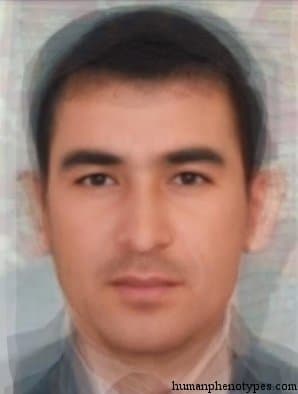
Composite source: Human Phenotypes — Transcaspian
Geographic Distribution
Transcaspian is documented across Central Asia, with its historical reference center near 39.4° N, 59.4° E. The coordinates mark where the type was most characteristic roughly 1500 years ago; population movements since then have scattered and blended the distribution far beyond that point.
Physical Characteristics
Light brown skin, straight dark hair.
- Rather tall, mesoskelic, ectomorph
- Mesocephalic, hypsicranic with a (strongly) leptorrhine, sometimes convex nose
- Face is long and thin
- Beard growth is moderate and weaker than in Orientalids
- Eyes mildly slanting, Mongolian folds in a few individuals
Historical Background
West-Central Asian Orientalid with Aralid admixture, particularly common in Turkmens. Significantly differs from other Central Asians by longer heads and taller stature. Relatively recent contact type that probably developed in the ancient Joresmi, Alans, and Sogidans due to Mongoloid admixture during the first millennium. Extends in low frequencies to Afghanistan, Iran, Azerbaijan, Uzbekistan, and Turkey.
Research History & Naming
Every label in the historical catalogue has an author and a date, and Transcaspian has accumulated its share of competing attributions. For Transcaspian, the literature extract below shows the naming chain — from the first definition through the later revisions that shaped the current entry.
First described and named Transcaspian by Oshanin ( 1927 , 1964 ). Jarcho (1934) and Coon (1939) regarded it as a local variety of Mediterranean, Cole (1965) as the Turkoman variety of Irano Afghan. Aleksejev (1974) and others suggested to integrate it into Caspian (~Iranid). However, Debets (1970) notes strong Mongoloid features and Bernhard (1993) describes them as long-headed Turanids.
Comparison With Nearby Phenotypes
Ranked by great-circle distance from Transcaspian's reference center, these are the five nearest documented phenotypes — the closest being Aralid at 638 km. Overlapping distributions like these are exactly what makes the quiz hard, and the Aralid row is where to start looking.
| Phenotype | Region | Distance | Distinguishing trait |
|---|---|---|---|
| Aralid | Central Asia | 638 km | Light yellowish-brown skin, straight, sometimes wavy hair. |
| Iranid | Middle East | 741 km | Light brown skin, straight or wavy, brown or black hair. |
| Proto Iranid | Middle East | 865 km | Fair to light brown skin, straight or wavy, light brown to black hair. |
| Plains Pamirid | Central Asia | 1,018 km | Light brown skin, often straight, brown or black hair, eyes sometimes mixed. |
| East Pamirid | Central Asia | 1,067 km | Light brown skin, straight or wavy, often brown hair, and mixed eyes. |
Transcaspian in the Game
When the Transcaspian composite shows up in the quiz, players who know the Central Asia distribution pattern have the edge. The reference answer sits near 39.4° N, 59.4° E; pins on the wrong continent score close to zero, so even a rough regional instinct beats a precise but misdirected pin.
Transcaspian Phenotype FAQ
- Where does the Transcaspian phenotype come from?
- Historical sources center the Transcaspian phenotype on 39.4° N, 59.4° E (Central Asia). Treat that as a rough anchor: the type appeared across a wider surrounding area — its nearest documented neighbors, Aralid and Iranid, sit 638 and 741 km from the reference point — and its present-day distribution no longer matches the historical map.
- What does the Transcaspian phenotype look like?
- The composite emphasizes recurring traits: light brown skin, straight dark hair. The full trait list for Transcaspian appears in the physical characteristics section above.
- Is the Transcaspian phenotype a race or a nationality?
- No. Phenotypes like Transcaspian are descriptive averages, not ancestry groups. Transcaspian is one of several types documented in and around Central Asia — see the comparison table above — and the same individual can carry traits associated with several of them at once. The Transcaspian entry describes a statistical pattern, not a group of people and not a nationality.
- How does Transcaspian appear in the game?
- When the Transcaspian face comes up in Classic Daily or Challenge Mode, you pin the world map where you believe the type is historically most common, and the score decays with your distance to 39.4° N, 59.4° E. The nearest documented type, Aralid, lies about 638 km away, so regional placement usually carries most of the score.
References & Literature
Primary sources for the Transcaspian entry, listed as cited in the historical literature. The naming and classification debates around Transcaspian referenced above run through these works.
- Oshanin, L. V. 1927. Les matériaux sur l'anthropologie de l'Asie Centrale. Bull de l'Univ. de l'Asie Centrale Taschkent XVI, 172-185, XVII, 63-102.
- Oshanin, L. V. 1964. Anthropological Composition of the Population of Central Asia, and the ethnogenesis of its Peoples. Vol 1-3.
- Jarcho, A. I. 1934. Antropologiceskii sostav turetskich narodnostej Azii. Anthrop. Zurn.
- Coon, C.S.. 1939.. The Races of Europe. The Macmillan Company. New York.
- Cole, S. 1965. Races of Man. Butler & Tanner Ltd. Frome and London.
- Alekseyev, V. P. 1974. Geography of the human race.
- Debets, G. F. 1970. Physcial anthropology of Afghanistan. 1-2. Russ. Transl. Ser., Peabody Mus. Arch. Ethnol 4, Cambridge.
- Bernhard, W. 1993. Anthropologie von Südwestasien. In.: Schwidetzky, I.: Rassengeschichte der Menschheit 14, Asien 4. Oldenbourg.
Related Phenotypes
More entries from the same region of the historical map as Transcaspian, each with its own composite and trait profile.
Aralid
Central Asia · 638 km away
West Tungid variety of the vast Central Asian steppes, influenced by Turanid. Developed in ancient times when Hunnic, Avar, and Chasar expan...
Iranid
Middle East · 741 km away
Distinctive type of the Iranian Plateau. One of the main elements in Persians, especially in Southwestern Iran. An important element in Kurd...
Proto Iranid
Middle East · 865 km away
Coarse type of Iran and Asia Minor, that can be considered an eastern Eurafricanid variety. More ancient than the more gracile Iranids and P...
Plains Pamirid
Central Asia · 1,018 km away
The most widespread Pamirid variety, typical for the steppes and lowlands from Uzbekistan to Xinjiang and the Ferghana Valley. Somewhat infl...
East Pamirid
Central Asia · 1,067 km away
The most Europoid Pamirid subtype. Most common in Pamiri speakers of the Pamir Mountains in Eastern Tajikistan and Northern Afghanistan, esp...
Further Reading
Background articles from the blog that explain where the Transcaspian type fits, how these composites are built, and what a face can and cannot tell you.
Ethnicity From a Face: Which Layer Carries the Signal
A face is not one trait but a stack of layers, and asking a photograph for ethnicity from face assumes every one of those layers tells...
Ethnicity Do I Look: A Question About Observers
The phrase is a fragment of a longer question, and its verb points at an observer, not at you. Perception research shows what observers...