Uralid Phenotype - Face Features & Origin
West Sibirid subtype, especially common in the basin of the Ob River among Khanty and Mansi people. Its reference coordinates sit near 61.9° N, 68.6° E in Siberia. Rather than a single portrait, the Uralid composite below is a statistical average, and the surrounding sections — traits, distribution, research history, references — give that average its context.
Average Face
What you see below is a statistical construction of the Uralid reference population. Faces recorded from the Uralid sample were overlaid and merged; the result keeps the features most members shared and discards personal variation. It reads like a Uralid portrait, but it works like a histogram.
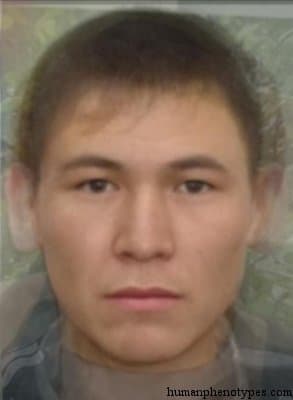
Composite source: Human Phenotypes — Uralid
Geographic Distribution
The reference center for Uralid sits near 61.9° N, 68.6° E in Siberia. Around that anchor, prevalence falls off gradually — the type is not confined to one valley or one modern border, and the historical map should be read as a gradient rather than a boundary.
Physical Characteristics
Light brown skin, straight or wavy, usually brown, sometimes red, blonde, or black hair and mixed eyes.
- Short, macroskelic, endomorph
- Mesocephalic, chamaecranic with a mesorrhine, moderately prominent, and occasionally plump nose (especially in females)
- The face is flat in some individuals
- Hair growth is average, cheekbones and the folds of the upper eyelids are strong
- Lips very thin
Historical Background
West Sibirid subtype, especially common in the basin of the Ob River among Khanty and Mansi people. Sometimes in Altai and Khakassia. Due to the harsh Siberian climate, this type was never very numerous. Today, the indigenous groups are largely outnumbered by Russians.
Research History & Naming
Every label in the historical catalogue has an author and a date, and Uralid has accumulated its share of competing attributions. For Uralid, the literature extract below shows the naming chain — from the first definition through the later revisions that shaped the current entry.
The type was named Uralic by Bunak (1932) , who divided it as the Uralic proper (Oby variant) from Sub Uralic (~Volgid). This was adopted by later Russian authors (e.g. Alexeev, 1979 ). Biasutti (1967) also defined an Uralid race. Described as a West Sibirid Obid subrace by Lundman ( 1943 , 1952 ), part of West Sibirid for Eickstedt (1952) .
Comparison With Nearby Phenotypes
Ranked by great-circle distance from Uralid's reference center, these are the five nearest documented phenotypes — the closest being Samoyedic at 896 km. Overlapping distributions like these are exactly what makes the quiz hard, and the Samoyedic row is where to start looking.
| Phenotype | Region | Distance | Distinguishing trait |
|---|---|---|---|
| Samoyedic | Siberia | 896 km | Light yellowish-brown skin with coarse-straight brown or black, rarely blonde hair. |
| Yenisey | Siberia | 1,107 km | Yellowish-reddish light brown skin, straight brown or black hair and mixed eyes. |
| Andronovo-Turanid | Central Asia | 1,459 km | Light brown skin, straight or wavy brown-black hair with dark or greenish eyes. |
| Volgid | Eastern Europe | 1,523 km | Fair skin, usually straight, sometimes wavy, brown to black hair, often, but not always dark eyes. |
| Katanga | Siberia | 1,877 km | Light yellowish-brown skin, darker than the Baykal type, coarse straight hair. |
Uralid in the Game
When the Uralid composite shows up in the quiz, players who know the Siberia distribution pattern have the edge. The reference answer sits near 61.9° N, 68.6° E; pins on the wrong continent score close to zero, so even a rough regional instinct beats a precise but misdirected pin.
Uralid Phenotype FAQ
- Where does the Uralid phenotype come from?
- Historical sources center the Uralid phenotype on 61.9° N, 68.6° E (Siberia). Treat that as a rough anchor: the type appeared across a wider surrounding area — its nearest documented neighbors, Samoyedic and Yenisey, sit 896 and 1,107 km from the reference point — and its present-day distribution no longer matches the historical map.
- What does the Uralid phenotype look like?
- The composite emphasizes recurring traits: light brown skin, straight or wavy, usually brown, sometimes red, blonde, or black hair and mixed eyes. The full trait list for Uralid appears in the physical characteristics section above.
- Is the Uralid phenotype a race or a nationality?
- No. Phenotypes like Uralid are descriptive averages, not ancestry groups. Uralid is one of several types documented in and around Siberia — see the comparison table above — and the same individual can carry traits associated with several of them at once. The Uralid entry describes a statistical pattern, not a group of people and not a nationality.
- How does Uralid appear in the game?
- When the Uralid face comes up in Classic Daily or Challenge Mode, you pin the world map where you believe the type is historically most common, and the score decays with your distance to 61.9° N, 68.6° E. The nearest documented type, Samoyedic, lies about 896 km away, so regional placement usually carries most of the score.
References & Literature
Primary sources for the Uralid entry, listed as cited in the historical literature. The naming and classification debates around Uralid referenced above run through these works.
- Bunak, V. 1932. Neues Material zur Aussonderung anthropologischer Typen unter der Bevölkerung Osteuropas. Zeitschrift für Morphologie und Anthropologie, 30 (3). 441-503.
- Alexeev, V. P. 1979. The Differential Geography of Races. In: Stini, W. A. Physiological and Morphological Adaptation and Evolution. De Gruyter.
- Biasutti, R. 1967 (1941). Le Razze e i Popoli della terra. 4th Ed. Vol 1-4. U.T.E.T., Torino.
- Lundman, B. 1943. Jordens Människoraser och Folkstammar. Nybloms Förlag, Uppsala.
- Lundman, B. 1952. Umriss der Rassenkunde des Menschen in geschichtlicher Zeit. Ejnar Munksgaard. Kopenhagen.
- Eickstedt, E. von. 1952. Biodynamik der Europiden. In: Historia Mundi. Band 1, Munich, 115-134.
Related Phenotypes
If Uralid interested you, these neighboring phenotype entries cover adjacent parts of the map with distinctly different trait bundles.
Samoyedic
Siberia · 896 km away
Northwestern Sibirid contact type, influenced by strong Tungid and possibly Lappid elements. Has migrated to the Yamal peninsula and surroun...
Yenisey
Siberia · 1,107 km away
Sibirid subtype of the Yenisei River basin in Siberia. Shows some Americanoid features. Also seems to be culturally and linguistically linke...
Andronovo-Turanid
Central Asia · 1,459 km away
Northern Turanid variant, has probably been more widespread prior to the Tungid expansion of Hunnic, Avar, and Chasar tribes. Influenced by ...
Volgid
Eastern Europe · 1,523 km away
Eurasian type, especially common west of the Ural in the basins of Sura and Moksha Rivers of Russia. Found in Mari, Chuvash, Volga-Finns. Mo...
Katanga
Siberia · 1,877 km away
Western Tungid variety, influenced by Sibirid, but with several distinctive features differentiating it from both. Named after the Khatanga ...
Further Reading
Background articles from the blog that explain where the Uralid type fits, how these composites are built, and what a face can and cannot tell you.
Ethnicity Guesser vs hbd.gg: Two Ways to Ask a Face
Two sites ask a face to name a place. Here is what each one shows you, where breadth and provenance actually differ, and how to tell...
Ethnic Guesser: Which Facial Cues Actually Decide a Round
A round of the game turns on a handful of facial cues, and they are not equal. Here is how pigment, the epicanthic fold, nasal shape...