Yenisey Phenotype - Face Features & Origin
Sibirid subtype of the Yenisei River basin in Siberia. Its reference coordinates sit near 61.2° N, 89.6° E in Siberia. Rather than a single portrait, the Yenisey composite below is a statistical average, and the surrounding sections — traits, distribution, research history, references — give that average its context.
Average Face
What you see below is a statistical construction of the Yenisey reference population. Faces recorded from the Yenisey sample were overlaid and merged; the result keeps the features most members shared and discards personal variation. It reads like a Yenisey portrait, but it works like a histogram.
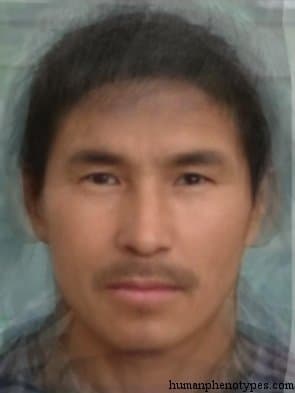
Composite source: Human Phenotypes — Yenisey
Geographic Distribution
Yenisey is documented across Siberia, with its historical reference center near 61.2° N, 89.6° E. The coordinates mark where the type was most characteristic roughly 1500 years ago; population movements since then have scattered and blended the distribution far beyond that point.
Physical Characteristics
Yellowish-reddish light brown skin, straight brown or black hair and mixed eyes.
- Short, macroskelic, ectomorph to mesomorph
- Mildly brachycephalic, chamaecranic with a mesorrhine, often long and hooked nose that is relatively high
- Oblong face, eyes slanting, Mongolian fold rare
- Hair growth is average
Historical Background
Sibirid subtype of the Yenisei River basin in Siberia. Shows some Americanoid features. Also seems to be culturally and linguistically linked to Pacifids, although no close genetic relationship is clear. May show a Proto Mongoloid state. Most common among the Ket people. They were never very numerous, numbering around 1000 individuals. In lower frequencies in other Uralic people and Nenets.
Research History & Naming
Every label in the historical catalogue has an author and a date, and Yenisey has accumulated its share of competing attributions. For Yenisey, the literature extract below shows the naming chain — from the first definition through the later revisions that shaped the current entry.
The type was defined and named as the Yenisey Uralic subtype by Levin (1963) . This was adopted by Debets (1974) and others. Usually part of Uralid ( Alekseev, 1983 ) or regarded as an Americanoid Uralid ( Debets, 1947 ) . Biasutti (1967) placed it together with Nenets and Chukchi in Paleo Sibirid, Eickstedt (1934) described it as a pure West Sibirid.
Comparison With Nearby Phenotypes
Ranked by great-circle distance from Yenisey's reference center, these are the five nearest documented phenotypes — the closest being Uralid at 1,107 km. Overlapping distributions like these are exactly what makes the quiz hard, and the Uralid row is where to start looking.
| Phenotype | Region | Distance | Distinguishing trait |
|---|---|---|---|
| Uralid | Siberia | 1,107 km | Light brown skin, straight or wavy, usually brown, sometimes red, blonde, or black hair and mixed eyes. |
| Samoyedic | Siberia | 1,321 km | Light yellowish-brown skin with coarse-straight brown or black, rarely blonde hair. |
| Baykal | Siberia | 1,387 km | Light yellowish-brown, sometimes fair skin with coarse straight, black, sometimes lighter hair and mixed eyes. |
| Katanga | Siberia | 1,389 km | Light yellowish-brown skin, darker than the Baykal type, coarse straight hair. |
| Mountain Aralid | Central Asia | 2,217 km | Light brown skin, straight, often black, sometimes light hair, and dark, sometimes mixed eyes. |
Yenisey in the Game
When the Yenisey composite shows up in the quiz, players who know the Siberia distribution pattern have the edge. The reference answer sits near 61.2° N, 89.6° E; pins on the wrong continent score close to zero, so even a rough regional instinct beats a precise but misdirected pin.
Yenisey Phenotype FAQ
- Where does the Yenisey phenotype come from?
- The reference coordinates for the Yenisey phenotype sit near 61.2° N, 89.6° E, in Siberia. That point marks the center of the Siberia distribution documented roughly 1500 years ago — actual prevalence spread well beyond it, toward entries such as Uralid 1,107 km away, and modern migration has blurred those boundaries further.
- What does the Yenisey phenotype look like?
- In the historical literature, yellowish-reddish light brown skin, straight brown or black hair and mixed eyes. For Yenisey these are statistical tendencies across a population, not a checklist every individual matches.
- Is the Yenisey phenotype a race or a nationality?
- No. A phenotype is a recurring bundle of visible traits documented by historical anthropologists across a population — for Yenisey, patterns such as yellowish-reddish light brown skin, straight brown or black hair and mixed eyes. The Yenisey entry is not a genetic ancestry, not a nationality, and not a statement about any individual person. Two people from the same country can match completely different phenotypes — one resembling Yenisey, another closer to Uralid — and one phenotype can span many modern borders.
- How does Yenisey appear in the game?
- In Classic Daily and Challenge Mode, the Yenisey composite face appears without a label. Your task is to drop a pin on the world map where you think that face is historically most common — the scoring uses the distance between your pin and the reference coordinates near 61.2° N, 89.6° E. The post-round review then shows the correct location, your distance error, and this Yenisey entry.
References & Literature
Primary sources for the Yenisey entry, listed as cited in the historical literature. The naming and classification debates around Yenisey referenced above run through these works.
- Levin, M. G. 1963. Ethnic origins of the people of Northeastern Asia. Arctic Inst. North America, Anthropology of the North. Translations from Russian sources 3. Toronto.
- Debets, G. 1974. Essay on the Graphical Presentation of the Genealogical Classification of Human Races. In: Bromley, Y. Soviet Ethnology and Anthropology Today. Mouton & Co.
- Alekseev, V.P. and I. I. Gochman. 1983. Physical anthropology of Soviet Asia. In: Schwidetzky, I. Rassengeschichte der Menschheit 9.
- Debets, G. F. 1947. O drevney garnitse yevropoidov i amerikanoidov v Yuzhoy Sibri. Sovetskaya etnografiya 1.
- Biasutti, R. 1967 (1941). Le Razze e i Popoli della terra. 4th Ed. Vol 1-4. U.T.E.T., Torino.
- L34
Related Phenotypes
Other human phenotypes whose documented centers lie in the same part of the map as Yenisey.
Uralid
Siberia · 1,107 km away
West Sibirid subtype, especially common in the basin of the Ob River among Khanty and Mansi people. Sometimes in Altai and Khakassia. Due to...
Samoyedic
Siberia · 1,321 km away
Northwestern Sibirid contact type, influenced by strong Tungid and possibly Lappid elements. Has migrated to the Yamal peninsula and surroun...
Baykal
Siberia · 1,387 km away
Northern Tungid variety, native to the vast, sparsely populated Taiga and Tundra regions of East Siberia, adapted to survive in the coldest ...
Katanga
Siberia · 1,389 km away
Western Tungid variety, influenced by Sibirid, but with several distinctive features differentiating it from both. Named after the Khatanga ...
Mountain Aralid
Central Asia · 2,217 km away
Tungid variety, weakly influenced by Turanid. Usually united with Aralid, but more Mongoloid. Native to the Tian Shan mountains of Kyrgyzsta...
Further Reading
Background articles from the blog that explain where the Yenisey type fits, how these composites are built, and what a face can and cannot tell you.
Ethnic Guesser: Which Facial Cues Actually Decide a Round
A round of the game turns on a handful of facial cues, and they are not equal. Here is how pigment, the epicanthic fold, nasal shape...
How AI Guesses Ethnicity From a Face: Eigenfaces, Landmarks, and Neural Networks
From Turk and Pentland's eigenfaces in 1991 to modern convolutional networks, face-classification AI has one core trick: reduce a face...