Samoyedic Phenotype - Face Features & Origin
Historical anthropology places the Samoyedic phenotype in Siberia, with a documented center near 69.9° N, 69.7° E. Northwestern Sibirid contact type, influenced by strong Tungid and possibly Lappid elements. The sections that follow unpack the Samoyedic entry in practice: the composite face, the traits it summarizes, the naming history, and the sources.
Average Face
Averaging the portraits behind Samoyedic leaves the features that repeat and erases the ones that do not. That is exactly how the Samoyedic composite below was built: individual photographs were aligned and statistically merged, exaggerating shared structure into a single reference face that no actual person looks like.
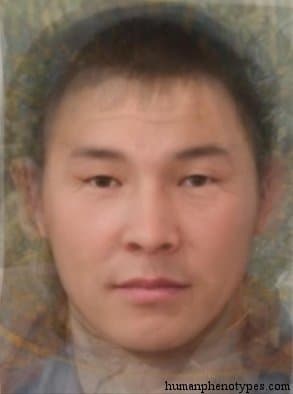
Composite source: Human Phenotypes — Samoyedic
Geographic Distribution
Geographically, Samoyedic anchors to 69.9° N, 69.7° E (Siberia). That is the point where historical anthropologists judged Samoyedic most concentrated, not a hard edge; modern migration and intermarriage have long since softened whatever boundaries once existed.
Physical Characteristics
Light yellowish-brown skin with coarse-straight brown or black, rarely blonde hair.
- Short, macroskelic, mesomorph to endomorph
- Brachycephalic, chamaecranic sometimes orthocranic
- Mildly leptorrhine or mesorrhine, slightly prominent nose
- The face is flat and fleshy with large, protruding cheekbones
- Body hair weak, the Mongolian fold is found regularly
Historical Background
Northwestern Sibirid contact type, influenced by strong Tungid and possibly Lappid elements. Has migrated to the Yamal peninsula and surrounding regions during the Middle Ages from a more southern place, possibly the Minusinsk Basin or Altai-Sajan region. Typified by the Nenets, also in Enets, and mixed in Selkups and Nganasans. Until the 19th century, relict populations existed in the Altai Mountains.
Research History & Naming
The passage below traces who first defined Samoyedic, which rival names competed with it, and how later authors consolidated or disputed the classification — the raw material of any serious phenotype reference.
The type was investigated early by Sommier (1887) . Lundman ( 1943 , 1967 ) treated them as a separate contact group, noting strong Lappid and Kumid elements. Eickstedt (1934) as Sibirid with Lappid influence, Biasutti (1967) even as Paleo Siberian. Alekseev (1983) and Levin (1963) as an admixed Uralid.
Comparison With Nearby Phenotypes
Ranked by great-circle distance from Samoyedic's reference center, these are the five nearest documented phenotypes — the closest being Uralid at 896 km. Overlapping distributions like these are exactly what makes the quiz hard, and the Uralid row is where to start looking.
| Phenotype | Region | Distance | Distinguishing trait |
|---|---|---|---|
| Uralid | Siberia | 896 km | Light brown skin, straight or wavy, usually brown, sometimes red, blonde, or black hair and mixed eyes. |
| Katanga | Siberia | 1,242 km | Light yellowish-brown skin, darker than the Baykal type, coarse straight hair. |
| Yenisey | Siberia | 1,321 km | Yellowish-reddish light brown skin, straight brown or black hair and mixed eyes. |
| North Lappid | Northern Europe | 1,675 km | Light brown skin, straight, usually dark brown, sometimes lighter hair and brown eyes. |
| Tavastid | Northern Europe | 1,804 km | Pale skin, straight, usually blonde hair, light eyes. |
Samoyedic in the Game
When the Samoyedic composite shows up in the quiz, players who know the Siberia distribution pattern have the edge. The reference answer sits near 69.9° N, 69.7° E; pins on the wrong continent score close to zero, so even a rough regional instinct beats a precise but misdirected pin.
Samoyedic Phenotype FAQ
- Where does the Samoyedic phenotype come from?
- The reference coordinates for the Samoyedic phenotype sit near 69.9° N, 69.7° E, in Siberia. That point marks the center of the Siberia distribution documented roughly 1500 years ago — actual prevalence spread well beyond it, toward entries such as Uralid 896 km away, and modern migration has blurred those boundaries further.
- What does the Samoyedic phenotype look like?
- In the historical literature, light yellowish-brown skin with coarse-straight brown or black, rarely blonde hair. For Samoyedic these are statistical tendencies across a population, not a checklist every individual matches.
- Is the Samoyedic phenotype a race or a nationality?
- No. A phenotype is a recurring bundle of visible traits documented by historical anthropologists across a population — for Samoyedic, patterns such as light yellowish-brown skin with coarse-straight brown or black, rarely blonde hair. The Samoyedic entry is not a genetic ancestry, not a nationality, and not a statement about any individual person. Two people from the same country can match completely different phenotypes — one resembling Samoyedic, another closer to Uralid — and one phenotype can span many modern borders.
- How does Samoyedic appear in the game?
- In Classic Daily and Challenge Mode, the Samoyedic composite face appears without a label. Your task is to drop a pin on the world map where you think that face is historically most common — the scoring uses the distance between your pin and the reference coordinates near 69.9° N, 69.7° E. The post-round review then shows the correct location, your distance error, and this Samoyedic entry.
References & Literature
The Samoyedic phenotype entry above is compiled from the 7 academic references. Readers are encouraged to consult the original Samoyedic sources for verification and deeper context.
- Sommier, S. 1887. Sirieni, Ostiachi e Samoiedi dell'Ob, AAE 17, Florence.
- Lundman, B. 1943. Jordens Människoraser och Folkstammar. Nybloms Förlag, Uppsala.
- Lundman, B. 1967. Geographische Anthropologie. Rassen und Völker der Erde. G. Fischer, Stuttgart
- Eickstedt, E. von. 1934. Rassenkunde und Rassengeschichte der Menschheit. Ferdinand Enke. Stuttgart.
- Biasutti, R. 1967 (1941). Le Razze e i Popoli della terra. 4th Ed. Vol 1-4. U.T.E.T., Torino.
- Alekseev, V.P. and I. I. Gochman. 1983. Physical anthropology of Soviet Asia. In: Schwidetzky, I. Rassengeschichte der Menschheit 9.
- Levin, M. G. 1963. Ethnic origins of the people of Northeastern Asia. Arctic Inst. North America, Anthropology of the North. Translations from Russian sources 3. Toronto.
Related Phenotypes
Other human phenotypes whose documented centers lie in the same part of the map as Samoyedic.
Uralid
Siberia · 896 km away
West Sibirid subtype, especially common in the basin of the Ob River among Khanty and Mansi people. Sometimes in Altai and Khakassia. Due to...
Katanga
Siberia · 1,242 km away
Western Tungid variety, influenced by Sibirid, but with several distinctive features differentiating it from both. Named after the Khatanga ...
Yenisey
Siberia · 1,321 km away
Sibirid subtype of the Yenisei River basin in Siberia. Shows some Americanoid features. Also seems to be culturally and linguistically linke...
North Lappid
Northern Europe · 1,675 km away
Northern Lappid variety, somewhat closer to Sibirid, possibly due to Samoyedic influence. Associated with Eastern Saami (formerly "Lapps"), ...
Tavastid
Northern Europe · 1,804 km away
East Baltid variety, typical for the eastern shores of the Baltic sea, similar to Neo Danubian and Borreby. Named after the Tavastia provinc...
Further Reading
Background articles from the blog that explain where the Samoyedic type fits, how these composites are built, and what a face can and cannot tell you.
What Country Do I Look Like: The Count Comes Before the Face
Which country a face resembles depends on which official list you are using, and the world publishes several that disagree on how many...
Ethnicity Guesser vs hbd.gg: Two Ways to Ask a Face
Two sites ask a face to name a place. Here is what each one shows you, where breadth and provenance actually differ, and how to tell...