North Lappid Phenotype - Face Features & Origin
Northern Lappid variety, somewhat closer to Sibirid, possibly due to Samoyedic influence. The entry below collects the North Lappid composite face, its documented distribution around 70.0° N, 24.8° E in Northern Europe, its physical characteristics, the research history behind the name, and the academic references that support all of it.
Average Face
The North Lappid composite below is not a photograph of a real person. Historical anthropologists aligned multiple individual portraits from the North Lappid reference population and averaged them into one image, so recurring structures — skull outline, nose form, lip thickness, brow position — dominate while individual idiosyncrasies cancel out.
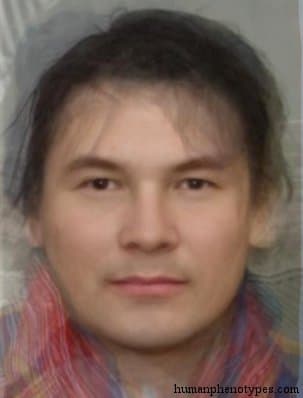
Composite source: Human Phenotypes — North Lappid
Geographic Distribution
The reference center for North Lappid sits near 70.0° N, 24.8° E in Northern Europe. Around that anchor, prevalence falls off gradually — the type is not confined to one valley or one modern border, and the historical map should be read as a gradient rather than a boundary.
Physical Characteristics
Light brown skin, straight, usually dark brown, sometimes lighter hair and brown eyes.
- Short, meso- macroskelic, endomorph with relatively long arms
- Brachycephalic, sometimes mesocephalic, chamae- orthocranic
- Mesorrhine, often concave nose with a depressed root
- Compared to Scando Lappid, the forehead is slightly narrower, the chin slightly stronger, eyebrows thicker and slanting eyes more common
- Hair growth rather weak
Historical Background
Northern Lappid variety, somewhat closer to Sibirid, possibly due to Samoyedic influence. Associated with Eastern Saami (formerly "Lapps"), e.g. Skolt and Inari speakers. Extends from Finnmark in Norway across Northern Finland to the Kola Peninsula. Rare today, but still extended to St. Petersburg around 1700. Blends in Nenets with Sibirid and in the Volga Kama region with Volgid (Sub Lappid).
Research History & Naming
The passage below traces who first defined North Lappid, which rival names competed with it, and how later authors consolidated or disputed the classification — the raw material of any serious phenotype reference.
Defined by Lundman ( 1940 , 1943 , 1967 ) as North Lappid or Kackid ("kacke", Saami = sea). Has already been examined early ( Escard,1886 ). Most authors added included it in Lappid ( Bunak, 1932 ; Eickstedt, 1952 ; Biasutti, 1967 ; Knussmann, 1996 ).
Comparison With Nearby Phenotypes
The five phenotypes whose documented centers lie closest to North Lappid, ranked by great-circle distance. They are the types players most often confuse with North Lappid in the quiz, precisely because their distributions overlap.
| Phenotype | Region | Distance | Distinguishing trait |
|---|---|---|---|
| Strandid | Northern Europe | 562 km | Fair to light brown skin, straight or wavy, usually brown to black hair and mixed eyes. |
| Tavastid | Northern Europe | 631 km | Pale skin, straight, usually blonde hair, light eyes. |
| Fenno Nordid | Northern Europe | 749 km | Pale skin, straight, red to white-blonde sometimes reddish-brown hair. |
| Trønder | Northern Europe | 924 km | Rosy-white skin, straight or wavy, often golden blonde, sometimes red or brown hair with light eyes. |
| Savolaxid | Northern Europe | 953 km | Pale to fair skin, straight, dirty blonde or brown hair, often light eyes. |
North Lappid in the Game
North Lappid is one of the faces that can appear in Classic Daily and Challenge Mode. When it does, the winning pin lands near 70.0° N, 24.8° E in Northern Europe — and because the scoring decays with distance, recognizing the region matters more than pixel-perfect placement.
North Lappid Phenotype FAQ
- Where does the North Lappid phenotype come from?
- The reference coordinates for the North Lappid phenotype sit near 70.0° N, 24.8° E, in Northern Europe. That point marks the center of the Northern Europe distribution documented roughly 1500 years ago — actual prevalence spread well beyond it, toward entries such as Strandid 562 km away, and modern migration has blurred those boundaries further.
- What does the North Lappid phenotype look like?
- In the historical literature, light brown skin, straight, usually dark brown, sometimes lighter hair and brown eyes. For North Lappid these are statistical tendencies across a population, not a checklist every individual matches.
- Is the North Lappid phenotype a race or a nationality?
- No — and the North Lappid naming history above shows why. North Lappid was defined, renamed, and regrouped repeatedly by different researchers, which is the opposite of how a fixed racial category would behave. A phenotype is a recurring bundle of visible traits recorded across a population; the North Lappid label says nothing about where any individual's ancestors were born.
- How does North Lappid appear in the game?
- In Classic Daily and Challenge Mode, the North Lappid composite face appears without a label. Your task is to drop a pin on the world map where you think that face is historically most common — the scoring uses the distance between your pin and the reference coordinates near 70.0° N, 24.8° E. The post-round review then shows the correct location, your distance error, and this North Lappid entry.
References & Literature
The North Lappid phenotype entry above is compiled from the 8 academic references. Readers are encouraged to consult the original North Lappid sources for verification and deeper context.
- Lundman, B. 1940. Nordens rastyper : geografi och historia. Albert Bonnier. Stockholm.
- Lundman, B. 1943. Jordens Människoraser och Folkstammar. Nybloms Förlag, Uppsala.
- Lundman, B. 1967. Geographische Anthropologie. Rassen und Völker der Erde. G. Fischer, Stuttgart
- Escard, F.. 1886. Le Prince Roland Bonaparte in Laponie: Episodes et Tableaux. Paris, G. Chamerot.
- Bunak, V. 1932. Neues Material zur Aussonderung anthropologischer Typen unter der Bevölkerung Osteuropas. Zeitschrift für Morphologie und Anthropologie, 30 (3). 441-503.
- Eickstedt, E. von. 1952. Biodynamik der Europiden. In: Historia Mundi. Band 1, Munich, 115-134.
- Biasutti, R. 1967 (1941). Le Razze e i Popoli della terra. 4th Ed. Vol 1-4. U.T.E.T., Torino.
- L96
Related Phenotypes
Other human phenotypes whose documented centers lie in the same part of the map as North Lappid.
Strandid
Northern Europe · 562 km away
Alpinoid North European type most common in Southwestern Norway. The name derives from the Norwegian word for beach ("Strand"). Probably a r...
Tavastid
Northern Europe · 631 km away
East Baltid variety, typical for the eastern shores of the Baltic sea, similar to Neo Danubian and Borreby. Named after the Tavastia provinc...
Fenno Nordid
Northern Europe · 749 km away
Ancient type of Northeastern Europe, sometimes placed in Nordid, sometimes East Baltid. Associated with Finno-Ugric people, once widespread ...
Trønder
Northern Europe · 924 km away
North European type, combines features of Paleo Atlantid, Hallstatt, and East Nordid. One of the main elements in the ancient Vikings. Their...
Savolaxid
Northern Europe · 953 km away
East Baltid variety, named after the Savolaxia province of Finland, similar to Neo Danubian. Core population in Eastern Finland, Karelia, an...
Further Reading
Background articles from the blog that explain where the North Lappid type fits, how these composites are built, and what a face can and cannot tell you.
AI Phenotype Scanner: What a Scanner Cannot Do for a Face
The phrase names a face classifier, not a device that reads a stored record. What the scanner metaphor hides, what the 209-entry...
Guess the Nationality: What 48 Country Average Faces Actually Show
National average faces converge with geography - neighbors look alike because populations mix along the routes terrain allows.