Why Some Populations Have Light Eyes, and Most Do Not
Light eyes are a high-frequency trait in a handful of regions and a rare, scattered variant almost everywhere else on the map. Between those two situations lies arithmetic that decides what the observation means.
Frequency first, presence second
The question treats a population as though it had a property called eye colour, and as though some populations had a lighter setting than others. What surveys actually report is a proportion: the share of adults in a sample who fall into a band on a colour chart. In Estonia, Finland and Sweden that share has come out above 80 percent in several national samples. Across central Europe it sits near half. Around the Mediterranean it drops to somewhere between one in five and one in three. In most East Asian samples it is below one percent.
The arithmetic of a rare trait is easy to misread. At half a percent, a town of two thousand people holds about ten residents with light eyes, enough for the trait to be noticed and nowhere near enough to describe the town. The same rate in a city of two million is ten thousand people, a visible minority with its own habits, its own schools and its own weddings. Presence and frequency answer different questions, and only the second can be looked up in a table.
- North-eastern Europe: above 80 percent of adults in several national surveys
- Central Europe: close to half
- Mediterranean basin: roughly one in five to one in three
- East Asia and most of sub-Saharan Africa: below one percent, with documented regional exceptions
Two ways an iris ends up pale
In the northern case the iris is built correctly and carries almost no pigment in its front tissue. The variant behind most of it sits inside an enhancer in HERC2 on chromosome 15, where it lowers the output of the neighbouring OCA2 gene and leaves the stroma pale while the retina behind stays fully pigmented. Vision is unaffected because nothing structural has been lost. That is why the trait behaves like a cosmetic difference, and why it can climb to high frequency in a region without an obvious cost attached to it.
Albinism reaches a pale iris by a different road. Variants in OCA2, TYR, SLC45A2 or GPR143 cut pigment in skin and hair as well, and, the part that matters clinically, in the retinal pigment epithelium. Without that layer the fovea does not develop properly, so acuity often lands near 20/200 or worse, usually with nystagmus and photophobia. Reported prevalence runs from roughly one in four thousand to one in ten thousand births depending on region, with well-documented clusters above that range. A population can therefore show pale irises without carrying the northern enhancer at all.
Where the variant is common enough to notice
Central Asia is where the counts stop being negligible outside Europe. The derived allele turns up at frequencies worth measuring among the Hazara of the Hindu Kush, the Kalash of Chitral and communities in the Nuristani valleys, and the route usually proposed for it is the movement of steppe pastoralists: Afanasievo, then Andronovo, then Indo-Iranian-speaking groups across the Pamir and down onto the plains. Whether the allele arrived in one movement or several is unresolved, and the surveys that would settle it are thin for this variant outside Europe.
The catalogue's own Central Asian entries show what an intermediate result looks like once an observer writes it down. Andronovo-Turanid, defined by Henkey and Horvath in 1998 from Kazakh material, is recorded with dark or greenish eyes. Green is the load-bearing word there. It requires a scattering stroma with some melanin left in it, so it sits between the two extremes rather than at either end, and an entry that grades its way into greenish is describing a continuum instead of a category boundary.
Small populations wander
Small populations do not need a reason to change frequency. If a variant starts at two percent in a population with an effective size of five hundred, the standard deviation of its frequency is the square root of p times one minus p divided by twice N, which comes to about 0.44 percentage points per generation. Left alone for forty generations that is a spread of roughly 2.8 points in either direction, so the variant can double, halve or vanish in a mountain valley without anyone benefiting from it.
Founder effects do the rest of the work. A few hundred people carrying one copy between them settle a valley, marry inside it for thirty generations, and the copy becomes a local feature rather than a continental one. The same geography that keeps a dialect intact keeps an allele frequency intact: mountain valleys, islands, endogamous villages. Groups usually named when this pattern is discussed include the Sámi, Kabyle communities in the Atlas and Druze villages in the Levant, though the sampling behind each of those claims varies in quality and none of them is settled.
No one can name the advantage
Skin pigmentation has a working adaptive account. Ultraviolet light at high latitude is scarce for much of the year, and lighter skin synthesises vitamin D more efficiently, the argument set out by Jablonski and Chaplin in 2000. Iris colour has no equivalent. The proposals on the table are sexual selection, extended by analogy from hair, genetic drift, and pleiotropy with skin and hair variants, and none of them has been demonstrated. Where the literature says contested, it means contested.
The cost side is better documented than the benefit side. A pale iris transmits more stray light to the retina, which is why light-eyed people report glare and photophobia more often, and light iris colour is a reported risk factor for uveal melanoma, with pooled odds ratios in the region of one and a half to two. That cancer is an order of magnitude more common in populations of European ancestry than in East Asian or African ones. A trait carrying a measurable cost and no measurable benefit is best explained by drift until someone demonstrates otherwise.
What the entries write down
The catalogue does not resolve any of this and does not try. Aisto Nordid, named by Lundman in 1943 and 1946 from the coastal Baltic, is recorded with blue or grey eyes and described as purest in western Finns and west Estonians. Fenno Nordid, separated by Eickstedt in 1934 among Finno-Ugric populations, is recorded with light, often water-blue eyes. Strandid, set out by Lundman in 1946 after Bryn's 1926 description of a Norwegian Alpinoid, is recorded with mixed eyes. Andronovo-Turanid carries dark or greenish ones.
Two Norwegian entries and the Baltic entries disagree about the same question, and that is the useful part. Strandid is concentrated in southwestern Norway and Paleo Atlantid in Norwegian mountain valleys, and both are recorded with mixed eyes, while the Baltic rows are recorded as blue or grey. Latitude does not dictate what an observer writes into a row. What an observer writes is a grade assigned inside one local sample, which is why 209 rows record descriptions rather than a lookup table running from coordinate to colour.
The map has moved since
Between roughly 1820 and 1914 the variant travelled further than it had in the preceding three thousand years. Emigration carried it to southern Brazil, Argentina, Uruguay and southern Chile, where the descendants of Italian, German, Polish and Spanish arrivals now form regional majorities, and to Australia, New Zealand and the northern United States. A country-level average today blends populations that were geographically separate when the catalogue's descriptions were written down.
Admixture inside countries does the same work at a smaller scale. The variant now appears where a 1500-year-old map would not place it, at fractions of a percent, because one grandparent came from somewhere else. That is the point where the inference reverses. A frequency describes a sample, and a face is not a sample. The 209 entries describe distributions recorded roughly fifteen hundred years ago, and reading one of them back onto a living person asks the record to do something it was never built to do.
Frequently Asked Questions
- Are light eyes found only in Europe?
- No, but they are frequent only there. Above 80 percent of adults in Estonia, Finland and Sweden fall into the light bands in several national surveys, while most East Asian samples sit below one percent. Frequencies worth counting also appear among the Hazara, the Kalash of Chitral and Nuristani communities in Central Asia, and at low rates around the Levant and the Maghreb. In much of sub-Saharan Africa a pale iris is more often a sign of albinism, which is a different pathway with different consequences.
- Why do some populations have light eyes at high frequency?
- Because a variant that arose once became common in one region and spread with people rather than with need. The strongest known contributor is an enhancer variant in HERC2 that lowers OCA2 output and leaves the iris stroma pale. Its frequency is highest around the Baltic and falls with distance from there, and it appears elsewhere mainly through later movement and through drift in small, endogamous populations. No selective advantage for light eyes has been demonstrated; sexual selection and drift remain proposals rather than findings.
- Does light eye colour tell you someone's ancestry?
- It tells you that a variant is more common in some regions than others, which is a statement about samples. It cannot be run backwards onto a person: the variant is absent from many people whose families come from high-frequency regions and present in people whose families do not, and the catalogue's 209 entries describe distributions recorded roughly 1,500 years ago. A trait frequency is a property of a counted group, and a single face is not a counted group.
Related Phenotypes
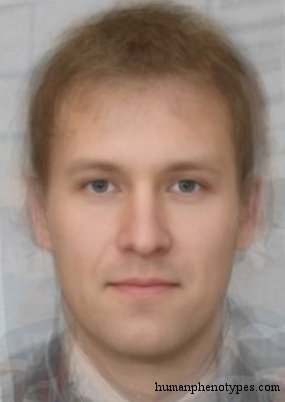
Faces from the encyclopedia that appear in this article. Open any entry for its full description, distribution, and references.
Aisto Nordid
Northern Europe
East Nordid subvariety, common in coastal regions of Baltic countries. One of the last strongholds of East Nordids that are only a minority ...
Fenno Nordid
Northern Europe
Ancient type of Northeastern Europe, sometimes placed in Nordid, sometimes East Baltid. Associated with Finno-Ugric people, once widespread ...
Strandid
Northern Europe
Alpinoid North European type most common in Southwestern Norway. The name derives from the Norwegian word for beach ("Strand"). Probably a r...
Andronovo-Turanid
Central Asia
Northern Turanid variant, has probably been more widespread prior to the Tungid expansion of Hunnic, Avar, and Chasar tribes. Influenced by ...
Test what you learned
Put your eye for regional faces to work in the daily quiz — a composite face, a world map, and your best guess.