South Amazonid Phenotype - Face Features & Origin
The most dynamic Amazonid variety, emerged in northern savannahs and spread south across Brazil to Paraguay and Argentina, pushing back older Lagids. The entry below collects the South Amazonid composite face, its documented distribution around 12.2° S, 55.6° W in South America, its physical characteristics, the research history behind the name, and the academic references that support all of it.
Average Face
The South Amazonid composite below is not a photograph of a real person. Historical anthropologists aligned multiple individual portraits from the South Amazonid reference population and averaged them into one image, so recurring structures — skull outline, nose form, lip thickness, brow position — dominate while individual idiosyncrasies cancel out.
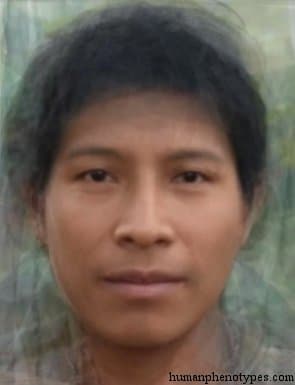
Composite source: Human Phenotypes — South Amazonid
Geographic Distribution
Geographically, South Amazonid anchors to 12.2° S, 55.6° W (South America). That is the point where historical anthropologists judged South Amazonid most concentrated, not a hard edge; modern migration and intermarriage have long since softened whatever boundaries once existed.
Physical Characteristics
Yellowish/reddish light to medium brown skin, straight or slightly wavy hair.
- (Rather) short, mesoskelic, ectomorph to endomorph
- Mesocephalic, sometimes brachycephalic, mildly hypsicranic
- Mesorrhine, prominent high-rooted nose
- Face is oval and relatively high, cheekbones not very pronounced, forehead broad, slightly receding chin
- Eyes slanting, Mongolian fold rare
Historical Background
The most dynamic Amazonid variety, emerged in northern savannahs and spread south across Brazil to Paraguay and Argentina, pushing back older Lagids. Common among Tupian speakers, e.g. Apika, Awá-Guajá, Guarani, Kawahib, Chiriguano, Piripkura, etc., and the extinct Tupi and Querandí. Although tribal numbers collapsed since European contact, still important in Brazilian / Paraguayan Mestizos.
Research History & Naming
The passage below traces who first defined South Amazonid, which rival names competed with it, and how later authors consolidated or disputed the classification — the raw material of any serious phenotype reference.
Eickstedt (1934) defined and described the type as South Brasilid. Amazonid was used synonymously instead of Brasilid ( Imbelloni, 1958 ; Biasutti, 1967 ; Kunter, 1987 ). Lundman (1967) also defined a southern Tupi Amazonid subgroup. Brasilid was used by Canals Frau (1950) and Knussman (1996) , among others.
Comparison With Nearby Phenotypes
The five phenotypes whose documented centers lie closest to South Amazonid, ranked by great-circle distance. They are the types players most often confuse with South Amazonid in the quiz, precisely because their distributions overlap.
| Phenotype | Region | Distance | Distinguishing trait |
|---|---|---|---|
| Bororo | South America | 663 km | Olive medium brown skin with straight and black rarely wavy hair. |
| Botocudo | South America | 1,410 km | Yellowish/copperish light brown skin with straight or wavy hair. |
| Lagoa Santa | South America | 1,496 km | Yellowish/copperish light to medium brown skin, straight or wavy hair. |
| Central Andid | South America | 1,573 km | Medium olive-brown skin, straight, rarely wavy hair. |
| North Andid | South America | 1,784 km | Medium, sometimes dark olive-brown skin with straight, sometimes wavy hair. |
South Amazonid in the Game
South Amazonid is one of the faces that can appear in Classic Daily and Challenge Mode. When it does, the winning pin lands near 12.2° S, 55.6° W in South America — and because the scoring decays with distance, recognizing the region matters more than pixel-perfect placement.
South Amazonid Phenotype FAQ
- Where does the South Amazonid phenotype come from?
- Historical sources center the South Amazonid phenotype on 12.2° S, 55.6° W (South America). Treat that as a rough anchor: the type appeared across a wider surrounding area — its nearest documented neighbors, Bororo and Botocudo, sit 663 and 1,410 km from the reference point — and its present-day distribution no longer matches the historical map.
- What does the South Amazonid phenotype look like?
- The composite emphasizes recurring traits: yellowish/reddish light to medium brown skin, straight or slightly wavy hair. The full trait list for South Amazonid appears in the physical characteristics section above.
- Is the South Amazonid phenotype a race or a nationality?
- No. Phenotypes like South Amazonid are descriptive averages, not ancestry groups. South Amazonid is one of several types documented in and around South America — see the comparison table above — and the same individual can carry traits associated with several of them at once. The South Amazonid entry describes a statistical pattern, not a group of people and not a nationality.
- How does South Amazonid appear in the game?
- When the South Amazonid face comes up in Classic Daily or Challenge Mode, you pin the world map where you believe the type is historically most common, and the score decays with your distance to 12.2° S, 55.6° W. The nearest documented type, Bororo, lies about 663 km away, so regional placement usually carries most of the score.
References & Literature
The South Amazonid phenotype entry above is compiled from the 7 academic references. Readers are encouraged to consult the original South Amazonid sources for verification and deeper context.
- Eickstedt, E. von. 1934. Rassenkunde und Rassengeschichte der Menschheit. Ferdinand Enke. Stuttgart.
- Imbelloni, J. 1958. Nouveaux apports à la classification de l'homme américain. Miscellanea P. Rivet octogenario dicata. Mexico.
- Biasutti, R. 1967 (1941). Le Razze e i Popoli della terra. 4th Ed. Vol 1-4. U.T.E.T., Torino.
- Kunter, M. 1987. Population and racial history of Argentina, Uruguay and Paraguay. In: Schwidetzky, I. Rassengeschischte des Menschheit 12.
- Lundman, B. 1967. Geographische Anthropologie. Rassen und Völker der Erde. G. Fischer, Stuttgart
- Coon, C. S., Garn, S. M. and Birdsell, J. B. 1950. Races: a Study of Race formation in Man. Charles C. Thomas. Springfield.
- Knussmann, R. 1996. Vergleichende Biologie des Menschen: Lehrbuch der Anthropologie und Humangenetik. 2ed. Spektrum Akademischer Verlag.
Related Phenotypes
If South Amazonid interested you, these neighboring phenotype entries cover adjacent parts of the map with distinctly different trait bundles.
Bororo
South America · 663 km away
The northernmost Patagonid variety, often mixed with local Lagid elements, but with a variety of unique features. Native to the savannah and...
Botocudo
South America · 1,410 km away
Lagid subtype of the Mata Atlântica forests of Brazil, partially mixed with the Fuegid substratum (South Fuegids, Huarpids). Was the dominan...
Lagoa Santa
South America · 1,496 km away
Lagid proper, named after fossil remains of Brazil. Associated with one of the first migration waves to South America. Skulls sometimes Mela...
Central Andid
South America · 1,573 km away
Andid variety, mostly native the Andes mountains from South Peru to Northern Chile. The large thorax and other traits indicate a significant...
North Andid
South America · 1,784 km away
The most important and numerous Andid subvariety, adapted to the high altitudes of the Peruvian and Ecuadorian Andes. Typified by Quechua. T...
Further Reading
Background articles from the blog that explain where the South Amazonid type fits, how these composites are built, and what a face can and cannot tell you.
Ethnic Guesser: Which Facial Cues Actually Decide a Round
A round of the game turns on a handful of facial cues, and they are not equal. Here is how pigment, the epicanthic fold, nasal shape...
What Ethnicity Am I? Three Ways to Actually Answer It
The question is personal, but the answers arrive from three different places: records, DNA, and appearance. Each can tell you something...