North Andid Phenotype - Face Features & Origin
The most important and numerous Andid subvariety, adapted to the high altitudes of the Peruvian and Ecuadorian Andes. Its reference coordinates sit near 13.5° S, 72.0° W in South America. Rather than a single portrait, the North Andid composite below is a statistical average, and the surrounding sections — traits, distribution, research history, references — give that average its context.
Average Face
What you see below is a statistical construction of the North Andid reference population. Faces recorded from the North Andid sample were overlaid and merged; the result keeps the features most members shared and discards personal variation. It reads like a North Andid portrait, but it works like a histogram.
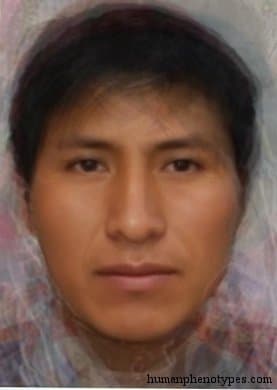
Composite source: Human Phenotypes — North Andid
Geographic Distribution
The reference center for North Andid sits near 13.5° S, 72.0° W in South America. Around that anchor, prevalence falls off gradually — the type is not confined to one valley or one modern border, and the historical map should be read as a gradient rather than a boundary.
Physical Characteristics
Medium, sometimes dark olive-brown skin with straight, sometimes wavy hair.
- Short, mesoskelic, endomorph to mesomorph with a large thorax, an adaption to the high altitude
- Meso- brachycephalic, hypsicranic, rather small-headed
- Mildly leptorrhine, long and often hooked nose that may appear Orientaliform
- Large and long face with marked features, especially in men, often giving a serious expression
- Chin relatively prominent, forehead receding
- Eyes mildly slanted
Historical Background
The most important and numerous Andid subvariety, adapted to the high altitudes of the Peruvian and Ecuadorian Andes. Typified by Quechua. The dominant element in the ancient Inca Empire the largest in pre-Columbian America. Still the most numerous Native American type even today with more than 10 million individuals.
Research History & Naming
The passage below traces who first defined North Andid, which rival names competed with it, and how later authors consolidated or disputed the classification — the raw material of any serious phenotype reference.
Defined as the Northern Andid variety by Eickstedt (1934) and Drexel (1955) , based on earlier studies (e.g. Ferris, 1916 ). Part of Andid ( Canals Frau, 1950 ; Lundman, 1967 ; Knussman, 1996 ) or combined with Pubelid in Pueblo-Andid ( Imbelloni, 1952 ; Biasutti, 1967 ) / Pervuid ( Lundman, 1943 ).
Comparison With Nearby Phenotypes
Geography, not alphabet, ordered this table: the five phenotype centers closest to North Andid's, with the traits most likely to be mistaken for it (Central Andid leads at 351 km). In gameplay, these five account for most of the wrong-but-nearby pins against North Andid.
| Phenotype | Region | Distance | Distinguishing trait |
|---|---|---|---|
| Central Andid | South America | 351 km | Medium olive-brown skin, straight, rarely wavy hair. |
| West Amazonid | South America | 1,003 km | Medium (yellowish/reddish) brown skin. |
| Bororo | South America | 1,129 km | Olive medium brown skin with straight and black rarely wavy hair. |
| South Amazonid | South America | 1,784 km | Yellowish/reddish light to medium brown skin, straight or slightly wavy hair. |
| Pampid | South America | 2,132 km | Olive medium brown skin with straight and black rarely wavy hair. |
North Andid in the Game
In gameplay terms, North Andid rewards region-level recall: the score is computed from the distance between your pin and 13.5° S, 72.0° W. Players often confuse North Andid with Central Andid (351 km out) in the comparison table above — those confusions are exactly what the distance penalty is designed to expose.
North Andid Phenotype FAQ
- Where does the North Andid phenotype come from?
- The reference coordinates for the North Andid phenotype sit near 13.5° S, 72.0° W, in South America. That point marks the center of the South America distribution documented roughly 1500 years ago — actual prevalence spread well beyond it, toward entries such as Central Andid 351 km away, and modern migration has blurred those boundaries further.
- What does the North Andid phenotype look like?
- In the historical literature, medium, sometimes dark olive-brown skin with straight, sometimes wavy hair. For North Andid these are statistical tendencies across a population, not a checklist every individual matches.
- Is the North Andid phenotype a race or a nationality?
- No — and the North Andid naming history above shows why. North Andid was defined, renamed, and regrouped repeatedly by different researchers, which is the opposite of how a fixed racial category would behave. A phenotype is a recurring bundle of visible traits recorded across a population; the North Andid label says nothing about where any individual's ancestors were born.
- How does North Andid appear in the game?
- In Classic Daily and Challenge Mode, the North Andid composite face appears without a label. Your task is to drop a pin on the world map where you think that face is historically most common — the scoring uses the distance between your pin and the reference coordinates near 13.5° S, 72.0° W. The post-round review then shows the correct location, your distance error, and this North Andid entry.
References & Literature
The North Andid phenotype entry above is compiled from the 9 academic references. Readers are encouraged to consult the original North Andid sources for verification and deeper context.
- Eickstedt, E. von. 1934. Rassenkunde und Rassengeschichte der Menschheit. Ferdinand Enke. Stuttgart.
- Drexel, A. 1955. Die Völker der Erde. 2nd Ed. Akademie Verlag. Zürich.
- Ferris, H. B. 1916. The Indians of Cuzco and the Apurimac. Mem. Amer. Anthr. Assoc. 3, 57-148.
- Canals Frau, S. 1950. Prehistoria de América. Editorial Sudamericana. Buenos Aires.
- Lundman, B. 1967. Geographische Anthropologie. Rassen und Völker der Erde. G. Fischer, Stuttgart
- Knussmann, R. 1996. Vergleichende Biologie des Menschen: Lehrbuch der Anthropologie und Humangenetik. 2ed. Spektrum Akademischer Verlag.
- Imbelloni, J. 1952. Rassentypen und Biodynamik von Amerika. In: Historia Mundi. Band 1, Munich, 188-203.
- Biasutti, R. 1967 (1941). Le Razze e i Popoli della terra. 4th Ed. Vol 1-4. U.T.E.T., Torino.
- Lundman, B. 1943. Jordens Människoraser och Folkstammar. Nybloms Förlag, Uppsala.
Related Phenotypes
If North Andid interested you, these neighboring phenotype entries cover adjacent parts of the map with distinctly different trait bundles.
Central Andid
South America · 351 km away
Andid variety, mostly native the Andes mountains from South Peru to Northern Chile. The large thorax and other traits indicate a significant...
West Amazonid
South America · 1,003 km away
Amazonid subtype, the most frequent type in the Western Amazon rainforest. Common among Arawakan speakers, typical groups are Yawalapiti, As...
Bororo
South America · 1,129 km away
The northernmost Patagonid variety, often mixed with local Lagid elements, but with a variety of unique features. Native to the savannah and...
South Amazonid
South America · 1,784 km away
The most dynamic Amazonid variety, emerged in northern savannahs and spread south across Brazil to Paraguay and Argentina, pushing back olde...
Pampid
South America · 2,132 km away
Slightly gracilised Patagonid variety, native to the vast plains of the Argentinian Chaco and Pampa. Sometimes mixed with Amazonid elements....
Further Reading
Background articles from the blog that explain where the North Andid type fits, how these composites are built, and what a face can and cannot tell you.
The Evolutionary Story Behind Andean Faces
From round, heat-conserving faces above 3,500 meters to mixed-mestizo lowland populations, the skulls of the Andes are a lesson in...
Human Phenotypes: A Field Guide to the 209 Types
Nordid, Huanghoid, Bantuid, Andid - the named human phenotypes are a century-old vocabulary for visible variation.