Bororo Phenotype - Face Features & Origin
The northernmost Patagonid variety, often mixed with local Lagid elements, but with a variety of unique features. Its reference coordinates sit near 13.5° S, 61.5° W in South America. Rather than a single portrait, the Bororo composite below is a statistical average, and the surrounding sections — traits, distribution, research history, references — give that average its context.
Average Face
What you see below is a statistical construction of the Bororo reference population. Faces recorded from the Bororo sample were overlaid and merged; the result keeps the features most members shared and discards personal variation. It reads like a Bororo portrait, but it works like a histogram.
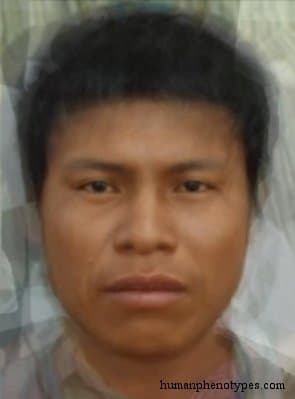
Composite source: Human Phenotypes — Bororo
Geographic Distribution
Geographically, Bororo anchors to 13.5° S, 61.5° W (South America). That is the point where historical anthropologists judged Bororo most concentrated, not a hard edge; modern migration and intermarriage have long since softened whatever boundaries once existed.
Physical Characteristics
Olive medium brown skin with straight and black rarely wavy hair.
- Tall, mesoskelic, mesomorph
- Brachycephalic, mildly hypsicranic
- Mesorrhine, straight, and relatively high nose
- Facial features are robust and angular with supraorbital ridges and very broad foreheads
- Eyes slanting, lips full, body hair weak
Historical Background
The northernmost Patagonid variety, often mixed with local Lagid elements, but with a variety of unique features. Native to the savannah and forest landscapes of West Bolivia and the Brazilian state of Mato Grosso. Typified by the Bororo that include Umutina and others. More mixed in Bakairi, Nahukuá, and the groups of Gran Chaco. Population decreased dramatically since European contact, and only a few thousand remain.
Research History & Naming
Typological names were coined, contested, and renamed repeatedly across the 20th century, and Bororo is no exception. The extract below records the researchers who defined Bororo, the alternative labels it accumulated, and where the modern consensus settled.
Biasutti (1967) defined a Bororo subrace of his Pampids. Similarly, Eickstedt (1934) regarded them a northern, brachycephalised Pampid subtype. Also placed in Pampid by others (e.g. Imbelloni, 1958 ). Detailed early descriptions by Ehrenreich (1897) .
Comparison With Nearby Phenotypes
The five phenotypes whose documented centers lie closest to Bororo, ranked by great-circle distance. They are the types players most often confuse with Bororo in the quiz, precisely because their distributions overlap.
| Phenotype | Region | Distance | Distinguishing trait |
|---|---|---|---|
| South Amazonid | South America | 663 km | Yellowish/reddish light to medium brown skin, straight or slightly wavy hair. |
| Central Andid | South America | 912 km | Medium olive-brown skin, straight, rarely wavy hair. |
| North Andid | South America | 1,129 km | Medium, sometimes dark olive-brown skin with straight, sometimes wavy hair. |
| West Amazonid | South America | 1,755 km | Medium (yellowish/reddish) brown skin. |
| Botocudo | South America | 1,936 km | Yellowish/copperish light brown skin with straight or wavy hair. |
Bororo in the Game
Bororo is one of the faces that can appear in Classic Daily and Challenge Mode. When it does, the winning pin lands near 13.5° S, 61.5° W in South America — and because the scoring decays with distance, recognizing the region matters more than pixel-perfect placement.
Bororo Phenotype FAQ
- Where does the Bororo phenotype come from?
- Historical sources center the Bororo phenotype on 13.5° S, 61.5° W (South America). Treat that as a rough anchor: the type appeared across a wider surrounding area — its nearest documented neighbors, South Amazonid and Central Andid, sit 663 and 912 km from the reference point — and its present-day distribution no longer matches the historical map.
- What does the Bororo phenotype look like?
- The composite emphasizes recurring traits: olive medium brown skin with straight and black rarely wavy hair. The full trait list for Bororo appears in the physical characteristics section above.
- Is the Bororo phenotype a race or a nationality?
- No. Phenotypes like Bororo are descriptive averages, not ancestry groups. Bororo is one of several types documented in and around South America — see the comparison table above — and the same individual can carry traits associated with several of them at once. The Bororo entry describes a statistical pattern, not a group of people and not a nationality.
- How does Bororo appear in the game?
- When the Bororo face comes up in Classic Daily or Challenge Mode, you pin the world map where you believe the type is historically most common, and the score decays with your distance to 13.5° S, 61.5° W. The nearest documented type, South Amazonid, lies about 663 km away, so regional placement usually carries most of the score.
References & Literature
Every claim on this page traces back to the sources below — the researchers who defined, measured, and argued over the Bororo type. The originals behind the Bororo entry are worth consulting directly.
- Biasutti, R. 1967 (1941). Le Razze e i Popoli della terra. 4th Ed. Vol 1-4. U.T.E.T., Torino.
- Eickstedt, E. von. 1934. Rassenkunde und Rassengeschichte der Menschheit. Ferdinand Enke. Stuttgart.
- Imbelloni, J. 1958. Nouveaux apports à la classification de l'homme américain. Miscellanea P. Rivet octogenario dicata. Mexico.
- Ehrenreich, P. 1897 Anthropologische Studien über die Urbewohner Brasiliens. Braunschweig.
Related Phenotypes
If Bororo interested you, these neighboring phenotype entries cover adjacent parts of the map with distinctly different trait bundles.
South Amazonid
South America · 663 km away
The most dynamic Amazonid variety, emerged in northern savannahs and spread south across Brazil to Paraguay and Argentina, pushing back olde...
Central Andid
South America · 912 km away
Andid variety, mostly native the Andes mountains from South Peru to Northern Chile. The large thorax and other traits indicate a significant...
North Andid
South America · 1,129 km away
The most important and numerous Andid subvariety, adapted to the high altitudes of the Peruvian and Ecuadorian Andes. Typified by Quechua. T...
West Amazonid
South America · 1,755 km away
Amazonid subtype, the most frequent type in the Western Amazon rainforest. Common among Arawakan speakers, typical groups are Yawalapiti, As...
Botocudo
South America · 1,936 km away
Lagid subtype of the Mata Atlântica forests of Brazil, partially mixed with the Fuegid substratum (South Fuegids, Huarpids). Was the dominan...
Further Reading
Background articles from the blog that explain where the Bororo type fits, how these composites are built, and what a face can and cannot tell you.
What Ethnicity Do I Look Like? What a Face Can and Cannot Tell
The question assumes a face carries an ethnicity label. What it carries is a set of trait distributions that overlap heavily between...
The Evolutionary Story Behind Andean Faces
From round, heat-conserving faces above 3,500 meters to mixed-mestizo lowland populations, the skulls of the Andes are a lesson in...