Botocudo Phenotype - Face Features & Origin
Lagid subtype of the Mata Atlântica forests of Brazil, partially mixed with the Fuegid substratum (South Fuegids, Huarpids). Its reference coordinates sit near 18.5° S, 44.2° W in South America. Rather than a single portrait, the Botocudo composite below is a statistical average, and the surrounding sections — traits, distribution, research history, references — give that average its context.
Average Face
What you see below is a statistical construction of the Botocudo reference population. Faces recorded from the Botocudo sample were overlaid and merged; the result keeps the features most members shared and discards personal variation. It reads like a Botocudo portrait, but it works like a histogram.
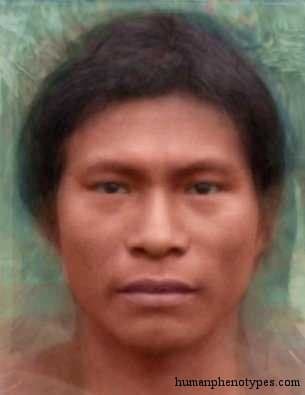
Composite source: Human Phenotypes — Botocudo
Geographic Distribution
The reference center for Botocudo sits near 18.5° S, 44.2° W in South America. Around that anchor, prevalence falls off gradually — the type is not confined to one valley or one modern border, and the historical map should be read as a gradient rather than a boundary.
Physical Characteristics
Yellowish/copperish light brown skin with straight or wavy hair.
- Short, often macroskelic, endomorph to ectomorph
- Dolicho- mesocephalic, chamaecranic, large-headed with a lepto- mesorrhine, straight or low-rooted / concave nose
- Face relatively low and small, only with weak supraorbital ridges
- Sometimes mild prognathy
- Cheekbones broad, jaw narrower than in the Lagoa Santa type
Historical Background
Lagid subtype of the Mata Atlântica forests of Brazil, partially mixed with the Fuegid substratum (South Fuegids, Huarpids). Was the dominant type of the Botocudo (Aimoré) people that experienced a dramatic population decline after European colonisation. Today, the last Botocudo survive as the Krenak, who still number a few hundred.
Research History & Naming
The passage below traces who first defined Botocudo, which rival names competed with it, and how later authors consolidated or disputed the classification — the raw material of any serious phenotype reference.
Detailed early investigations were made by Ehrenreich (1887) . Eickstedt (1934) included them in the Lagoa Santa type, Lundman (1967) in Campid. In contrast, Imbelloni ( 1938 , 1952 ) separated them as Fuegid or Fuegid-admixed ( Imbelloni, 1958 ). This was kept by Cerulli (1967) and Kunter (1987) . Gonçalves et al. (2013) identified genetic links to Polynesians.
Comparison With Nearby Phenotypes
Ranked by great-circle distance from Botocudo's reference center, these are the five nearest documented phenotypes — the closest being Lagoa Santa at 126 km. Overlapping distributions like these are exactly what makes the quiz hard, and the Lagoa Santa row is where to start looking.
| Phenotype | Region | Distance | Distinguishing trait |
|---|---|---|---|
| Lagoa Santa | South America | 126 km | Yellowish/copperish light to medium brown skin, straight or wavy hair. |
| South Amazonid | South America | 1,410 km | Yellowish/reddish light to medium brown skin, straight or slightly wavy hair. |
| Bororo | South America | 1,936 km | Olive medium brown skin with straight and black rarely wavy hair. |
| Huarpid | South America | 2,289 km | Medium, sometimes dark brown skin, often with wavy hair. |
| Pampid | South America | 2,470 km | Olive medium brown skin with straight and black rarely wavy hair. |
Botocudo in the Game
When the Botocudo composite shows up in the quiz, players who know the South America distribution pattern have the edge. The reference answer sits near 18.5° S, 44.2° W; pins on the wrong continent score close to zero, so even a rough regional instinct beats a precise but misdirected pin.
Botocudo Phenotype FAQ
- Where does the Botocudo phenotype come from?
- Historical sources center the Botocudo phenotype on 18.5° S, 44.2° W (South America). Treat that as a rough anchor: the type appeared across a wider surrounding area — its nearest documented neighbors, Lagoa Santa and South Amazonid, sit 126 and 1,410 km from the reference point — and its present-day distribution no longer matches the historical map.
- What does the Botocudo phenotype look like?
- The composite emphasizes recurring traits: yellowish/copperish light brown skin with straight or wavy hair. The full trait list for Botocudo appears in the physical characteristics section above.
- Is the Botocudo phenotype a race or a nationality?
- No. A phenotype is a recurring bundle of visible traits documented by historical anthropologists across a population — for Botocudo, patterns such as yellowish/copperish light brown skin with straight or wavy hair. The Botocudo entry is not a genetic ancestry, not a nationality, and not a statement about any individual person. Two people from the same country can match completely different phenotypes — one resembling Botocudo, another closer to Lagoa Santa — and one phenotype can span many modern borders.
- How does Botocudo appear in the game?
- When the Botocudo face comes up in Classic Daily or Challenge Mode, you pin the world map where you believe the type is historically most common, and the score decays with your distance to 18.5° S, 44.2° W. Fair warning: the nearest other entry in our dataset, Lagoa Santa, sits just 126 km away, so this face rewards precise placement — the right country alone is not always enough.
References & Literature
The Botocudo phenotype entry above is compiled from the 9 academic references. Readers are encouraged to consult the original Botocudo sources for verification and deeper context.
- Ehrenreich, P. Über die Botocudos der brasilianischen Provinzen Espiritu santo und Minas Geraes. Zeitschr. für Ethnol. 19. 1-82.
- Eickstedt, E. von. 1934. Rassenkunde und Rassengeschichte der Menschheit. Ferdinand Enke. Stuttgart.
- Lundman, B. 1967. Geographische Anthropologie. Rassen und Völker der Erde. G. Fischer, Stuttgart
- I38
- Imbelloni, J. 1952. Rassentypen und Biodynamik von Amerika. In: Historia Mundi. Band 1, Munich, 188-203.
- Imbelloni, J. 1958. Nouveaux apports à la classification de l'homme américain. Miscellanea P. Rivet octogenario dicata. Mexico.
- Czekanowski, J.. 1967. Cz owiek w czasie i przestrzenie. Pa stwowe Wydawnictwo Naukowe. Warsaw.
- Kunter, M. 1987. Population and racial history of Argentina, Uruguay and Paraguay. In: Schwidetzky, I. Rassengeschischte des Menschheit 12.
- Giuffrida-Ruggeri. 1913. Distribuzione e origine dei gruppi umani dell'Africa nord-orientale. AAE. 43.
Related Phenotypes
More entries from the same region of the historical map as Botocudo, each with its own composite and trait profile.
Lagoa Santa
South America · 126 km away
Lagid proper, named after fossil remains of Brazil. Associated with one of the first migration waves to South America. Skulls sometimes Mela...
South Amazonid
South America · 1,410 km away
The most dynamic Amazonid variety, emerged in northern savannahs and spread south across Brazil to Paraguay and Argentina, pushing back olde...
Bororo
South America · 1,936 km away
The northernmost Patagonid variety, often mixed with local Lagid elements, but with a variety of unique features. Native to the savannah and...
Huarpid
South America · 2,289 km away
Northern Fuegid variety that is often considered part of the Lagoid group. Shows Melanesiform features and probably arrived with one of the ...
Pampid
South America · 2,470 km away
Slightly gracilised Patagonid variety, native to the vast plains of the Argentinian Chaco and Pampa. Sometimes mixed with Amazonid elements....
Further Reading
Background articles from the blog that explain where the Botocudo type fits, how these composites are built, and what a face can and cannot tell you.
Human Phenotypes: A Field Guide to the 209 Types
Nordid, Huanghoid, Bantuid, Andid - the named human phenotypes are a century-old vocabulary for visible variation.
The Evolutionary Story Behind Andean Faces
From round, heat-conserving faces above 3,500 meters to mixed-mestizo lowland populations, the skulls of the Andes are a lesson in...