The Evolutionary Story Behind Andean Faces
From round, heat-conserving faces above 3,500 meters to mixed-mestizo lowland populations, the skulls of the Andes are a lesson in adaptation pushed to its current edge.
A Face Built for Thin Air
Stand at 4,000 meters in the Peruvian highlands and the air carries roughly 60 percent of the oxygen it does at sea level. The body that has lived there for generations responds in ways that are profoundly physical—larger chest volume, more red blood cells, a higher density of capillaries in the lungs. What is easier to miss, because it is slower and silent, is that the skull itself was part of the same negotiation.
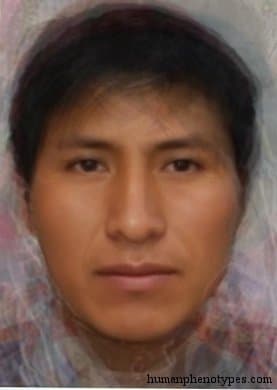
The face of the highland Andes tends to be moderately broad, with high cheekbones, a nose that is often relatively broad at the base, and a rounded, domed cranial vault that many older anthropologists called Andid. This is not a random shape. A rounder, fuller vault concentrates heat close to the head in a cold, high-altitude setting, and a somewhat broad, flat profile pads the face against frostbite in a way a thin, narrow face does not. It is the same logic that gives Arctic populations long, cold-relaying noses and sinuses—a face is partly a climate instrument, and the Andes wrote their own prescription into it.
That was the framework of the old typological literature, which treated the Andid face as a stable adaptation to the puna, the cold high plain above the tree line. The catalogue this site preserves keeps that description, anchored to roughly 1,500 years ago, precisely because it is a useful record of what trained observers documented—not because it explains every face you might meet in Cusco or La Paz today.
Deeper Than the Face: Oxygen Genetics
Modern genomics has found the real signature of Andean adaptation, and it is not in the cheekbones. A variant in the gene EPAS1—the same gene famously altered in Tibetans—is common in highland Andean populations and helps regulate the body's response to low oxygen. There are also striking changes in genes involved in heart-remodeling and vascular tone, because blood that carries more oxygen also moves more sluggishly and demands a heart that can handle it.
The striking point is that Tibetans and Andeans hit very similar solutions independently. They are separated by thousands of years of history and tens of thousands of kilometers; their ancestors diverged long before either reached a high plateau. Yet both turned on overlapping genetic machinery to solve the same problem. Convergent adaptation on this scale is a reminder of how powerfully environment sculpts the human body—and how much of that sculpting happens beneath the skin, invisible to the typologist who only measures a head.
Thousands of Years of High-Altitude Living
People have lived in the Andes longer than almost anywhere else at this altitude. Archaeologists have found evidence of human occupation in highland caves more than 10,000 years ago, and by 4,000 to 5,000 years ago populations were farming potatoes and quinoa and living permanently above 3,500 meters. That is not a blink of evolutionary time, but it is long enough for selection to act on a trait that matters for survival—and for generations to be shaped, face and all, by the thin air.
There is a bias to note here. Cities like La Paz sit above 3,600 meters, so modern high-altitude Andean populations are heavily represented in high-environment samples. But the Andes are a tilted staircase, not a single step. Coastal Peru is desert at sea level; the eastern slopes drain into the Amazon basin. People move up and down that staircase, and a valley community at 2,500 meters is not genetically or morphologically a carbon copy of a puna village at 4,200. As in most of the world, a region is a gradient, not a single stamp.
The Complications After 1492
No discussion of the Andes can ignore the last five centuries, because the region's faces bear the record of it. The Spanish conquest brought large-scale forced migration, disease that devastated highland populations, and centuries of mixing between Indigenous peoples, Europeans, and the African-descended populations who were brought to work in mines and plantations. The result is that modern Andean populations are, on average, a mixture—with Indigenous ancestry concentrated roughly in proportion to altitude. A community on the altiplano may share 85 percent or more of its ancestry with pre-Columbian Indigenous groups; a coastal cosmopolitan city may have a very different profile.
This matters for how we read any historical catalogue. A phenotype named for its highland center describes a distribution that was truer several centuries ago than it is today, and the Andid entries here are best understood as describing the Indigenous highland pattern, not the full genetic reality of any modern country. The disclaimer that runs across this site applies nowhere more than here: we describe historical appearance patterns, not modern nationality or identity.
None of this makes a composite of the Andes 'wrong.' It makes it a tool with a date stamp—a map of where a certain documented face used to be common, not a verdict on who lives there now. That distinction is the whole point of the project, and it is worth repeating in the middle of a story about mountains and blood.
What the Andid Entries Record
The catalogue breaks the Andean pattern into subtypes—North Andid, Central Andid, South Andid—that reflect the old typologists' sense of regional shading rather than hard genetic boundaries. The borders between these subtypes are exactly where the classification system is most artificial, and also most useful as a historical document: it shows us how observers of the 1800s and early 1900s carved a complex, continuous geography into diagrammable units.
Read that way, the Andid entries are not a cage for a living population. They are a preserved notation—a V1 of a sketch that modern genetics has redrawn, with far more nuance, but with the same broad conclusion: the highlands shaped the people who stayed in them, in the face and below it, in ways we can still measure and understand.
A Measurement, Not a Judgment
It is easy to slip from 'this face was common in a place 1,500 years ago' to 'these people are this phenotype,' and the second sentence is exactly the kind of claim this site refuses to make. A phenotype is a statistical tendency in a historical sample—a Central Andid composite is an average of documented faces, not a mold that any individual must fit. Genetically, highland Andeans share most of their genome with people everywhere else; the adaptations that stand out are a handful of oxygen genes, not a whole separate category of human.
So when you guess the Andes in the quiz and get it right, what you have correctly recognized is a historical landscape—the cold, high, inwardly-turned face of the mountains as recorded by the people who catalogued it. You have not classified a person, and no composite face on this site is meant to let you. That is what makes it a game about geography, and why it can stay one.
Frequently Asked Questions
- Why do highland faces look rounder than lowland ones?
- Cold and hypoxia select for faces that conserve heat and pad sensitive tissue: a fuller cranial vault, broader cheekbones, and a thicker facial mask. It is the same environmental logic seen in Arctic populations, expressed differently at altitude.
- Is Andean adaptation the same as Tibetan adaptation?
- Remarkably similar in effect but independently evolved. Both populations carry changes around the EPAS1 oxygen-regulating gene, but the specific variants differ because the two lineages reached their highlands separately. Convergent evolution, not shared descent.
- Does being Andid say anything about someone's DNA identity?
- No. The phenotype catalogue describes documented appearance patterns from roughly 1,500 years ago. Modern Andean people are genetically mixed, and the entrance is a small set of altitude-adaptation genes—not a category that maps onto any modern identity.
Related Phenotypes
Faces from the encyclopedia that appear in this article. Open any entry for its full description, distribution, and references.
North Andid
South America
The most important and numerous Andid subvariety, adapted to the high altitudes of the Peruvian and Ecuadorian Andes. Typified by Quechua. T...
Central Andid
South America
Andid variety, mostly native the Andes mountains from South Peru to Northern Chile. The large thorax and other traits indicate a significant...
South Andid
South America
The southernmost Andid variety, somewhat influenced by Patagonid. The dominant type in Mapuche, native to Chile. More mixed in the extinct C...
Test what you learned
Put your eye for regional faces to work in the daily quiz — a composite face, a world map, and your best guess.